
Our final evening in Pictou crept in quietly, the kind of soft Maritime dusk that makes everything feel a little nostalgic.
We’d spent the last weeks slowly settling into this campground. Learning its rhythms, its people, and that signature sulfured salty breeze.
It was during one of those weeks that we met Kathy and Rob, our next-door neighbors who rumbled into their site with the kind of entrance you feel before you see it.
One moment the campground was peaceful; the next, the ground trembled like a small, polite earthquake. We peeked out the window and there it was: their massive semi-truck cab towing their fifth-wheel. It looked like something capable of hauling a mountain.
Over the days that followed, we got to know them. Two warm, seasoned travelers with endless stories. Rob, a retired long-haul truck driver, let us climb into the cab one afternoon.
The cockpit was a sea of switches, screens, and dials that looked honestly as complex as that of an airplane. He walked us through them with the ease of someone who had crossed countries more times than most people cross intersections. At their picnic table, he shared the gold we didn’t know we needed: border-crossing advice. What to declare, what to toss, what could cause delays. By the time we were finished, Kathy had relieved us of most of our fruits and veggies, saving us from an unexpected audience with customs officers (or so we thought).
Morning came quickly. Our last one in Nova Scotia. The Bus all packed up, we were mentally prepared for the next chapter of our travels as we headed toward Maine.
The weather was calm, the kind of steady that lulls you into thinking maybe today will be smooth. Mistake.
Just as we fired up the truck and started pulling out of the site, Chris decided to check the tire pressure “one last time.” Wouldn’t you know it: The head of a nail was sticking out of one of the tires. Perfect. Exactly the type of suspenseful plot twist we love to experience right before a long drive ahead.
Since when had it been there? Who knows. And because one problem is never lonely, two of the trailer tires looked a little low as well. Fantastic.
Before leaving the campground, we stopped by the main office to say goodbye to Cameron—our unofficial “8th wonder of the world.” His red truck was parked out front, and he was as reliably present as he had been during our stay. To us, Cameron had become the heartbeat of the place, the kind of person who greets you like an old friend within minutes of meeting. His hospitality set a new benchmark for campgrounds everywhere. We joke now about the “Cameron Meter of Hospitality” we carry with us. Spoiler alert: So far no other campground host has even come close.
Once we finally hit the highway, we made it as far as the town of Au Lac, New Brunswick before deciding to top up the tires. A big truck stop appeared on the left, and we naturally assumed the next exit curved that way. It did not. The highway looped in the opposite direction, sending us down a cloverleaf detour while Rascal Flatts shouted “Life is a Highway” through the speakers like it was mocking our choices. Ten bonus minutes added to the side quest before we found our way back.
At the gas station, Chris pulled up beside the air pump. A universal confidence-draining machine that transforms fully functioning adults into confused teenagers. No two pumps are ever the same, and this one had mystery energy. I watched from the passenger seat as he fiddled with the controls, then noticed a man approaching him. They talked briefly—lips moving, gestures evident—and then the man ran off. Just sprinted away. Okay then.
Moments later he returned carrying a big red Milwaukee box like a hero in the final act of a movie.
Curiosity won, so I hopped out and walked around. Turns out his name was André, and he was not only incredibly kind, but also a Milwaukee super fan. He had the most impressive portable air compressor we’d ever seen. With pride, he demonstrated how it worked, walking us through its features like a brand ambassador. No jokes—if Milwaukee ever stumbles across this story, they should find André immediately and hire him on the spot. He even proudly wore a Milwaukee baseball cap, I’m not even exaggerating.
(And yes, that exact air pump has been sitting in our online shopping cart ever since. Still waiting for it to go on sale.)
How to Successfully Import Your Motorcycle… but Have Your Potatoes Confiscated
Because honestly, what travel story ever goes exactly the way you imagine?
After a few hours on the road, we began approaching the border crossing into Maine. That’s always when your brain decides to play “Did we forget something?” on repeat. We pulled our passports out, double-checked our paperwork, and eased into the lineup. Thankfully it was Labor Day, which meant the crossing was steady but not chaotic.
We rolled up to the tiny booth, handed over our documents, and answered the first question:
“Anything to declare?”
I reply, “Yes! My motorcycle, which needs to be imported.”
So far, so good.
Then came the second question:
“Any food in the vehicle?”
I confidently listed the easy items: Three bananas… a grapefruit…
And then my mind went entirely blank.
What do we have? Where did it come from? What even counts as food at this point?
The agent gave a small, polite smile, waved us through, and told us to park and head into the customs building for a secondary check. Perfect. Because this day needed additional suspense to spice up a border crossing.
Inside, we were greeted by a very kind officer who began the Great Food Review of 2025. We told him we’d given most of our produce away before leaving the campground, but weren’t certain what technically needed to be declared. With saint-like patience, he pulled out a printed checklist and began running through it with the gravitas of someone about to reveal whether we could keep our snacks.
Citrus? Not allowed.
Okay, goodbye lone grapefruit.
Bananas? Surprisingly fine.
Potatoes?
Ah. Trouble.
Potatoes from PEI were a no-go because of soil concerns. I informed him that ours came from a grocery store in Nova Scotia but had no idea where they were originally grown. “Not a problem, he said. I’ll inspect them.” (Which is not a sentence I thought I’d ever hear at a border crossing.)
Frozen meat? Approved.
We started to relax.
Then he asked the question that froze my soul:
“Are you transporting any live plants?”
Anything but that.
We were.
I had my little basil plant and more importantly my pothos. The very first plant I got when I moved to the United States. A plant with memories. A plant with personality. A plant I had successfully kept alive through multiple moves, a bus conversion, and my own questionable watering schedule. This was not just a plant; this was a green, leafy emotional support companion.
Chris saw my expression crumble and jumped in, asking if there were any workarounds—any permit, any exception, any universe where my plants could stay with me. But unless I had proof they originally came from the U.S., there was no option. Soil and pests are a serious deal.
Then, in a moment of pure plant-parent desperation, I asked,
“Will the plants be… rehoused? Taken care of?”
(Yes, I realize they are plants. But also: they are my plants.)
The agent hesitated—clearly weighing how to give an honest answer without making me cry in the lobby—and I followed his gaze to a large dumpster behind him.
Oh no.
No no no.
While the plant-confiscation mission was underway, the motorcycle importation process shifted gears. Literally. The importation agent asked me to bring him inside the camper so he could inspect the compliance stickers directly on my bike. As we stepped inside, we crossed paths with the food-inspection agent, who was now half-buried in our fridge, making sure everything left on board was approved for entry into the U.S.
Without looking up he asked, “Where are the potatoes stored?”
Top left cabinet, I pointed.
He opened it, pulled out the bag, and confirmed the verdict: they were indeed from PEI. Into the confiscation bag they went, their fate sealed.
Meanwhile, the motorcycle inspection continued. A few minutes passed as the importation agent crouched beside the bike, locating each required sticker and checking off his list. Once everything was verified, he looked around the space, and broke into a grin.
“This is a really nice trailer,” he said. “Is it new?”
And just like that, I started explaining that no, it definitely wasn’t new, and launched into the origin story of our renovations. Floors, paint, cabinets, the chaos and triumphs of converting a fifth-wheel into our home on wheels. Before long, I’m sharing our blog with him, giving a quick tour of the “before and afters,” turning the border-inspection moment into an unexpected mini open-house.
Back into the customs office, he stamped each page with slow, satisfying precision.
THUMP.
Next page.
THUMP.
It was the kind of bureaucratic rhythm that feels weirdly reassuring. Like yes, this is happening, this is official.
By the time we were done, the motorcycle was successfully imported, our bananas survived, and everything else—grapefruit, potatoes, and my beloved plants—had been claimed by the border gods.
Not quite the seamless crossing we’d imagined… But definitely one we’ll never forget.
Welcome to Maine
Off we went, back into the States and heading toward our next temporary home in Ellsworth, Maine. We chose this destination as we had wanted to explore Acadia National Park properly. We’d driven briefly through Maine and we’d promised ourselves that we would come back to hike it one day. That day had finally arrived.
We chose Timberland Acres RV Park for one very strategic reason: proximity. It was close enough to several trailheads without plunging us into the busy and overly touristy atmosphere of Bar Harbor. When we pulled in, the size of the campground struck us immediately. Rows of rigs stretched in every direction, almost like a small movable city. Fortunately, our site was tucked in front of a set of trees, offering a little pocket of shade that softened the midday heat. It was a small detail but it made settling in much more comfortable.
Once we settled, I drove to the main visitor center at Acadia National Park to get our entrance pass. What started as an in and out transaction, quickly turned into a travel-changing purchase when we acquired the America the Beautiful annual pass. With how often we planned to visit national parks, it felt like the smartest choice for the year ahead.
The visitor center was about thirty minutes from the campground, and a quick look at the park map showed that several trailheads were nearby. Between the official map and the AllTrails app, I started planning our daily mini adventures. Chris finishes work around 4:30, so we still had a couple of hours of daylight each day to squeeze in a short hike. The challenge was finding routes that would not overwhelm me. My fitness level lags behind Chris’, so I was searching for routes that were beautiful but manageable. I figured if we did a small hike every evening, I would unlock a new level of cardio in no time.
Of course, our first attempt did not go according to plan. AllTrails indicated the trailhead was in a specific spot, but when we arrived there was no parking area and no clear indication that it was an official start. We drove a little farther and found a designated parking lot, but it belonged to a completely different route. We abandoned our original plan and chose a safer option near Eagle lake. The loop was mostly flat and slightly rocky. It was not strenuous and offered beautiful views.
We quickly learned it is a multi use path that is also popular with gravel cyclists, something that we would definitely use on future visits.
By the end of our three weeks, we had completed an impressive amount of hiking. We reached nineteen of Acadia’s thirty-two peaks and logged just over forty miles. Not bad for a mix of weekend and after-work adventures.
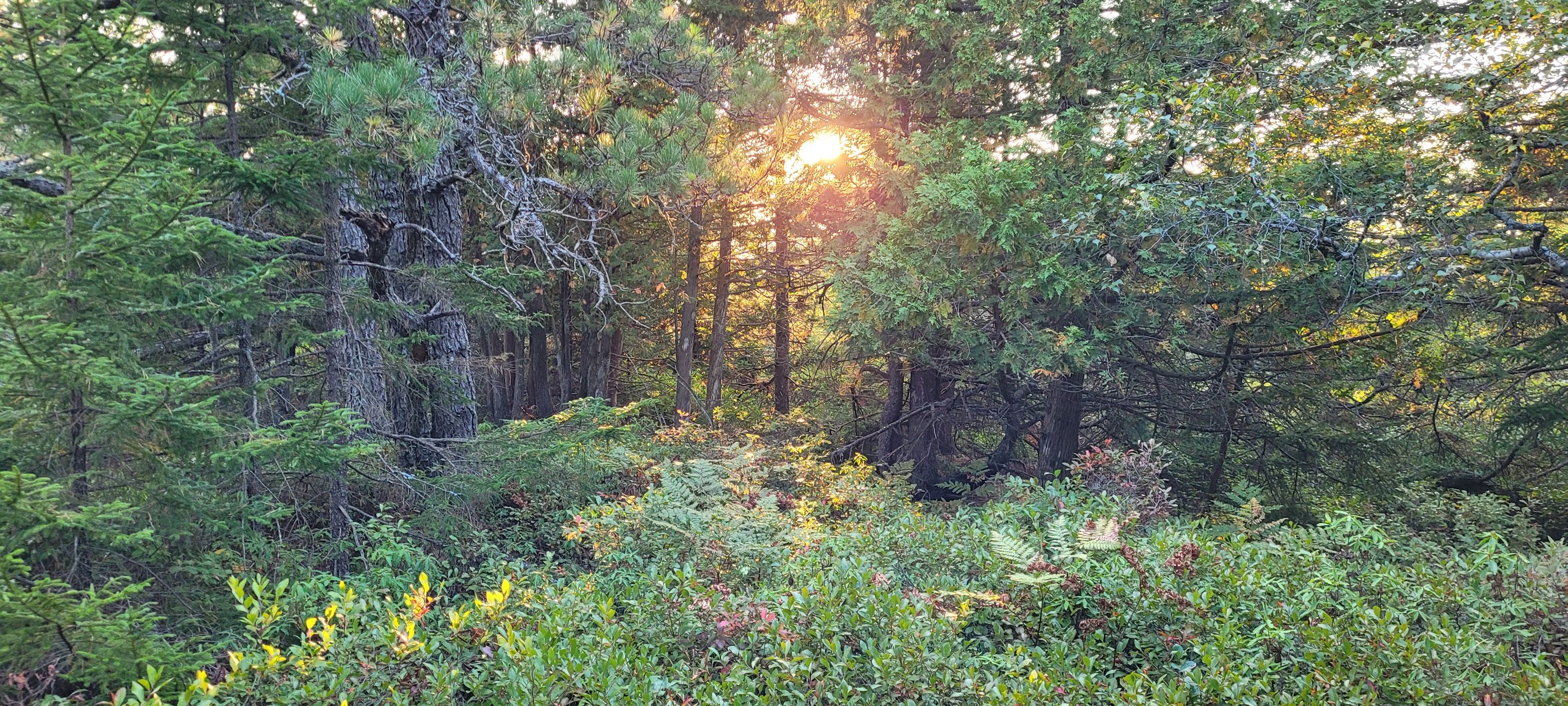
What truly made the hikes unforgettable, however, were the forests themselves. Towering cedar trees lined many of the trails, their bark patterned like fingerprints, each one unique. Sunlight filtered through the dense canopy, casting shifting patterns of light and shadow on the forest floor. The air smelled faintly of pine and damp earth, a crisp, clean scent that seemed to slow time as we walked. Alongside, the cedars, maples, birches, and spruce added layers of color and texture, while patches of ferns, moss, and wildflowers created a soft, green carpet beneath our feet. It felt almost mystical; quiet and secluded except for the occasional bird call or the rustle of leaves in the wind. Walking among these noble giants, I finally understood the appeal of Tolkien’s lengthy forest descriptions in The Lord of the Rings. I used to scoff at the detail, but now I see it—these forests are magical enough to warrant every word. I should really give those chapters another read.

At every peak, Chris and I took a moment to pause, sit, and enjoy a small snack, usually a peanut butter flavored Cliff Bar, while admiring the views around us. From those heights, we could see hidden harbors glinting in the sunlight, distant mountain tops layered in shades of green and blue, and on the evenings we hiked late, spectacular sunsets painted the sky in shades of pinks, oranges, and purples.
These pauses became a ritual, a way to mark our progress, soak in the scenery, and let the quiet majesty of Acadia sink in. The combination of challenging trails, lush forests, and breathtaking vistas made each hike not just an adventure, but a deeply immersive experience in one of the most beautiful corners of the East Coast.
Acadia quickly became one of our favorite stops of this journey. The landscape is rugged, demanding, and rewarding, and we left knowing there was so much more still waiting for us to discover.

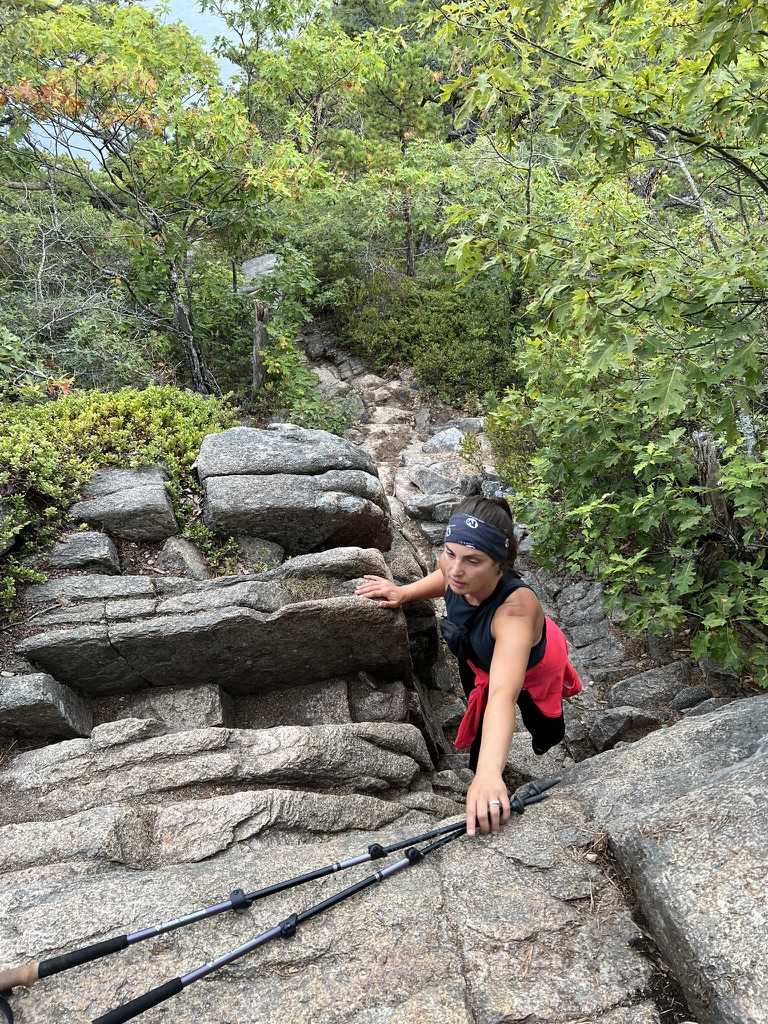
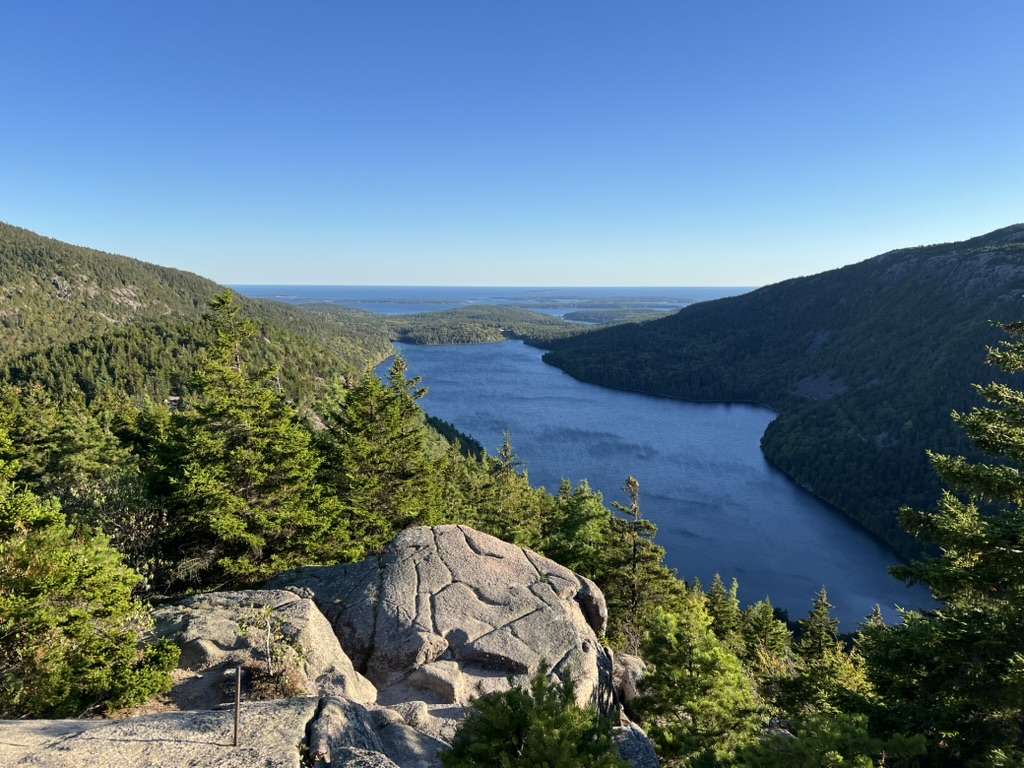
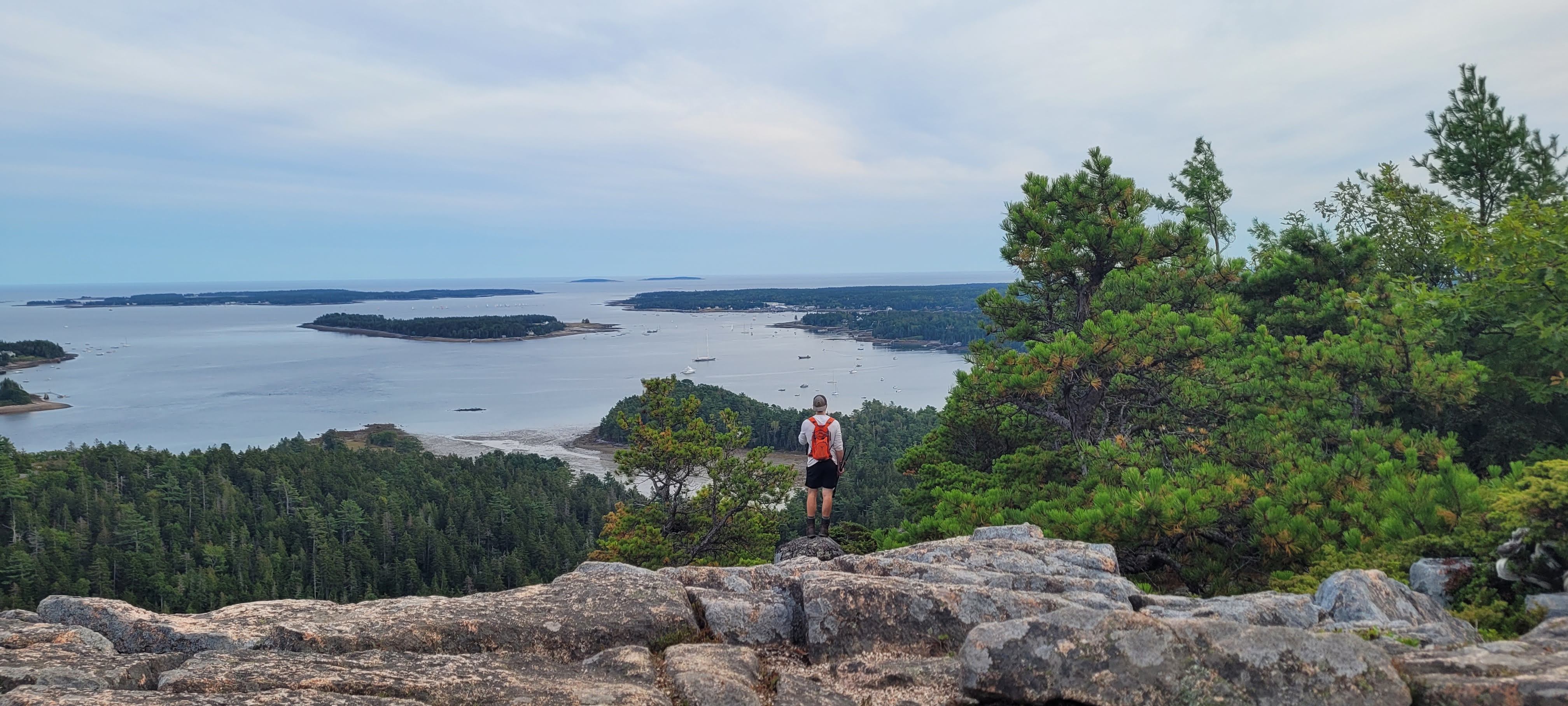
There’s Always a Learning Curve
Because we’d gotten used to filling up our water jugs at the local grocery store back in Nova Scotia—because of the slightly sulfuric smell of the campground water—we just assumed this would be the routine everywhere we parked.
So when we started running low on drinking water in Ellsworth, I headed to the main office to ask whether they had a fill station or if I needed to make a run to the local grocery store or big-box place.
I walk in and find four women: Two working behind the counter and two who look like they’re mid-conversation. I’m expecting some local wisdom or at least a straightforward answer. Never.
The minute I ask about getting drinking water, all four heads swivel toward me with the same expression you’d give someone who just asked where gravity comes from.
“Do you have a site here?” the woman behind the desk asks, her brow furrowed.
“Yah!” I say, smiling because I still think this is going somewhere helpful.
“And you’re asking about getting drinking water?” she repeats.
“Yah…” I say again, slower this time.
“Are you in a tent site?” she presses.
(Where is she going with this? Why is this so difficult?)
“No, we’re in a camper. On site 202,” I answer.
She leans slightly forward. “Do you have a sink in your camper?”
“Yes?” I reply, now fully confused. Is she serious?
Suddenly one of the other women jumps in, all warmth and Southern charm: “Oh, bless your heart! You want to know if the water is potable.” She places extra emphasis on “potable” as if that will solve everything. “Yes, you can drink the water right from your sink. Now, we drive home and fill up our jugs there because we prefer the taste of our well water. But you can absolutely drink it here!”
Great. Now I get to explain that we actually don’t have a “home” to drive to because the Bus is our home. But the good news is that we can drink straight from the faucet—something that absolutely did not require the level of interrogation I just endured.
As I walk back to the bus, shaking my head and laughing at the surreal exchange, I also remember that while I’m not American, I’ve lived here long enough to know that when someone begins a sentence with “Bless your heart,” it’s rarely as sweet as it sounds.
I could handle nail-studded tires, miles of steep trails, and border agents with more patience than me. But asking a simple question about water? Apparently, that was my Everest. At least now I know: in RV life, it’s never the mountains you climb but it’s the tiny questions that leave you questioning your sanity.


Liked this post? Leave a comment.