For those of you who thought that a space trip to Mars was out of your budget—I was one of you too. What I didn’t realize is that you don’t need a rocket ship to get you to a place that’s otherworldly. You just need to ride far enough west.
Welcome to Earth’s version of Mars. Somewhere out in the Big Bend region of West Texas.
The Big Bend BDR-X threads through places like Rio Grande Village, where the desert opens wide and the river quietly snakes through cottonwoods. From there, the route pulls you deeper into the Rio Grande river basin, where the terrain shifts to stay unpredictable under your tires.
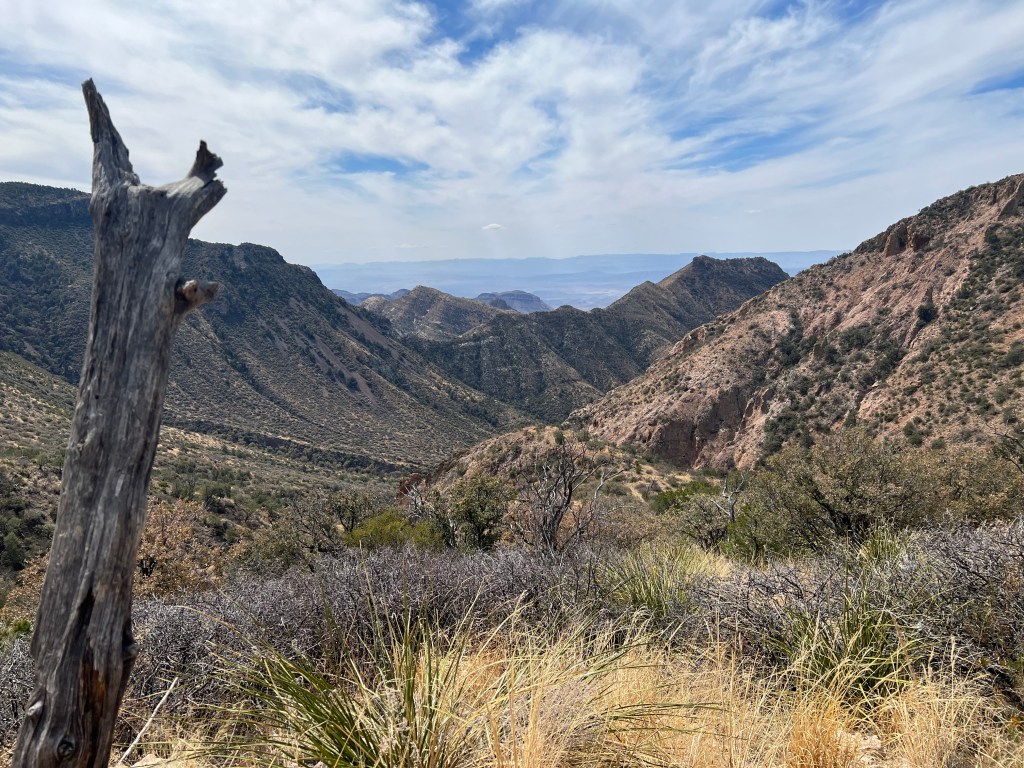
Out here, the land fractures, stretches, and shifts in color like it’s still remembering its volcanic past. The terrain is a mix of jagged basalt, compressed sediment, and endless desert floor that glows in shades of red, rust, and dust depending on how the light hits it. We are in the largest desert in North America: the Chihuahuan Desert. And right through the middle of it all runs the Rio Grande, carving deep canyons through limestone and marking the winding border between the U.S. and Mexico.
We’ve chosen to tackle this BDR-X route a little differently than the previous ones. Instead of leaving on a multi day motorcycle trip, we’re doing full day loops and coming back to the Bus as a basecamp for the night. The idea behind this is to guarantee a good night’s sleep instead of playing Russian roulette with motels or even worse, tent camping somewhere in the desert.
Since our arrival, Fort Davis had already made one thing very clear: the wind out here doesn’t mess around. It surely would turn a simple tent setup into a full-blown wrestling match and promise a night of flapping fabric and very little sleep. We’ve done enough of those to know that the next day would be groggily unpleasant and caffeine-dependent by mile 20. So yes, this version of the BDR-X came with a little more comfort. Which didn’t mean easy.
Day 1: Fort Davis to Marfa
We started in Fort Davis, heading through Alpine and down toward Marfa, combining sections of the route but keeping things mostly paved as we eased into the ride.
The plan was simple: ride the route, but also meet up with Bill and Val along the way. We stopped at the Venga Cafe where we enjoyed easy conversation with them, quickly falling into a relaxed rhythm of laughter and shared stories. It felt effortless, like we were old friends, and the stop turned into a welcome pause in the middle of the ride.
One of the attractions I was most excited about was meeting Clay, the legendary “Mayor” of Lajitas. In this tiny West Texas town, the title of mayor has long belonged not to a person, but to a goat. It’s a tradition that dates back to the 1980s, when locals jokingly elected a beer-drinking goat named Clay Henry as mayor. Since then, each successor has carried on the Clay Henry name, becoming the town’s beloved mascot and one of its most famous attractions. It may sound ridiculous—and that’s exactly the charm. Meeting Clay has become a rite of passage for anyone passing through Lajitas, adding a dose of Texas-sized humor to an already unforgettable destination.
Somewhere in all of this, we saw the Rio Grande for the first time. I feel bad writing that it was… underwhelming. We expected a wide, powerful river. Instead, it looked more like a shallow creek you could almost step across. Now granted, we were in the middle of a drought, but still, my imagination and cinematic references had prepared me for a large, deep and violently strong current flow across this infamous border.
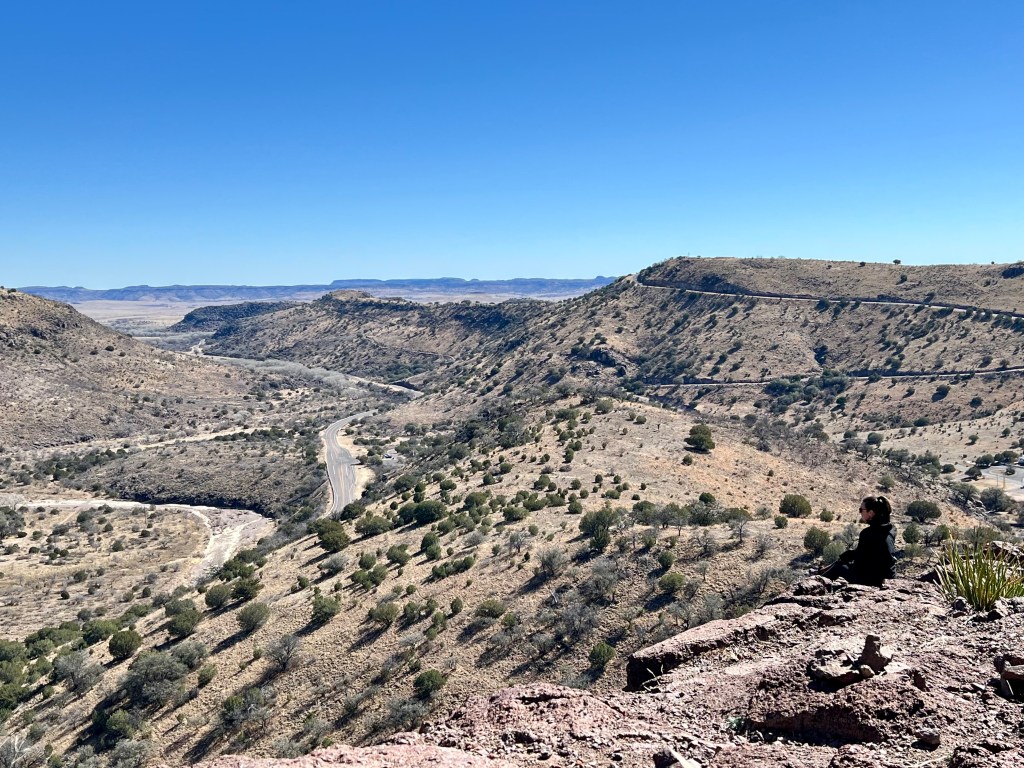
Still, the landscape along Highway 170 was striking. The canyon walls, open desert, and long empty stretches made everything feel bigger than it was.
We almost ran out of fuel after skipping a stop in Study Butte, assuming Presidio wasn’t far. Far enough, our gas tanks told us as the miles ticked on. Both of us finally rolled into the gas station on reserve with very little to spare.
At the pump, we met other riders we’d crossed paths with earlier, swapped a few stories, grabbed snacks, and watched a couple of kids put on a bicycle show in the parking lot. It’s funny how motorcycles have a way of bringing out the showman in young boys; trying to gain prestige in front of their older counterparts.
From there, the ride back toward Marfa felt long. Flat terrain, quiet roads, and a stretch where a closed road forced a quick detour and some guessing on reconnecting routes.
A stop at the Marfa Prada store added a surreal pause to the day. This is a minimalist desert art installation made to look like a luxury boutique, sitting alone beside the highway. The window displayed untouched shoes and handbags, sealed behind glass and slowly aging in the West Texas dust. We pulled over for a quick photo op, half amused and half impressed by the absurdity of this popular art display.
A highlight during our time in Texas was watching roadrunners cross the road in front of us every so often. Their sudden sprints ending with that awkward little hop made us laugh every time. A quick Google search about this observation failed produce any good explanations. I can only guess that it’s a victory hop after surviving a sprint in front of our motorcycles.
Day 2: Into the Remoteness of Southwest Texas
This morning we dropped into Section 4 and headed deeper into southwest Texas, where the landscape quickly shifts into something far more remote and unforgiving. It seems almost impossible to see so much cattle and wild horses make a home out of the seemingly unlivable landscape.
Road 170 runs through the basin of the Rio Grande, and for hours at a time it feels like there is nothing else in the world. The word desolate comes to mind as we ride on.
In several hours of riding, we saw only a handful of vehicles. Solitude became the dominant feature—beautiful, but also absolute. Out here, there’s no cell service, no amenities, and no margin for mistakes. Just the two of us, the bikes, and whatever the terrain decides to do next.
Just as we began to think no civilian vehicle could possibly make it through the rough, rocky terrain, a rancher’s truck appeared in the distance—calmly towing a small trailer with two calves inside. It felt bizarre to see something so ordinary moving through such harsh conditions. Later, an armored vehicle rolled past us, which somehow made the earlier sight feel even more absurd.
Then came “Godzilla Hill” a notorious section of the Big Bend BDR-X that can only be described as… so very steep. The terrain shifts between hard-packed dirt and embedded rock, with stretches of baby-head stones and erosion ruts that keep traction unpredictable, especially on the descent where the surface can turn slick and washed out in an instant. Braking wasn’t really an option; it was more about staying straight, reading the line ahead, and committing all the way through (while trying not yell too loudly in my helmet and have Chris go deaf).
Throughout the day, there were sections of silt that looked harmless, except for the fact that it could swallow the tires unpredictably. The bike would drop in it, its weight shifting without warning, and you would have to keep it moving or risk getting stuck.
Heat and fatigue started to stack up. Breaks were minimal, partly from a daylight management perspective and partly because there was no shade to speak of. Body aches and the heat caused emotions to escalate to the point of wondering when this particular road would end. Yes, the landscape was stunning in its own unique way, we thought, as we pushed ourselves without taking any breaks to speak of. But why was there no SHADE?!
After what felt like a lifetime, the smell of water along the Rio Grande hits us before we see it and the landscape changes instantly.
Migratory birds gathered along the banks, flying around and dotting the surrounding body of water in great numbers.
The dirt eventually gave way to washboard roads that seemed endless, until pavement finally appeared again like relief. From there, it was a straight shot toward Van Horn for food, fuel, and a highly anticipated and well deserved cold beverage.
Day 3: Terlingua, Texas
We drop back into Section 1 through Alpine, this time turning onto Terlingua Ranch Road to complete the sections we’d missed. The morning’s temperature is quite chilly in contrast with the extreme heat of the our last few days. We stop in Terlingua Ranch Lodge for some warm coffee and a late breakfast before starting our off-road day on Marathon road.
Confession time: I tend to over dramatize things. If you’ve been following along for a while, this comes as no surprise. I keep assuming that because I’m getting better at one specific type of terrain,every other one will follow.
Enter an abrupt beginning of deep, soft sand in the middle of nowhere, Terlingua. It didn’t start gently either, we turned the corner and immediately were greeted by an entire stretch of what I can safely name my biggest motorcycle nightmare.
“How would you describe the feeling of riding through deep sand?” You might ask.
You feel like your wheels have lost all traction. Your heart flutters in your chest as you feel completely ungrounded. The handlebars have a mind of their own as the front wheel starts to wobble in both directions. You can also see the “S-shaped” tracks of riders who’ve come before you and have also struggled through the section.
Panic sets in and all I want to do is slow down, which makes it worse. If I’m standing up on the pegs, I desperately want to sit, put both feet down and come to a complete stop. It’s unnerving when you remember that the key to stability in such treacherous terrain is to go faster so that your front wheel can get up over the sand and give you more of that elusive gliding feeling. Also, you don’t want to be death gripping your handlebars. A common analogy we’re taught is to imagine holding onto mushy bananas and you must arrive to your destination without squishing them.
It’s a frustrating battle between my nerves and the terrain, that obviously highlights only one winner in the situation: the SAND. After a few soft falls, I resign to paddling with both feet on the ground, rolling slowly across this section There are a few brief moments when I feel balanced enough to put one foot on the foot peg and get familiar with the feeling of sand under me. Any progress is welcomed, at this point.
What I know for sure is that the next time I get training, I definitely want to get proper practice on sandy terrain.
Once that ordeal is behind us we move onto pavement and visit a fossil bone exhibit—an unexpected reminder that this entire landscape was once underwater. The idea of ancient seas sitting beneath desert rock makes the imagination wander.
We continued toward Big Bend National Park, stopping at Rio Grande Village to refuel and regroup before taking on River Road.
River Road was remote, beautiful, and winding along the Rio Grande with wide views of canyon country. The mountains rose sharply to the north, and the scale of everything felt exaggerated in the best way. We passed the Mariscal Mine Ruins, remnants of an old mining operation slowly being reclaimed by the desert.
At one point, we noticed smoke rising from the brush near the river. Uncertainty crept in, our attention shifted, and in that brief moment of distraction, we both went down. Thankfully, they were minor crashes with quick recoveries and no significant damage, but it served as a reminder of how quickly things can change—and how important it is to stay focused out here.
The road eventually delivers us to Elena Canyon, where the Rio Grande has carved a breathtaking passage through towering limestone cliffs. Standing at its entrance feels like looking through a gateway into another world.
From Elena Canyon, we make our way back to Study Butte for fuel and a quick dinner. The gas station doesn’t have much to offer. Tonight’s menu consists of refrigerated sandwiches, candy bars, and Brisk Iced Tea.
By the time we head back toward The Bus, the desert sun has slipped below the horizon, leaving us with more than two hours of riding under the stars. With darkness comes a heightened awareness of the wildlife that calls Big Bend home. Deer and wild burros linger along the roadside, their eyes glowing brightly in our headlights long before their silhouettes come into view. Every corner demands extra caution, reminding us that, after sunset, the desert belongs as much to its wildlife as it does to those passing through.
Riding at night has a beauty all its own. A sense of calm settles over the desert as speeds naturally slow, the air cools, and your focus narrows to the ribbon of road illuminated by your headlight. On a clear night, you can even spot the North Star, a quiet reminder of how travelers once navigated these vast landscapes long before GPS.
After a long day, we both switch on music in our helmet communicators to carry us through the final miles. We roll back to The Bus around 11:30 p.m., wrapping up a 13-hour day in the saddle.
Another BDR in the books, after three long days on the bikes!
Driving from the Texas Hill Country out to West Texas is an experience in itself. Texas is big in a way that doesn’t fully make sense until you’re in it. It honestly reminds me of Canadian provinces in terms of distance. You can drive all day and still be in the same state.
While driving down the interstate the hills flattened, the trees spaced out, and eventually disappeared. The landscape opened up in a big way. Long straight roads, barely any turns, and a horizon that just kept going. It felt wide and exposed, but also kind of peaceful in its simplicity.
Then, just when it starts to feel like it will stay that way forever, West Texas decides to switch things up. Or maybe it’s because the speed limit is suddenly 80 mph and everything out here is moving at full throttle, including the scenery. That’s my completely unscientific explanation.
As we got closer to Fort Davis, the ground started to roll again. Subtle at first, then suddenly not subtle at all. Massive rock formations rise out of the desert like they have been waiting for their moment. Sharp, layered, and dramatic. It looks exactly like a western movie set, and yes, probably one with Clint Eastwood.
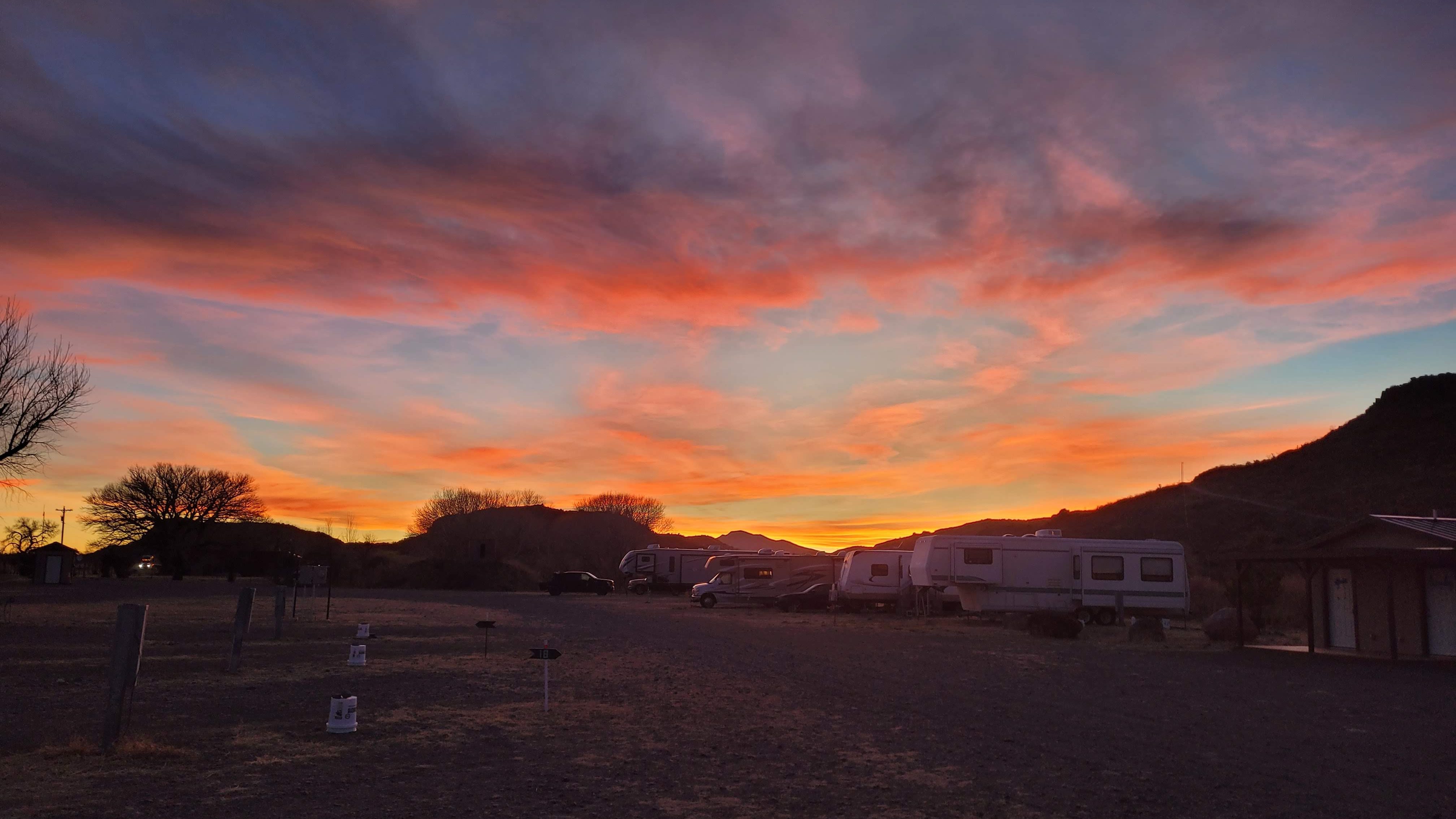
We pulled into Davis Mountains RV Park just as the light was starting to shift. It ended up being one of those campsites that steals the show. Right behind us, we had a clear view of the mountains rising up, nothing blocking it. Just open land and rugged peaks.
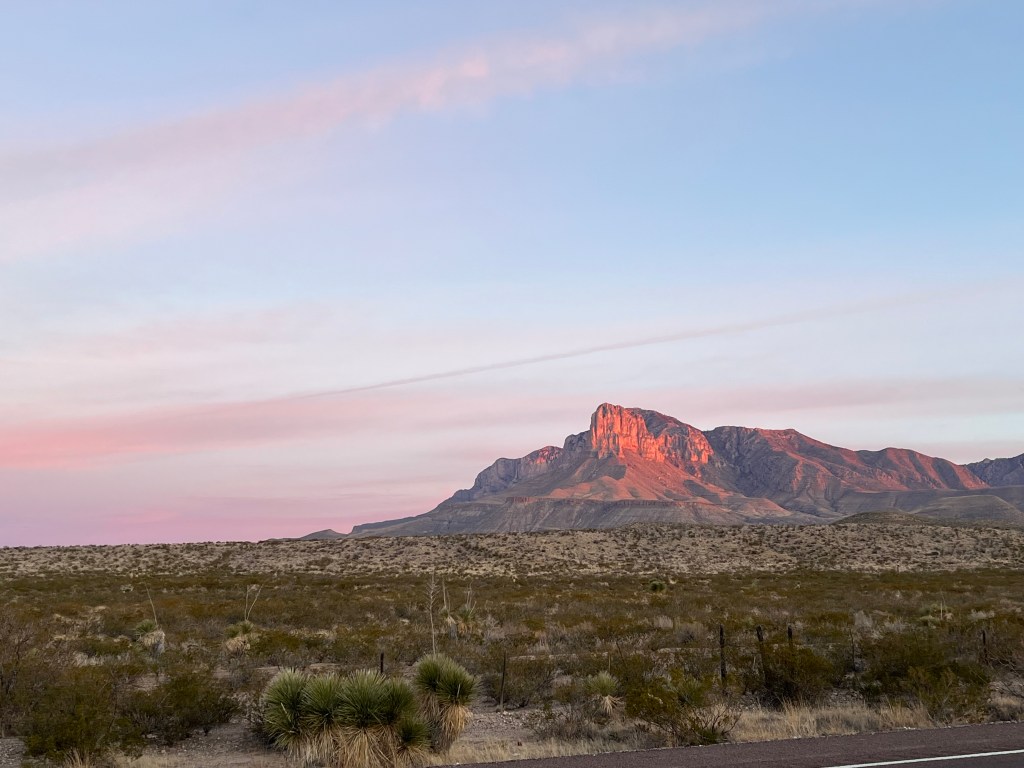
And the sunsets. Every single evening, the sky would turn this soft pink that slowly spread across the mountains and the desert floor. Not overly dramatic, just really, really beautiful.
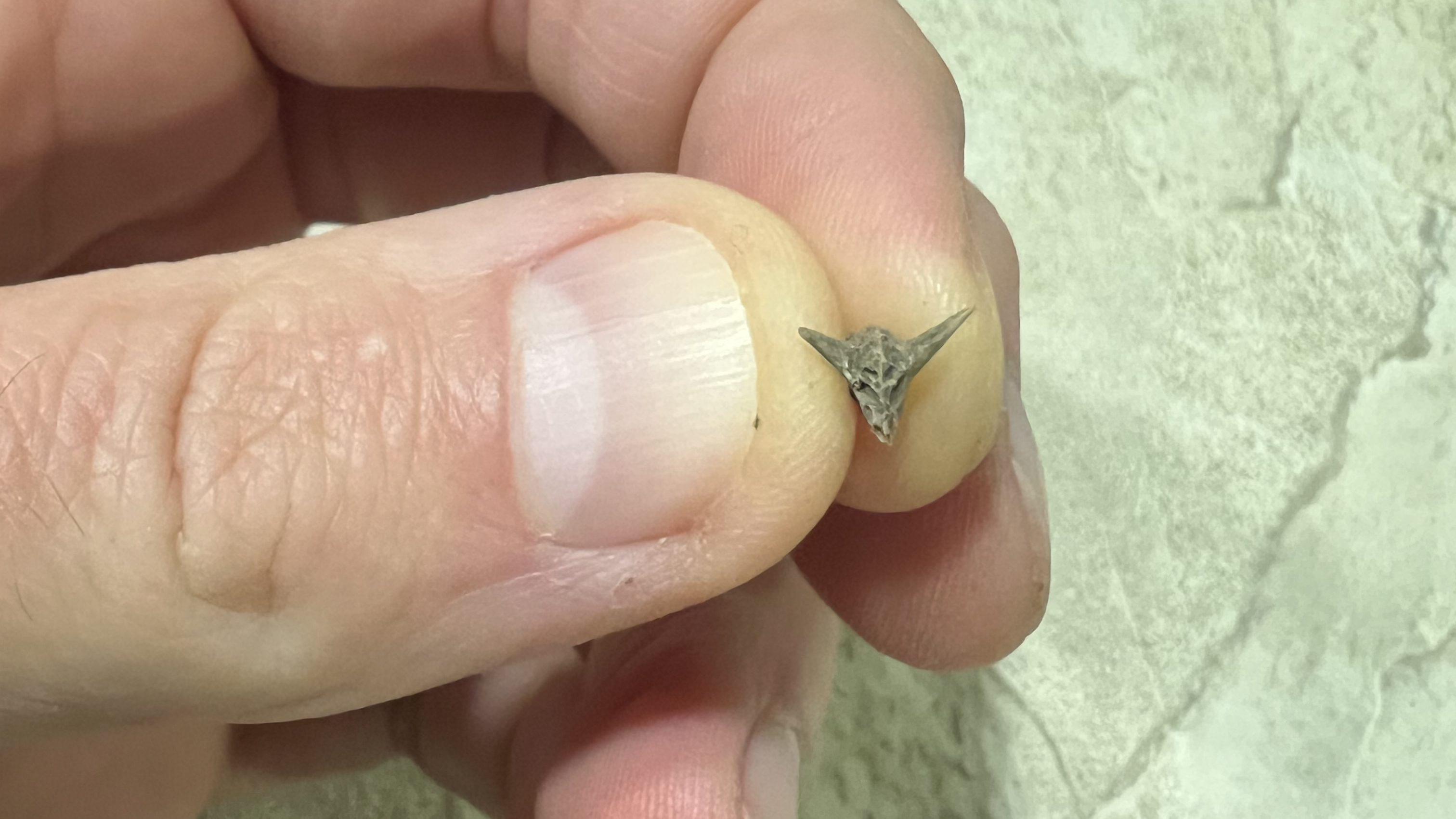
Of course, West Texas also made sure we didn’t get too comfortable. The wind picked up hard at night, strong enough to make the bus shake while we were trying to sleep. It brought back memories of that questionable night we spent along the Cabot Trail, listening to the wind howling outside our tent and making us regret certain life choices. There was also the constant threat of “goat heads,” these tiny but brutal sharp seed pods scattered all over the ground around the campsite. They stick straight into the bottom of your shoes, then somehow would make their way inside the Bus, where you inevitably step on one again in what you thought was a safe, barefoot-friendly zone.
Davis Mountain State Park
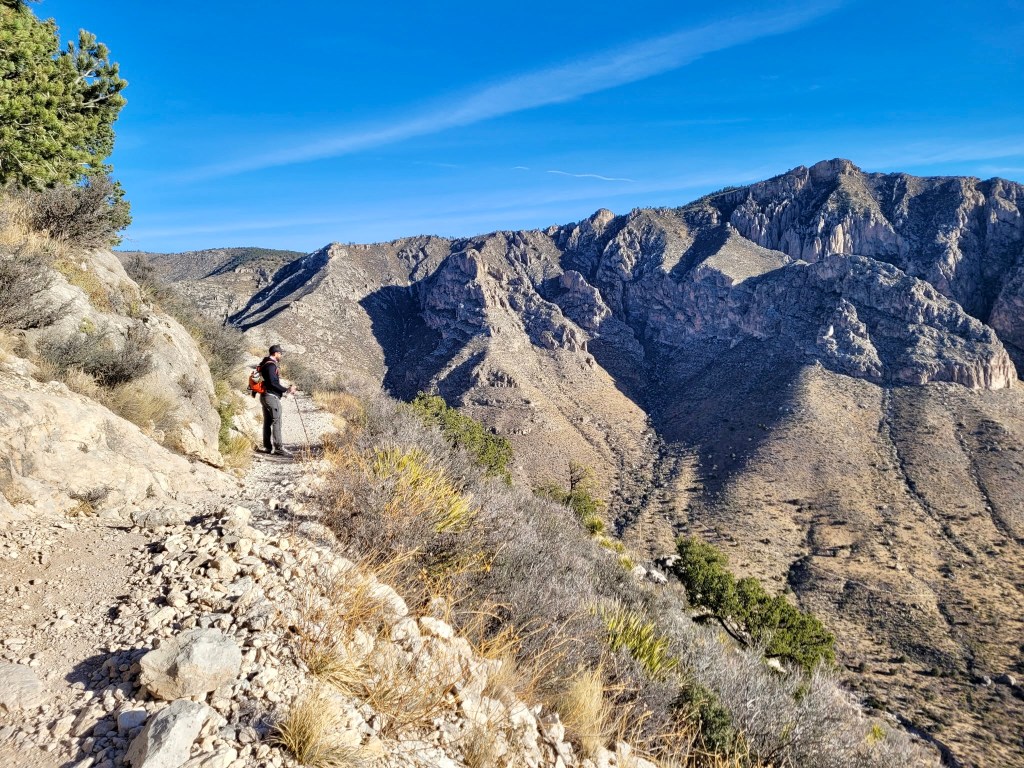
Our first Monday here was a holiday, we decided to spend it the best way possible, outside. We headed to Davis Mountains State Park for a full day of hiking and went with the Old CCC Trail and the Skyline Trail, which turned out to be a solid choice.
The park sits in the foothills of the Davis Mountains, and it feels completely different from the flat desert you drive through to get there. These mountains were formed by volcanic activity about 25 to 30 million years ago, and you can really see it in the terrain. The rock is layered, dark in places, and exposed along canyon walls and ridgelines. As you hike, you move through areas like Frazier Canyon and past formations like Sleeping Lion and Barrel Springs, which give the whole place a bit more character.
The topography keeps changing as you go. Lower down, it’s dry and rugged with open views. As you climb, the terrain tightens into canyons and ridges, and you start gaining elevation pretty quickly. The park sits around 5,000 to 6,000 feet, which sounds like it should make a difference. In reality, if uphill hiking already has you out of breath, this just feels like… more of the same. Still climbing, still questioning your choices, just with a better view.
What stood out most was how much life there is out there. It’s not just desert. You’ve got oaks and junipers scattered across the hills, grasses covering the ground, and even pinyon pines higher up, which feel slightly out of place but somehow fit. Then there’s the cacti, everywhere. Some small and easy to miss, others very clearly there to remind you to watch where you step.
Wildlife-wise, we actually got pretty lucky. We spotted a few javelinas, and heard birds pretty much the entire time. The American Bird Conservancy has recognized Davis Mountains State Park as a Globally Important Bird Area. The park is home to over 260 species of birds and provides refuge to several species of concern. The newly-constructed bird blind offers an enclosed viewing station, a shielded outside patio, and watering and feeding stations. It is a great place to view scrub jays, white-winged doves and acorn woodpeckers.
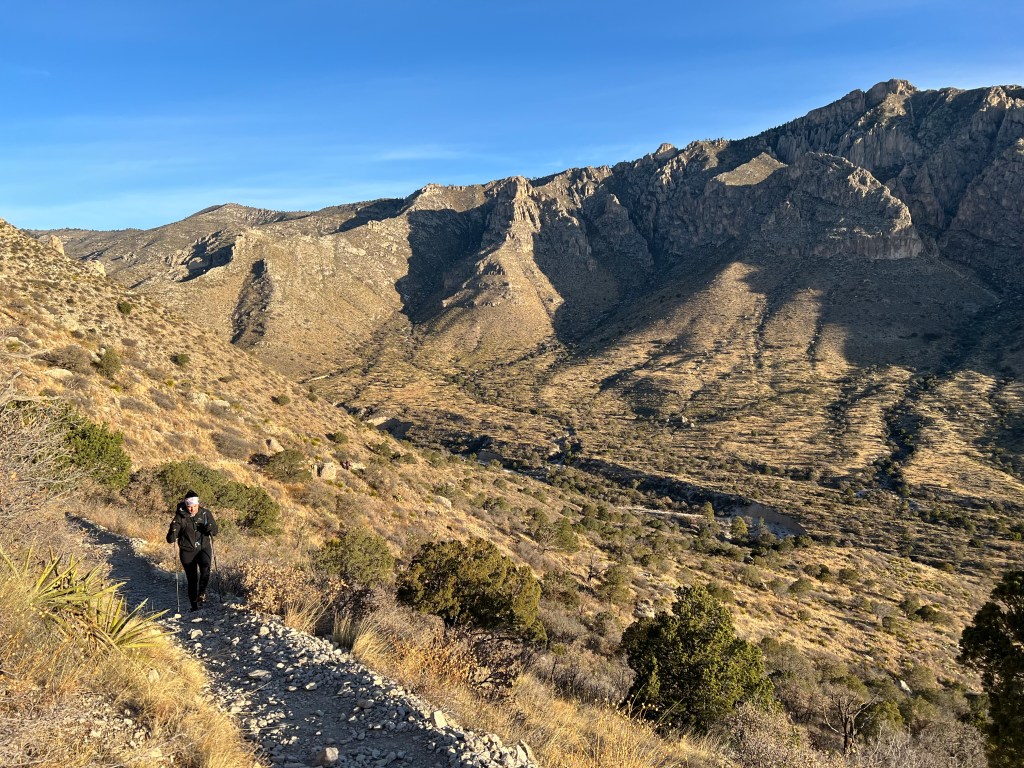
The trails themselves were great. The Old CCC Trail winds you through the canyon with a steady, consistent climb, while the Skyline Trail brings you higher up along the ridges with wide views over the mountains and desert below. It’s the kind of hike where the scenery keeps changing just enough to distract you from the burning legs.
And that was just our first visit.
We ended up going back later in the trip because it felt like we hadn’t quite seen enough. This time we started at the Indian Lodge Trail near Black Bear Restaurant, and it turned into one of those unexpectedly memorable hikes.
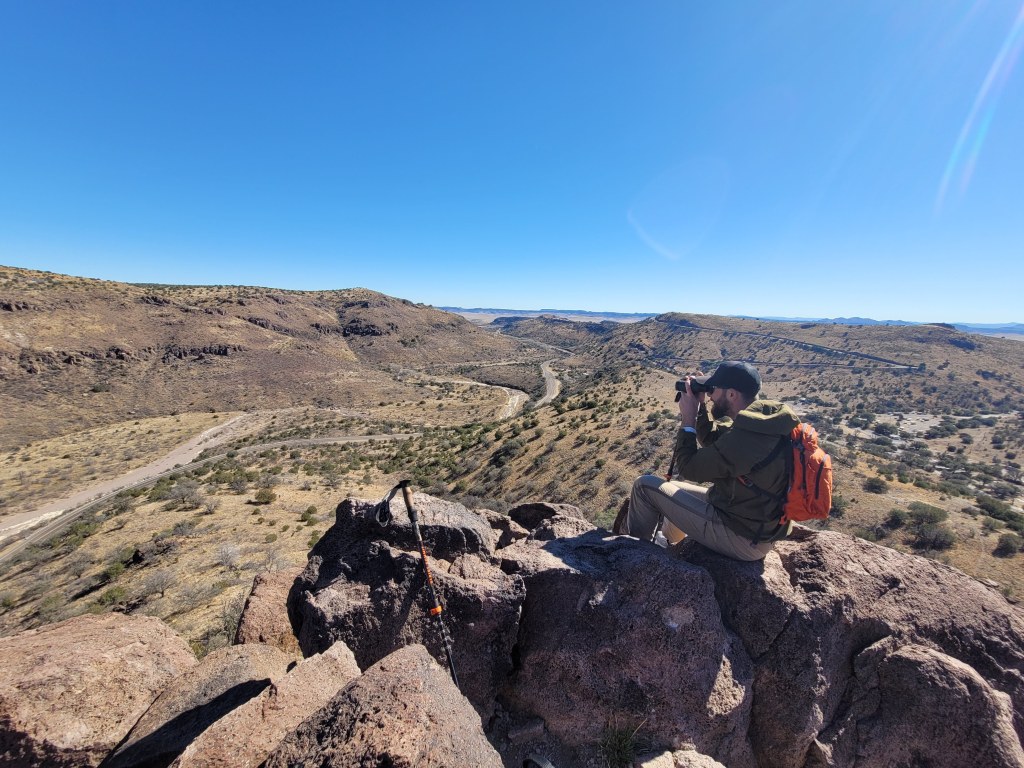
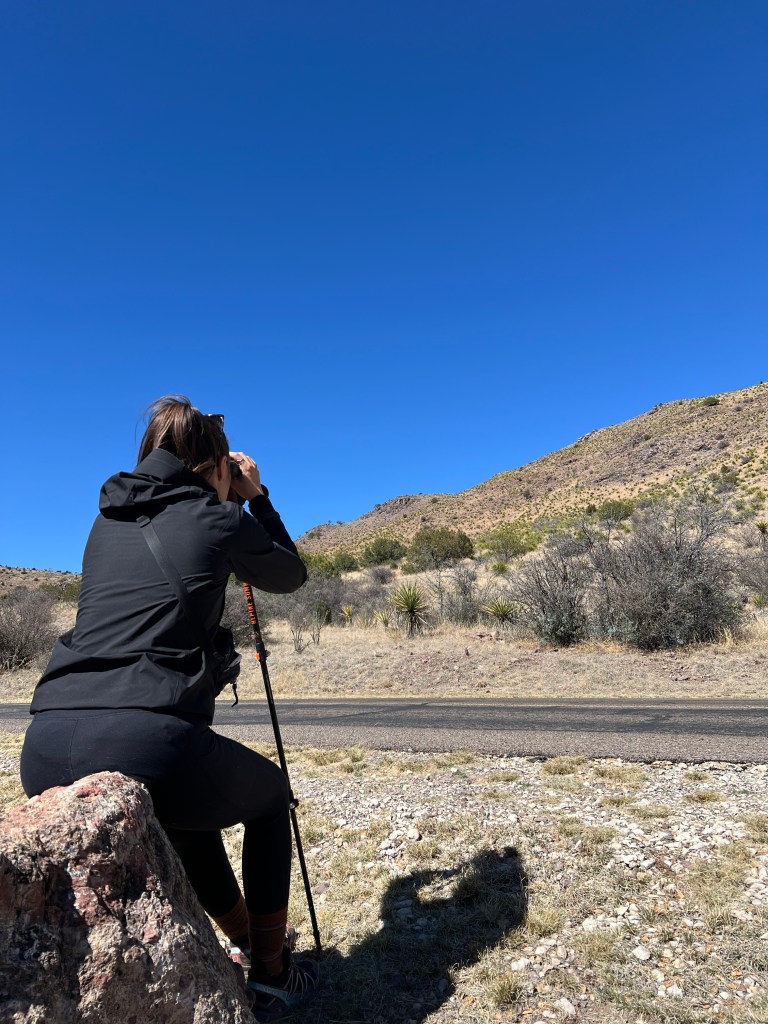
At one point, Chris is walking ahead of me and just stops. No warning. Binoculars come out immediately. Another episode of Chris and his knockers begins.
He is completely locked in, staring down into the ridge. Meanwhile, I’m behind him squinting into the distance like that’s going to magically improve my vision. No binoculars, no glasses, no clue. Just standing there pretending I also see something important.
Eventually, I get the update.
And honestly, they look like they were built for this place. Sandy-colored, perfectly camouflaged against the rock, long legs, and just casually standing on steep terrain like gravity is optional. They move around like it’s nothing, while we’re out here carefully watching every step on a marked trail.
They were aoudad (Barbary sheep)—a wild sheep species originally from the rocky mountains of North Africa. They were introduced to parts of the southwestern U.S. in the 1900s and have since become an invasive species, spreading into rugged desert and canyon landscapes where they compete with native wildlife and are notoriously hard to manage due to how well they adapt to steep, arid terrain.
We ended up spotting them again later from above, which made for a much better view. Naturally, the binoculars made a second appearance, and we took a minute to just watch them move through the landscape.
The sky was completely clear, bright blue with no clouds, and it made everything stand out more. The dark volcanic rock, the dry terrain, the scattered vegetation. It’s not lush, but it doesn’t feel empty either. Just raw and really well put together.
Guadalupe Mountains National Park
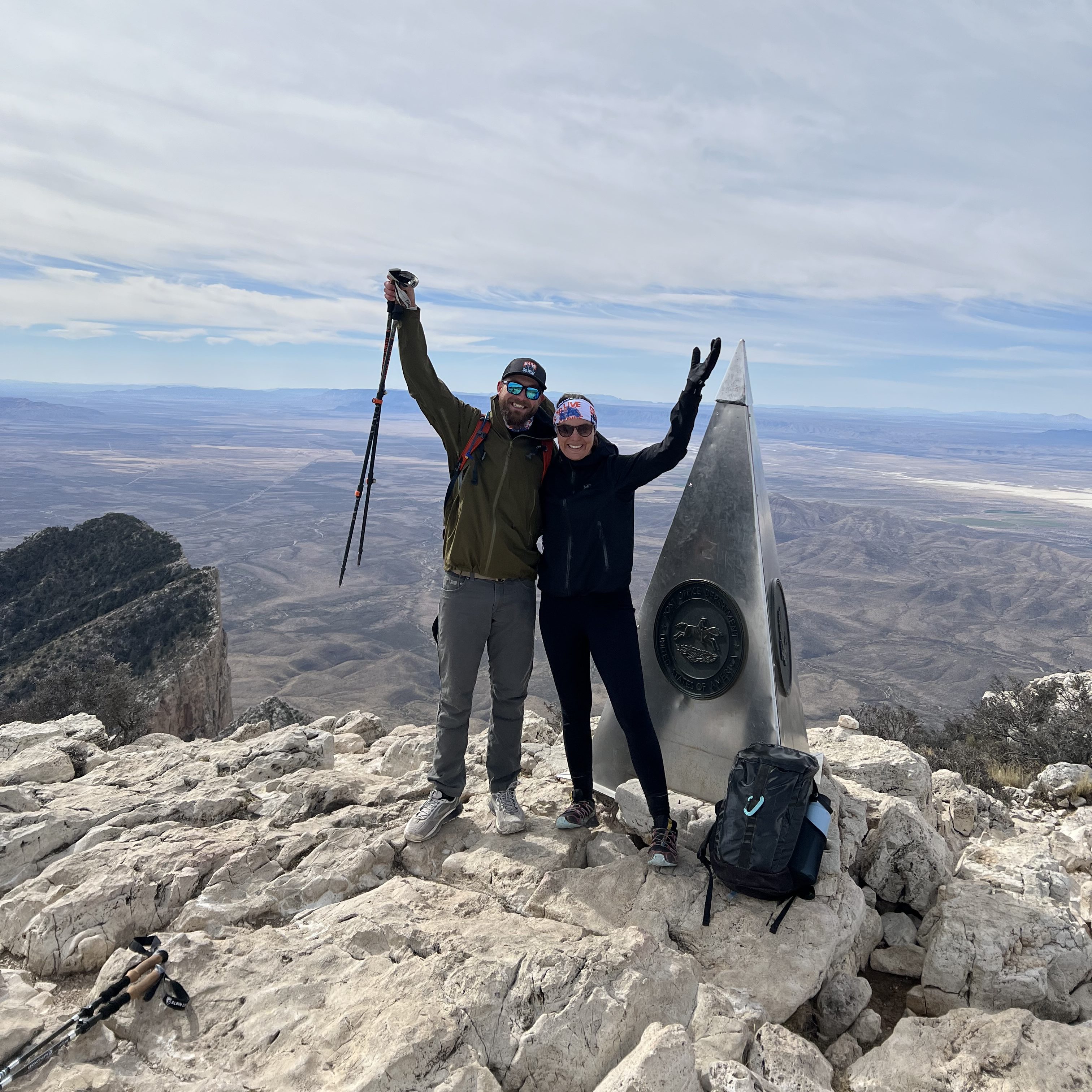
As outdoor enthusiasts, we tend to make the most of every available hour of daylight. On this particular Saturday morning, we set our alarms for 5 am, which already feels questionable. But stepping outside makes it worth it. Pitch black, quiet, and a sky full of stars. The kind of sight that makes you pause for a second before remembering… oh right, we’re about to hike the highest peak in Texas.
Coffee was non-negotiable. We made it in the dark, half awake, then hit the road for the 2.5 hour drive to Guadalupe Mountains National Park.
As we got closer, the sun started to come up, and we could see El Capitan and Guadalupe Peak lighting up in that early morning glow. It’s one of those views that makes you go quiet for a minute. Also one of those moments where you think… we’re hiking up that?
For context, Guadalupe Peak sits at 8,751 feet, and the park compares the climb to walking up the Empire State Building three times. THREE. TIMES. If I thought my cardio needed work before, this hike really confirms it.
It was also surprisingly cold. Like gloves and windbreaker the entire time kind of cold. And if you know me, that says a lot because I am usually overheating five minutes into any hike.
The trail started climbing right away. Basically a long series of switchbacks that just kept going. And going. And going. The higher we got, the windier it became. By the time we reached the top, it was straight up brutal. Cold, windy, and absolutely not the vibe for our usual “cute snack at the summit” moment.
So we admired the views, took it all in, and then very quickly decided… yeah, we’re eating somewhere else.
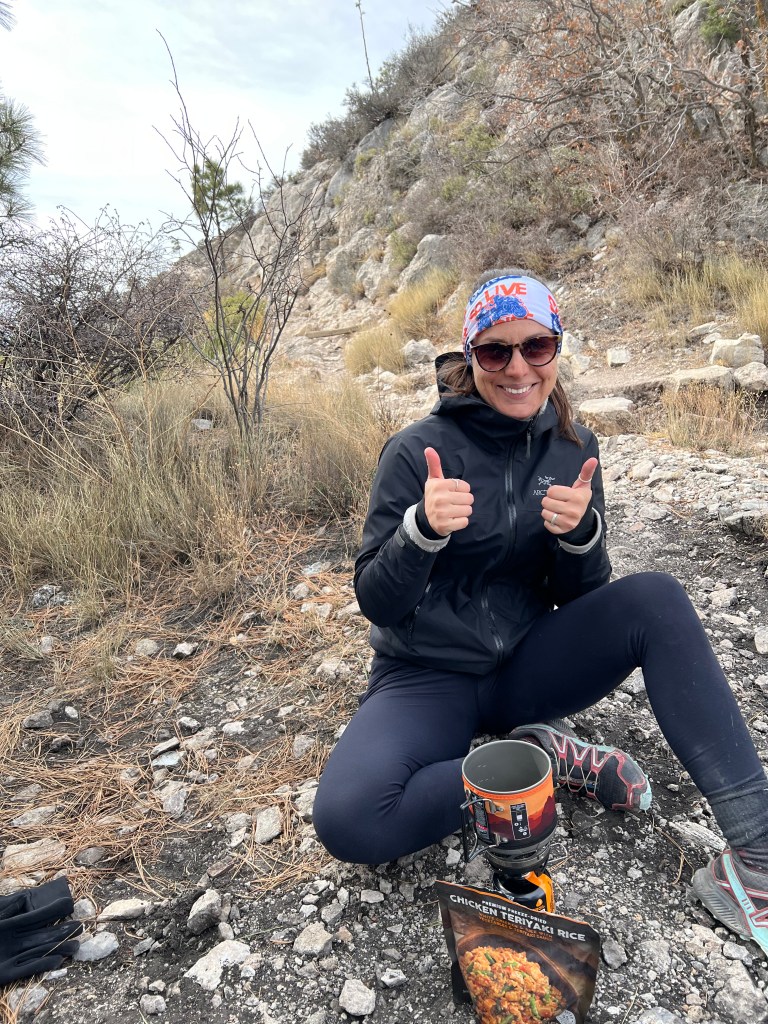
On the way down, we found a tucked-away spot just off the trail in a little wooded area that blocked the wind. Perfect. Out came my mini camp stove, and I started boiling water for the dehydrated meal I had packed.
Side note. Chris definitely thought it was over the top when I loaded up my Patagonia 22L day pack that morning. But halfway through a 9 mile hike, when hunger hit, suddenly it wasn’t overkill anymore. Funny how that works.
Honestly, that hot meal hit harder than anything we could have had considering we were still feeling chilly from the windy conditions.
The hike down though… different story. By the end, my knees were absolutely done. Like fully negotiating with each step. At one point I thought, wow, this is how I go from “active adult” to “needs a walker” in a single afternoon.
Also, I stand by this theory: what you crave after a hike says a lot about you as a person. Me? Gummy bears.
We found some at the visitor center made from prickly pear, which sounded promising. The reality? Not exactly what I expected. But did that stop me? Absolutely not. The whole bag was gone in under 20 minutes.
By the time we made it back to Fort Davis, options were limited, so we went straight for carbs. Pizza and hard cider. No hesitation. And honestly, it might have been one of the best meals of the trip.
We rolled back to the Bus just as the sun was setting, completely exhausted, a little sore, and already talking about what to do next.
West Texas was really starting to grow on us.
Big Bend National Park: The South Rim Hike
Another day, another alarm going off at a time when the sun has not even thought about showing up yet. Again, we’re driving 2+ hours south this time to tackle a 14 mile hike on the South Rim Trail in Big Bend National Park. At this point, I’m still holding onto the optimistic idea that my cardio will eventually catch up to my enthusiasm and stop making every incline feel like a nightmare.
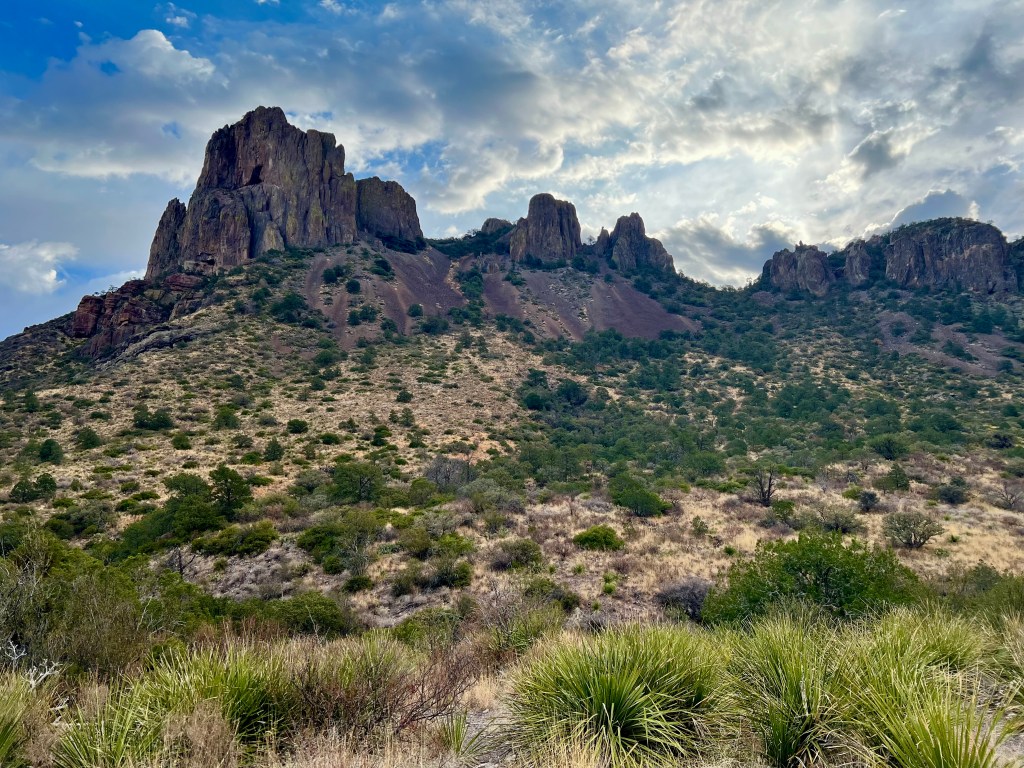
The drive into the park starts with long stretches of open desert, then slowly funnels you into the dramatic geology of the Chisos Mountains. These mountains are actually volcanic in origin, formed by ancient eruptions and later erosion, which explains the layered rock, steep canyon walls, and sharp contrasts in color as you move deeper in. You go from wide desert flats into narrow, winding roads that climb into the basin, with cliffs and rock faces stacking up on either side like they were carved on purpose.
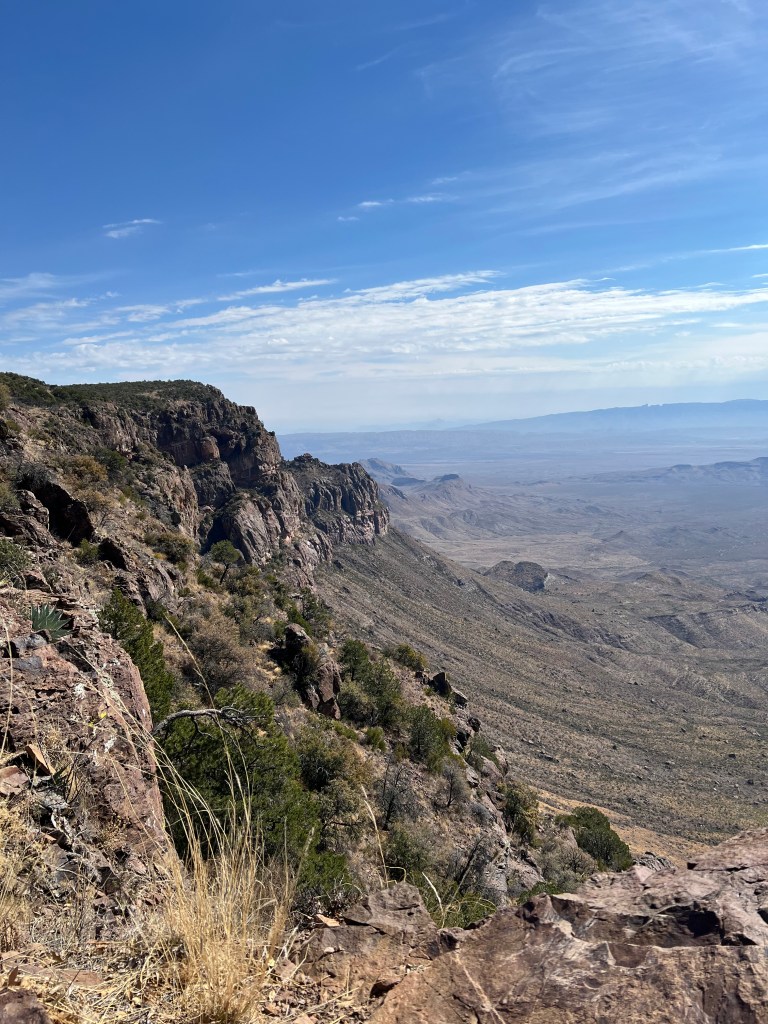
Once on the trail, the landscape continuously shifts as you gain elevation. The lower sections are classic desert terrain—dry, open, and dotted with hardy shrubs and cacti—before gradually giving way to rocky slopes and exposed ridgelines. The higher we climb, the more the landscape opens up around us, revealing sweeping views over the desert below, with mesas and distant mountain ranges layered all the way to the horizon.
Scattered along both sides of the trail are the remnants of burned trees, a quiet reminder of past fire events and the resilience of this ecosystem. Even in its most rugged and seemingly unyielding moments, the landscape is constantly rebuilding and adapting.
It’s also a surprisingly active wildlife area, especially for birds of prey. We spotted Peregrine Falcons riding thermals along the cliffs, barely moving, just letting the wind do the work. Turns out this area is an important habitat for protected raptors, which makes sense once you see how perfectly they fit into the landscape.
At the top of the South Rim, everything just opens up. Massive drop-offs, endless desert views, and that feeling that you’re standing on the edge of something much bigger than it looks on a map. We stopped there for lunch, which in our case means a dehydrated meal situation powered by my very necessary mini camp stove. Yes, again. Chris may or may not have questioned the packing choices beforehand, but at 7,000+ feet with wind picking up on a cliff edge, hot food suddenly feels like genius-level planning.
After a long break soaking in the expansive view all the way into Mexico, we eventually made our way back down, passing more of those wide canyon views and catching the light shifting across the rock as the day moved on.
Later, we learned that the trail was going to be closed the very next day for conservation work to protect the area and its wildlife, including those falcons we had been watching without even realizing how closely managed they were. It made the timing feel a little extra special, like we just squeezed in before the pause button was hit.
Definitely one of those hikes that sticks with you, both for the scale of the landscape and the reminder of how carefully it’s being preserved.
Star Party at The University of Texas McDonald Observatory
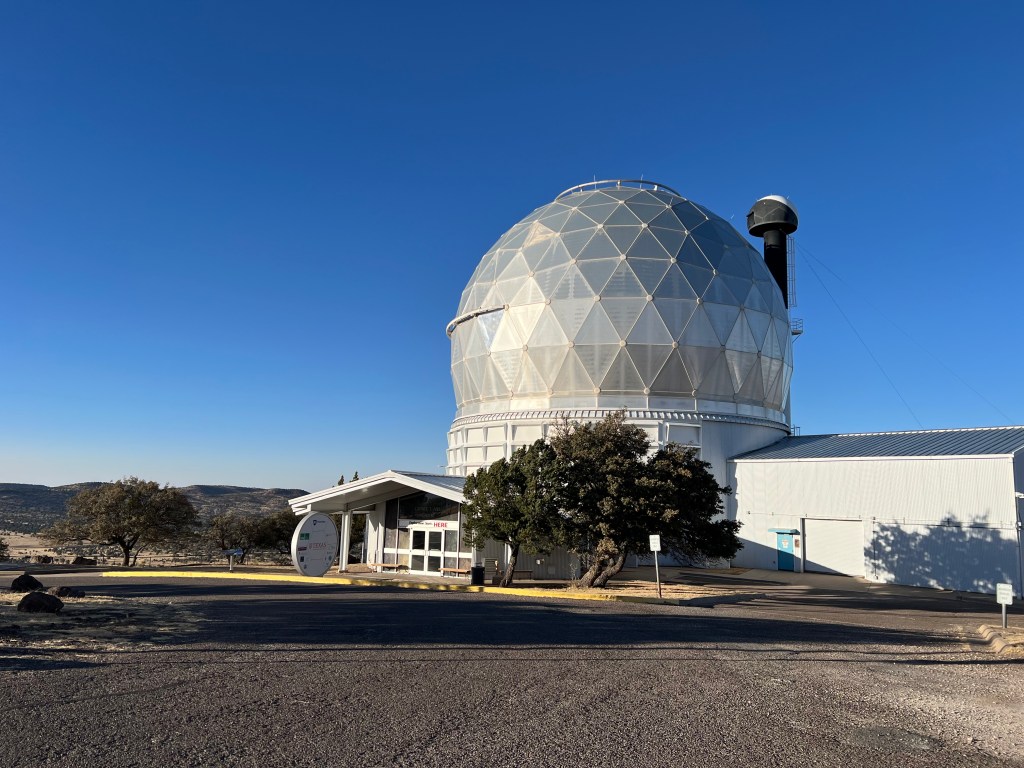
One of the things that makes Fort Davis unique was visiting the McDonald Observatory for their Star Party.
The observatory sits high up in the Davis Mountains, far away from city lights, which makes it one of the darkest skies in the country.
Once the sun set in the horizon and it got dark, the constellation tour started with a group presentation in this open-air amphitheater. The astronomer uses a laser pointer to trace shapes across the sky. It sounds simple, but it’s actually really cool to watch someone connect the dots in real time. Side note, most of the men in the amphitheater seemed more impressed by the laser pointer being visible in the sky than the actual star formations we were supposed to be impressed by.
We started picking out some of the more recognizable constellations like Orion, which is one of the easiest to spot because of the three bright stars that form Orion’s Belt. From there, they pointed out Ursa Major, which includes the Big Dipper, and explained how travelers have used it to navigate for centuries.
They also talked about how these constellations got their names. Most of them go back to ancient Greek and Roman times, when people used the stars to tell stories about gods, hunters, and mythical creatures. It’s kind of wild to think that the sky we’re looking at is the same one people were mapping thousands of years ago, just with way less light pollution.
After the presentation, we moved over to the telescope viewing area. There are multiple telescopes set up, each one focused on something different. One might be locked onto a star cluster, another on a planet, another on the moon. You just move from one to the next, and the volunteers explain what you’re looking at.
Because it was a full moon, the sky looked a little different than expected. Fewer faint stars, but the moon itself completely stole the show. Through the telescopes, you could see the surface in crazy detail. Craters, ridges, shadows. Way more texture than you ever notice just looking up on your own. It almost didn’t look real.
We saw quite a few bright stars, and learned how their color actually tells you something about their temperature. Blue-white stars are hotter, while orange and red ones are cooler.
At one point, they pointed out a faint, hazy patch that didn’t look like much to the naked eye, but through the telescope turned into a dense cluster of stars. That was one of those moments where it really clicks how much is out there that we just don’t see.
It’s not a fast experience, you wait your turn, and you look with wonder. But that’s kind of the point. By the end of the night, it felt like we had learned just enough to recognize a few things on our own, but also realized how much we don’t know.
Driving back in the dark, with the mountains barely visible and the sky still wide open above us, it felt like the kind of night you don’t get very often.
Fort Davis National Historic Site
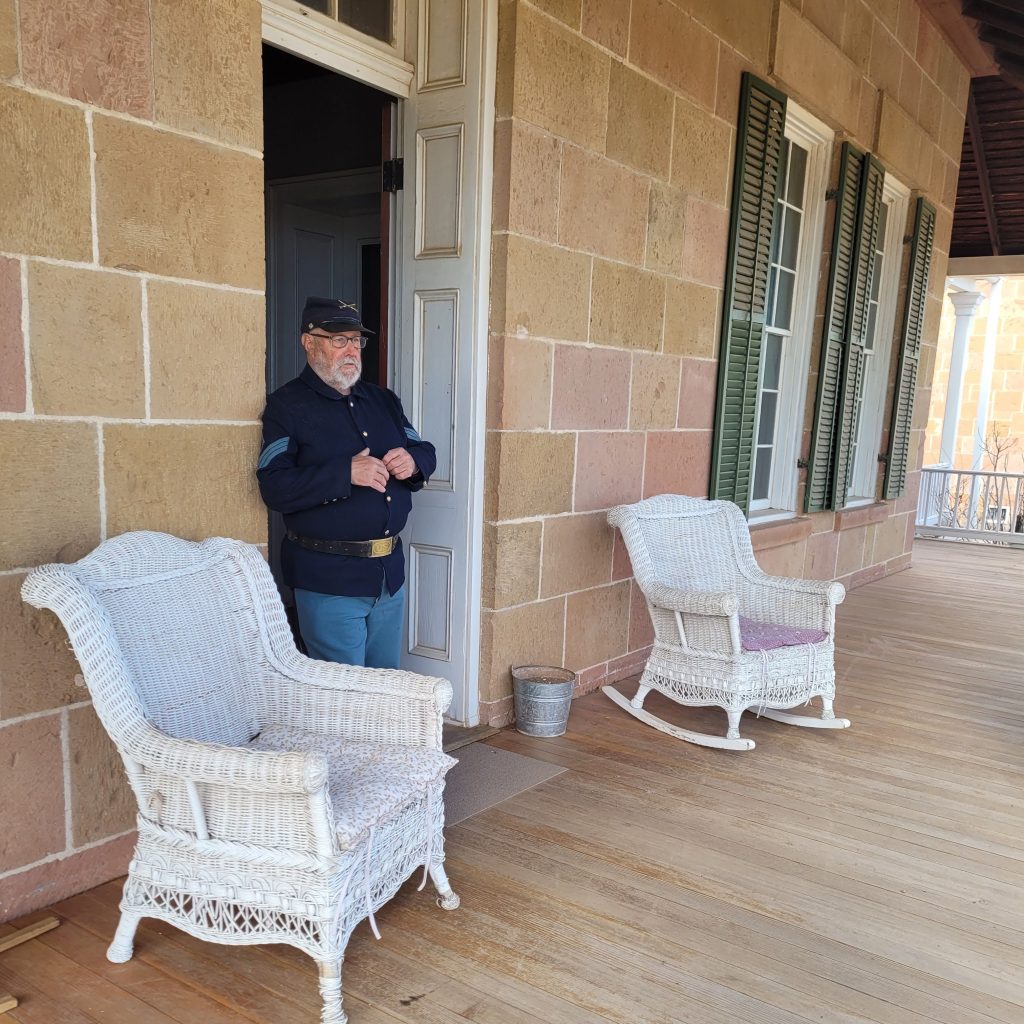
We also visited the Fort Davis National Historic Site, one of the best-preserved frontier military posts in the American Southwest, set within a dramatic mountain pass at the base of the Davis Mountains. After starting in the museum, which does a great job of grounding the site in its 19th-century frontier context, we joined a guided walking tour led by an interpreter dressed in a historically accurate U.S. Army uniform. That detail alone made it feel like stepping back in time.
The fort itself is spread across a wide, open valley framed by rugged limestone and volcanic rock formations—terrain that once made it a key strategic corridor through West Texas. The buildings are arranged in a clear military order: long, low enlisted men’s barracks, the more refined officers’ quarters with shaded porches, and functional structures like the hospital, commissary, and quartermaster buildings, all restored or stabilized to reflect their original footprint. You can still read the logic of frontier military life in how everything is spaced—practical, exposed, and designed for visibility and control in a remote landscape where resources were limited and conditions harsh.
Geologically, the site sits at a transition zone between desert basins and uplifted mountain terrain. The surrounding Davis Mountains are part of an ancient volcanic field, which explains the layered rock, jagged ridgelines, and the stark contrast between flat valley floor and steep surrounding slopes. This landscape shaped everything about the fort’s placement and purpose: it was built to monitor movement through the pass and assert control over a region that had long been traversed by Indigenous groups such as the Apache, who used these same routes for trade, migration, and seasonal movement long before the U.S. military established a presence.
Our guide also did a great job of explaining that history with nuance—describing how interactions between Native American communities and American soldiers were not one-dimensional, but ranged from conflict and forced displacement to moments of negotiation, dependence, and uneasy coexistence. Standing among the restored buildings, with the mountains rising on all sides, made it easier to understand why this location mattered so much—both strategically and culturally—within the broader story of the frontier West.
Honorable mention: When the campground gifts us only excellent neighbors
I’ve said this multiple times over the last year: one of the best parts of traveling is the people you meet along the way. It really is a privilege to talk to people from all over. Some are on their own journeys, others are locals you get to meet in their home places. Most interactions are brief, a nice conversation that fades as everyone moves on. But every now and then, you meet people you actually stay in touch with.
Enter Bill and Valory.
They pulled into the campsite one evening mid-hustle, trying to get their rig set up quickly so they would not miss the Star Party at McDonald Observatory. You know that slightly chaotic “we need to park, plug in, level, and immediately leave” energy.
We chatted here and there over the next couple of days, in between everyone’s packed schedules, and quickly realized they were just the sweetest couple. They are from Michigan and doing a month-long trip.
Since timing never quite lined up at the campground, we ended up exchanging phone numbers and loosely planning to meet up later in Terlingua, since Chris and I were heading that way on the motorcycle the following Saturday.
And we actually did it, which, let’s be honest, is not always guaranteed when people say “we should meet up sometime.”
We met for lunch at Venga Cafe and ended up having such an easy, natural time getting to know each other properly. The kind of conversation that flows so easily you forget you originally met in a campground parking lot a few days earlier.
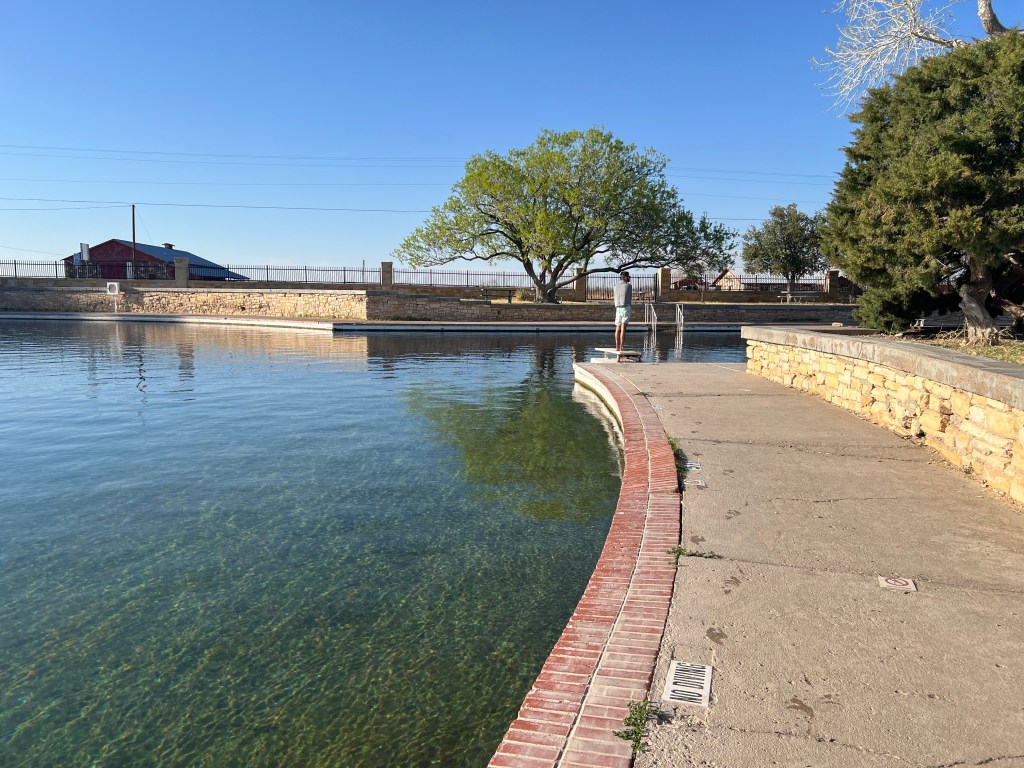
We even crossed paths again at Balmorhea State Park in West Texas, a remarkable desert oasis in the Chihuahuan Desert, before they continued on toward San Antonio. The park is centered around San Solomon Springs, one of the largest natural springs in Texas, which feeds a massive spring-fed swimming pool built by the Civilian Conservation Corps in the 1930s. The water stays a constant, crystal-clear temperature year-round and supports a surprisingly diverse aquatic ecosystem for such an arid landscape.
Quick side note—Balmorhea also has those tiny fish that gently nibble at your feet in the water, which is both strangely relaxing and slightly unsettling.
And then came Yvonne and Craig. Another fantastic couple, this time from Texas. We had a great time talking with Craig and listening to his deep Texan accent and slow cadence. His sense of humor was impeccable.
Once he picked up on my extroverted and easily impressionable personality, he summed it up perfectly: “You’re like a chicken, every day you wake up to a new world!” No truer or funnier words have ever been said.
He also shared a story about visiting his family in the Pacific Northwest, where the pace of conversation tends to be noticeably faster and more clipped. While there with them, he went to order food at a drive-through and found himself in one of those unexpectedly funny communication mismatches—he speaks a bit more slowly and deliberately, and the person on the other end was clearly not quite catching his rhythm. From his perspective, the order was simple enough that it shouldn’t have been complicated, which only made the moment more amusing as it unfolded.
In his telling, what made it even funnier was the contrast in styles—him calmly working through the order, and the drive-through pace moving at full speed—turning a routine stop for food into a surprisingly chaotic little exchange.
It’s funny how travel works sometimes. You go for the landscapes, the hikes, the big “must-see” places, and the sweeping views you’ve seen in photos—but what often stays with you most isn’t any of that. It’s the people you meet in between, and the small, unexpected moments that happen along the way. The conversations, the shared stories, the chance encounters that weren’t on any itinerary—those are the parts that linger long after the trip is over.
Before starting this newest chapter of our travels, we first have to rewind to one of our previous destinations.
The story of how we ended up in Louisiana actually begins much farther north, in Nova Scotia.
While we were there, I had a few memorable conversations with a man named Doug.
Doug was one of those people who seems to have lived several different lives, each one more interesting than the other. At one point he had been a bush pilot in Alaska. He had made his way there from California and, if I remember correctly, hitchhiked much of the journey. The kind of story that makes you pause and realize there are far more ways to live our lives. After more than a decade in Lafayette, Louisiana, Doug had plenty of stories to share. His descriptions of his life there and the places his wife and he cherished inspired us to look more closely at the destination and, eventually, make the journey south.
Doug said something during one of our conversations that has stayed with me: “The difference between adversity and adventure is your attitude.”
Such a simple sentence. Yet, it completely shifted how I saw this newly embarked travel lifestyle. Instead of viewing uncertainty as something to control, I began to see it as an invitation to something potentially meaningful. A reminder that what defines a person isn’t just what they do in life, but how they choose to live their lives. Sometimes, it’s the experiences, the risks, and the stories gathered along the way that shape us the most.
Traveling from Nova Scotia to Louisiana felt fitting, since their history is so intertwined.
Nova Scotia was the homeland of the Acadians. In the 1700s, many of them were deported during the Great Expulsion and eventually made their way to Louisiana.
Over time, the word Acadian evolved into Cajun, partly because the English struggled to pronounce the original French name.
And with that bit of history in mind, Lafayette suddenly felt like the perfect place to explore.
Not long after leaving Arkansas, the landscape began to change. The forests gave way to small palm trees, the air felt heavy with humidity and the roads slowly dropped into the flat, watery lowlands of southern Louisiana. We had officially entered bayou country.
Our arrival, however, did not quite match the romantic image I’d conveniently made up in my mind.
During the first week, it rained. And rained. And rained.
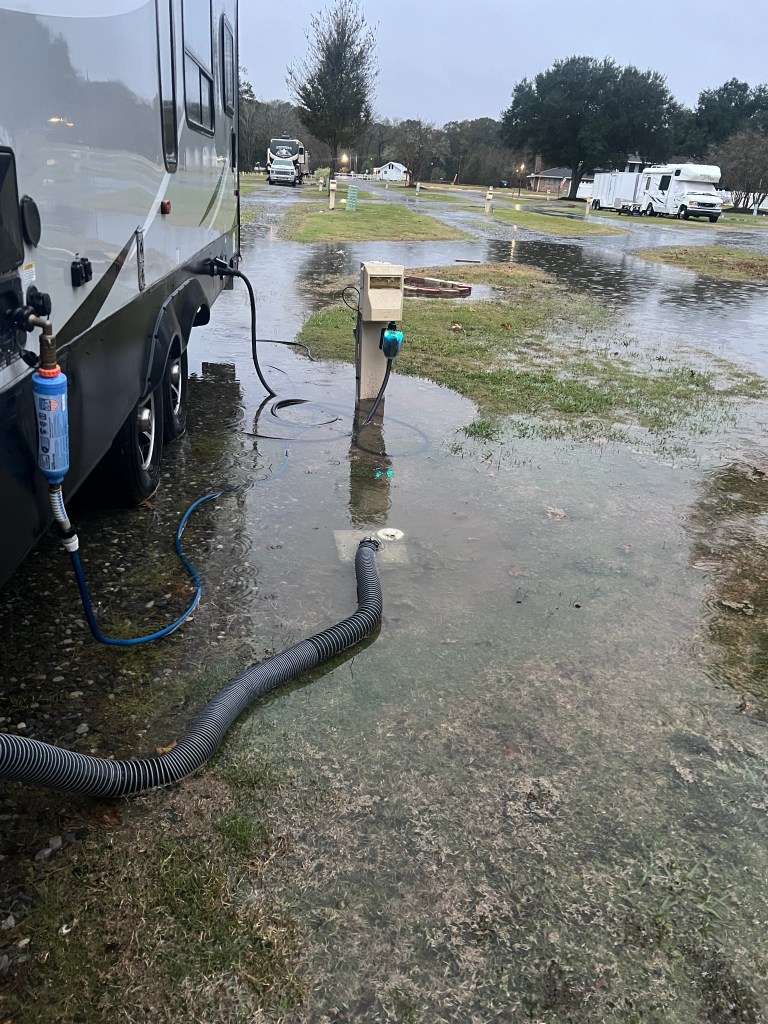
What started as a few wet days quickly turned into a relentless stretch of gray skies and steady downpours. The campground flooded and pools of water surrounded the trailers. Exploring was limited, and for a little while it felt like the weather had burst the bubble of adventure we had imagined. Instead of wandering through Cajun towns and bayous, we spent a lot of time inside the trailer, watching the rain fall and advancing our cribbage playing streak.
Once the weather cleared, we started discovering just how rich this corner of Louisiana really is.
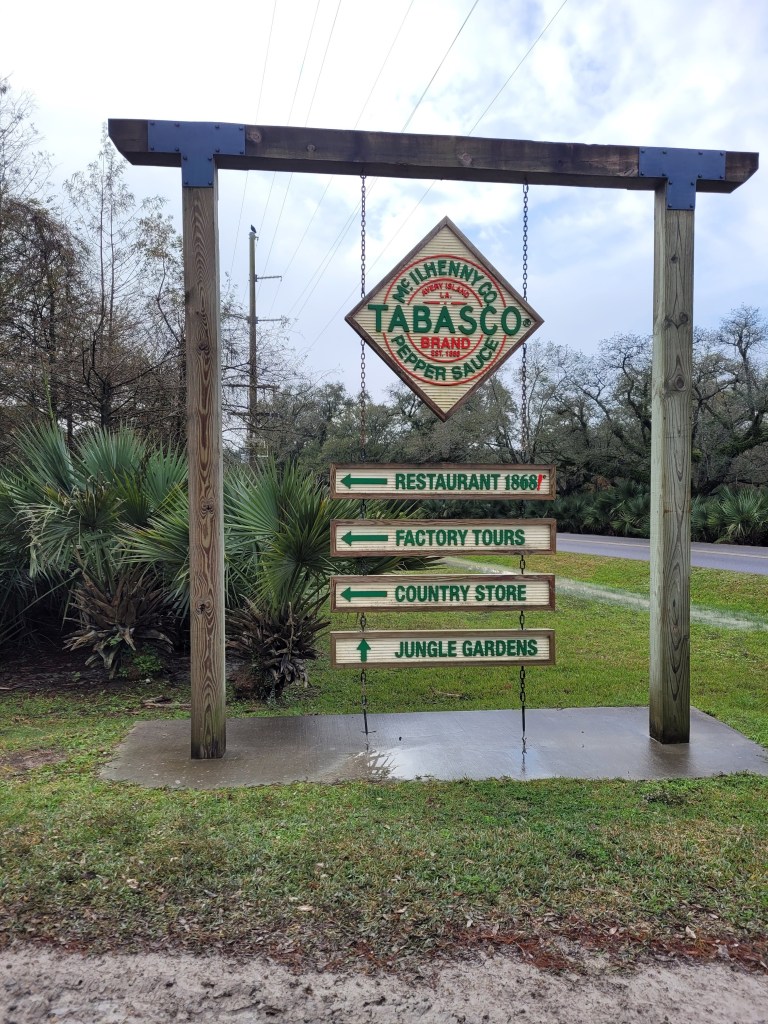
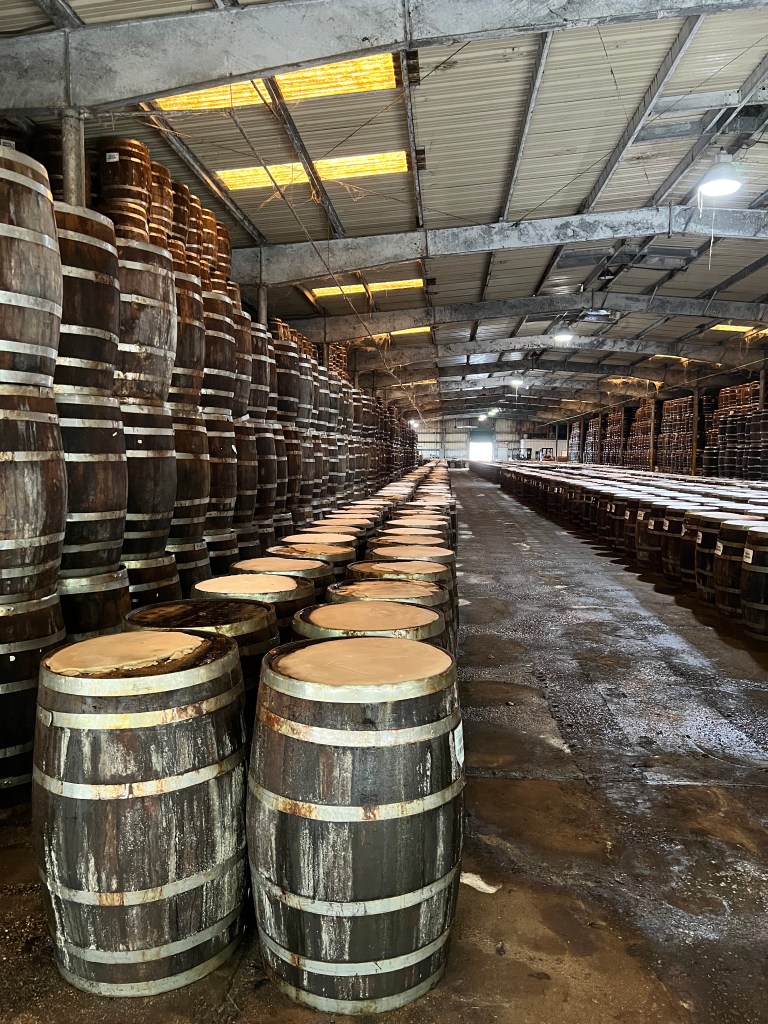
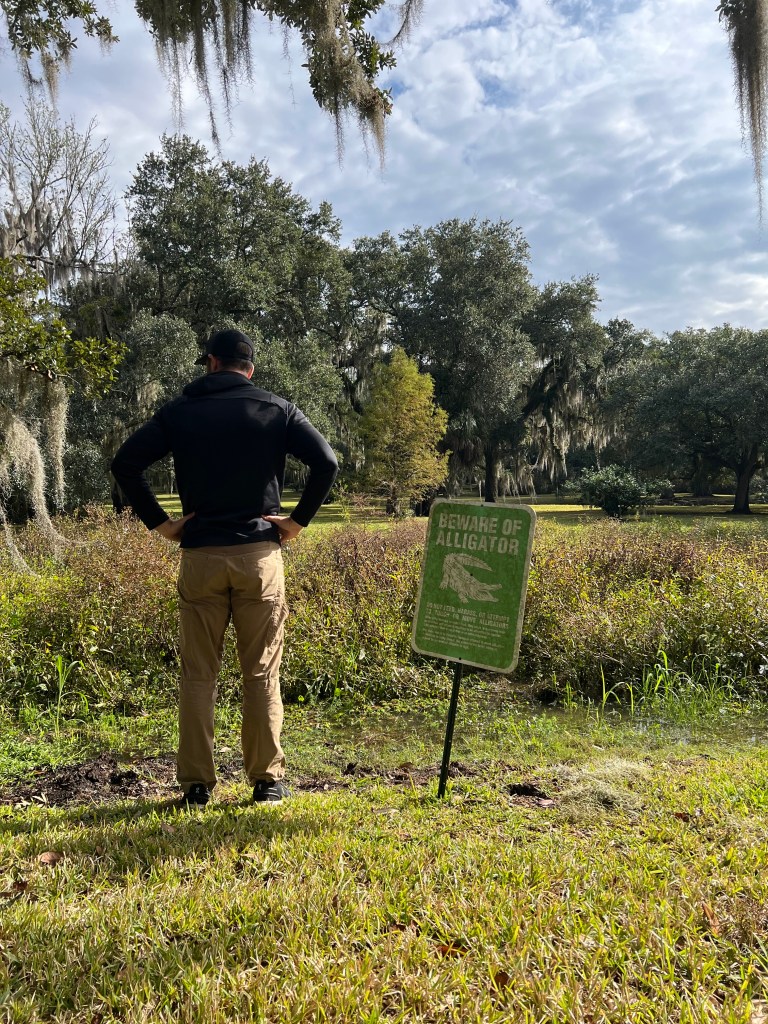
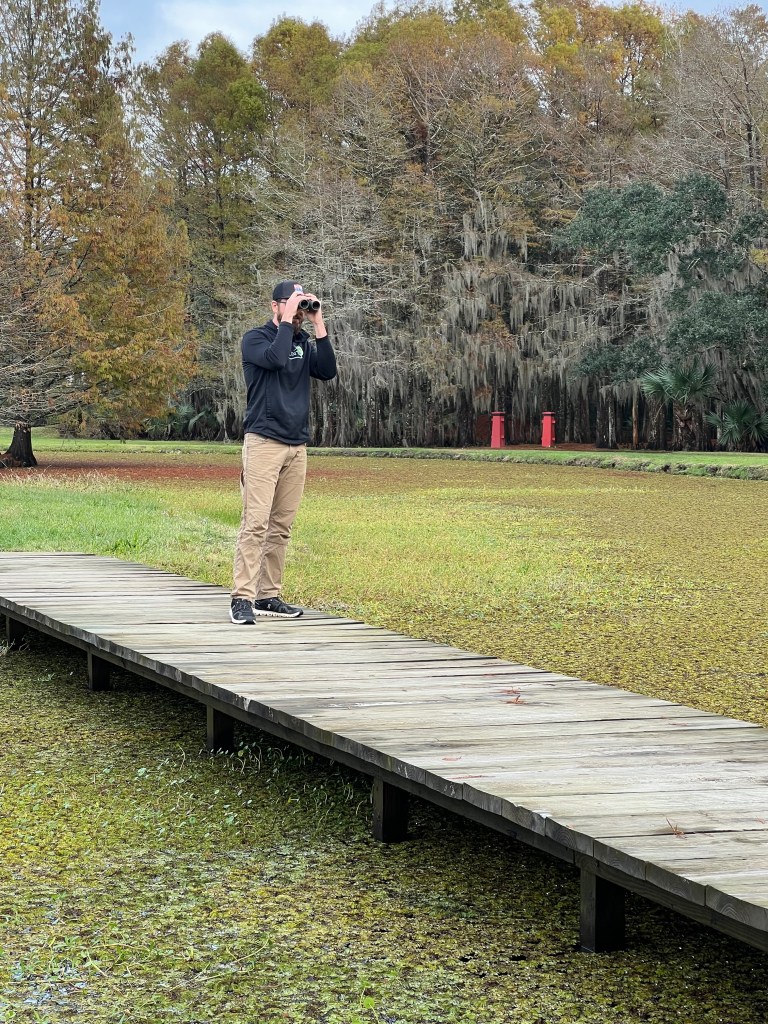
One morning we crossed Avery Island to tour the Tabasco factory. The smell of peppers in the air was impressive as we learned how the famous sauce is fermented and aged for 3 years before being bottled and shipped around the world. After the tour, we wandered through the Jungle Gardens, where quiet roads wind beneath massive oak trees and past ponds dotted with birds and the occasional small gator. Chris had been on a mission to spot one ever since we arrived in Louisiana, so I couldn’t help but laugh at how quickly he whipped out his binoculars, scanning the swamp like a seasoned wildlife tracker. I didn’t even know he’d packed them. It was the beginning of what would become our running joke: “Chris and his knockers.”
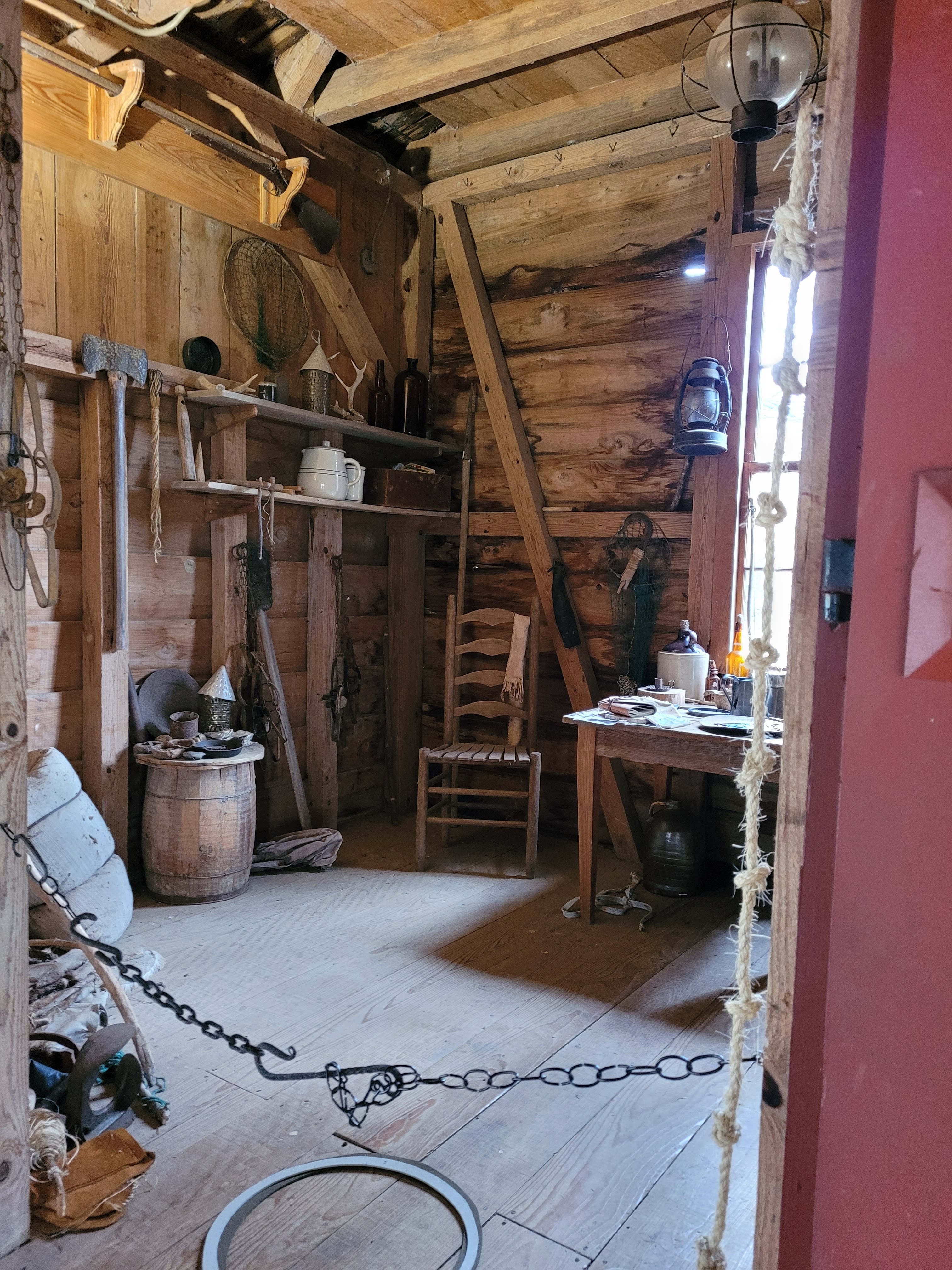
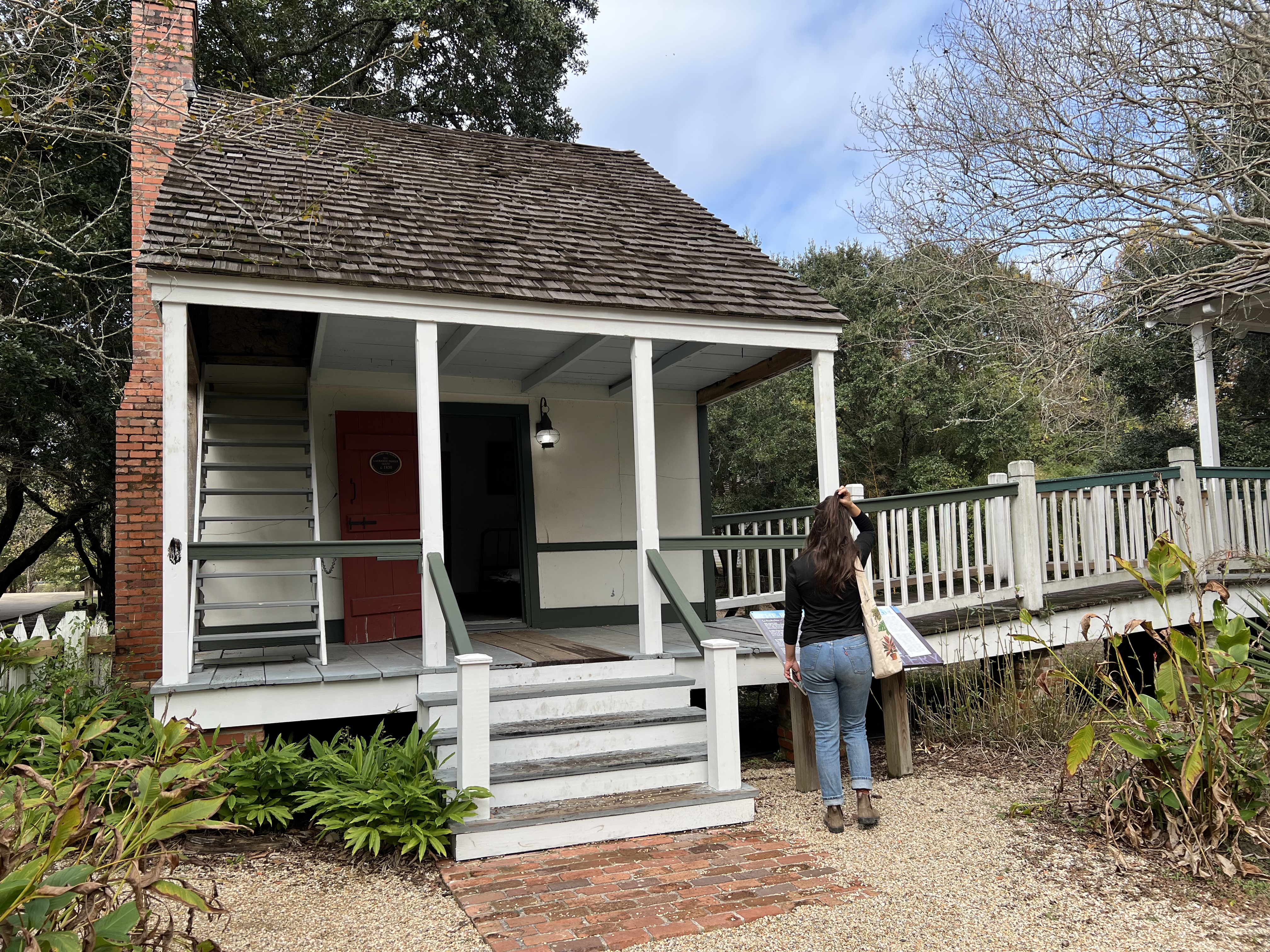
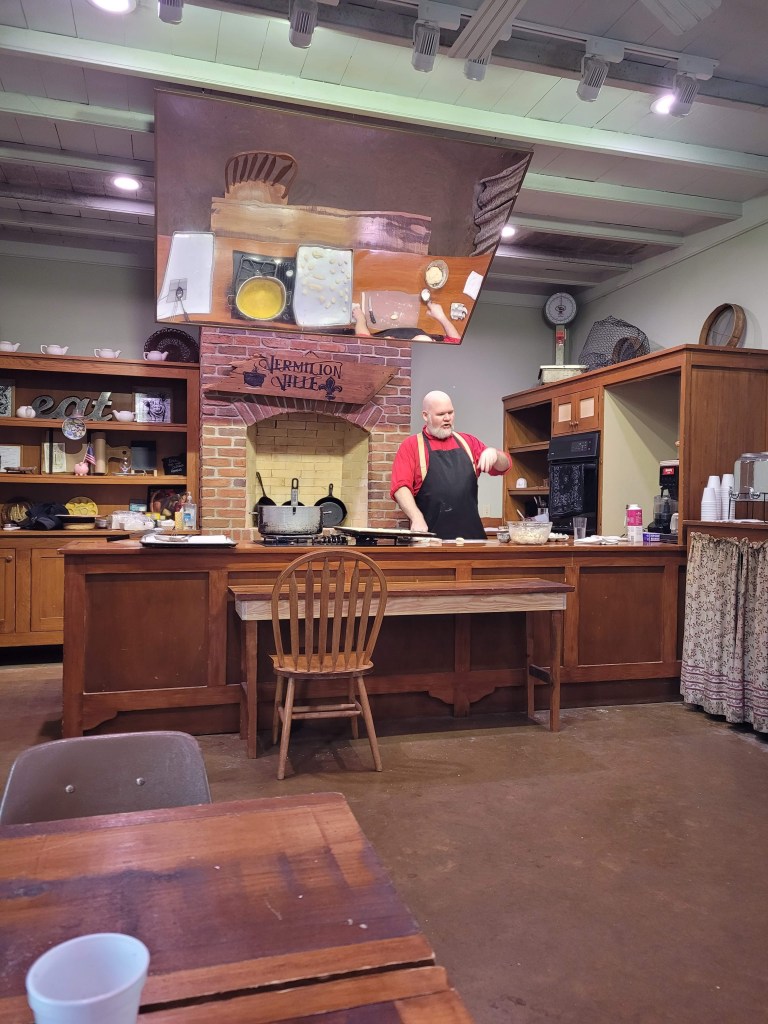
Another memorable day was spent at Vermilionville Historic Village, a living history village preserving Cajun and Creole heritage. Walking through the restored homes along the bayou felt like stepping into another slow, quiet century that was deeply rooted in tradition. And yet, just across the water, someone was fishing with loud rap music blasting, the bass thumping through the air. The contrast was impossible to ignore. Imagine standing inside an old forge with no modern amenities, while the beat of today’s music quite literally vibrated through the walls.
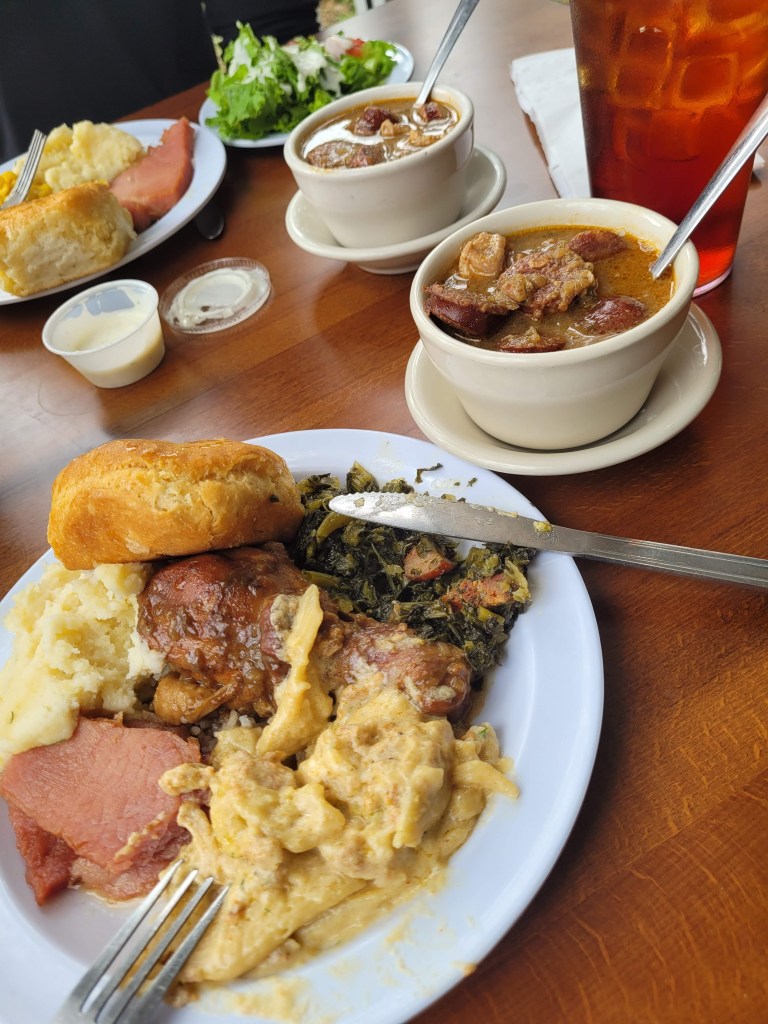
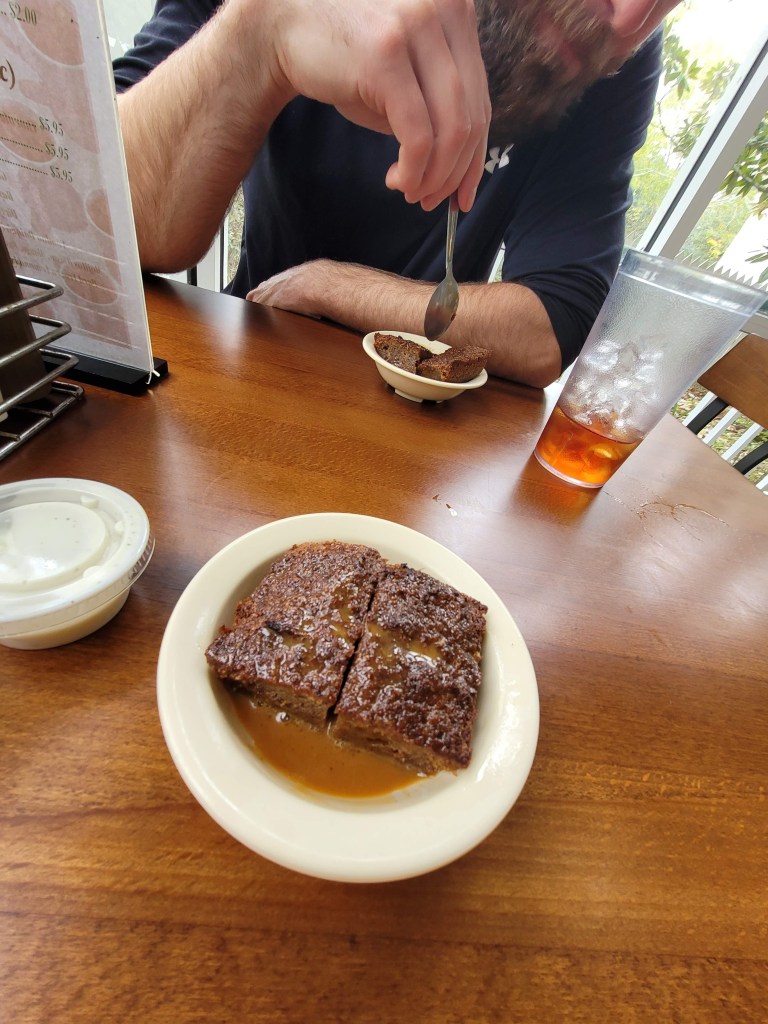
We stopped for lunch at La Cuisine de Maman (Mom’s Kitchen), where Chris swears he had the absolute best bread pudding of his entire existence. Afterwards we wandered into the dancehall where a zydeco band had started playing. Before long the dance floor filled with locals, many of them older couples who moved with effortless rhythm. Watching them spin and laugh across the floor felt like a window into everyday Cajun culture.
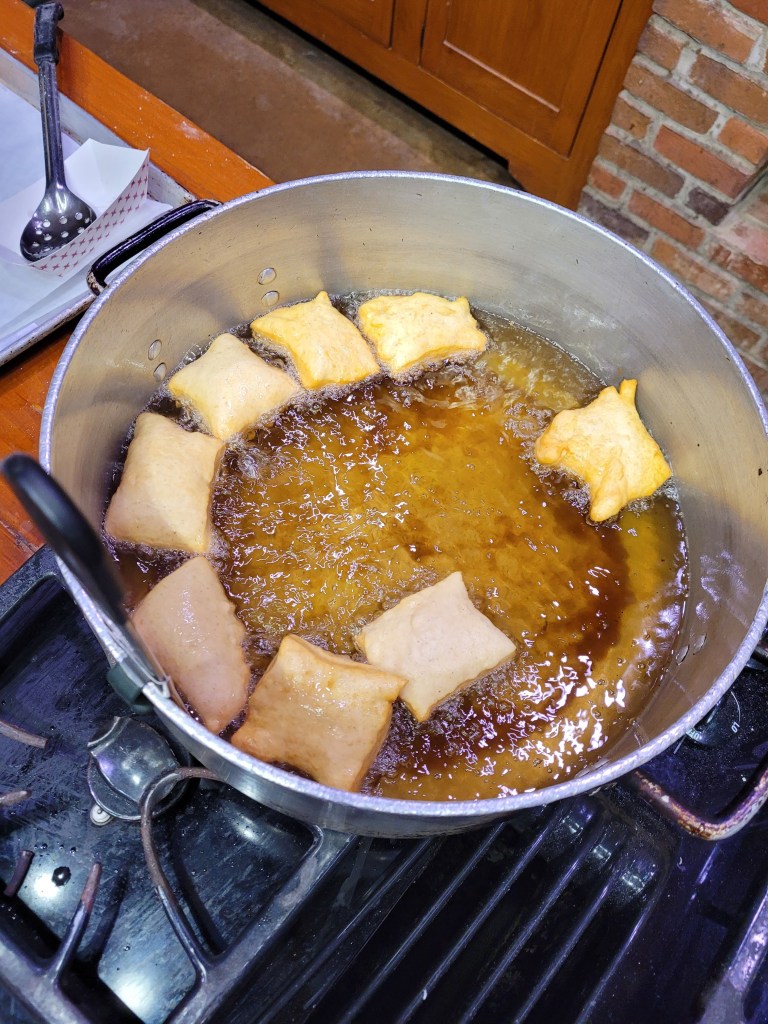
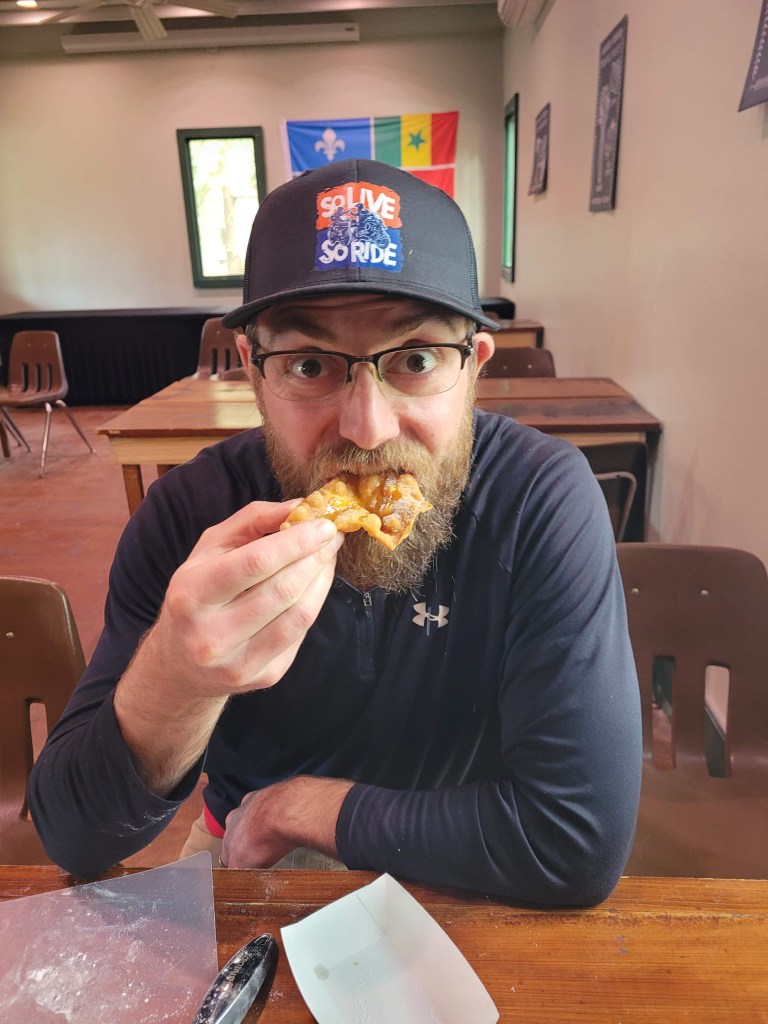
Our main reason for visiting Vermilionville was that I’d signed us up for a Cajun cooking class. We experienced heritage cooking at its finest, with a Hands-On Beignet Making Demo. Our food historian and beignet-maker supreme, Jay, guided us as he explained the origins of the famous beignets as we created delicious little dessert treats. By the end of the class, the room smelled like warm, fried dough and powdered sugar.
Louisiana: Where The Food Doesn’t Disappoint
Food, of course, quickly became the main gateway into Cajun country’s history.
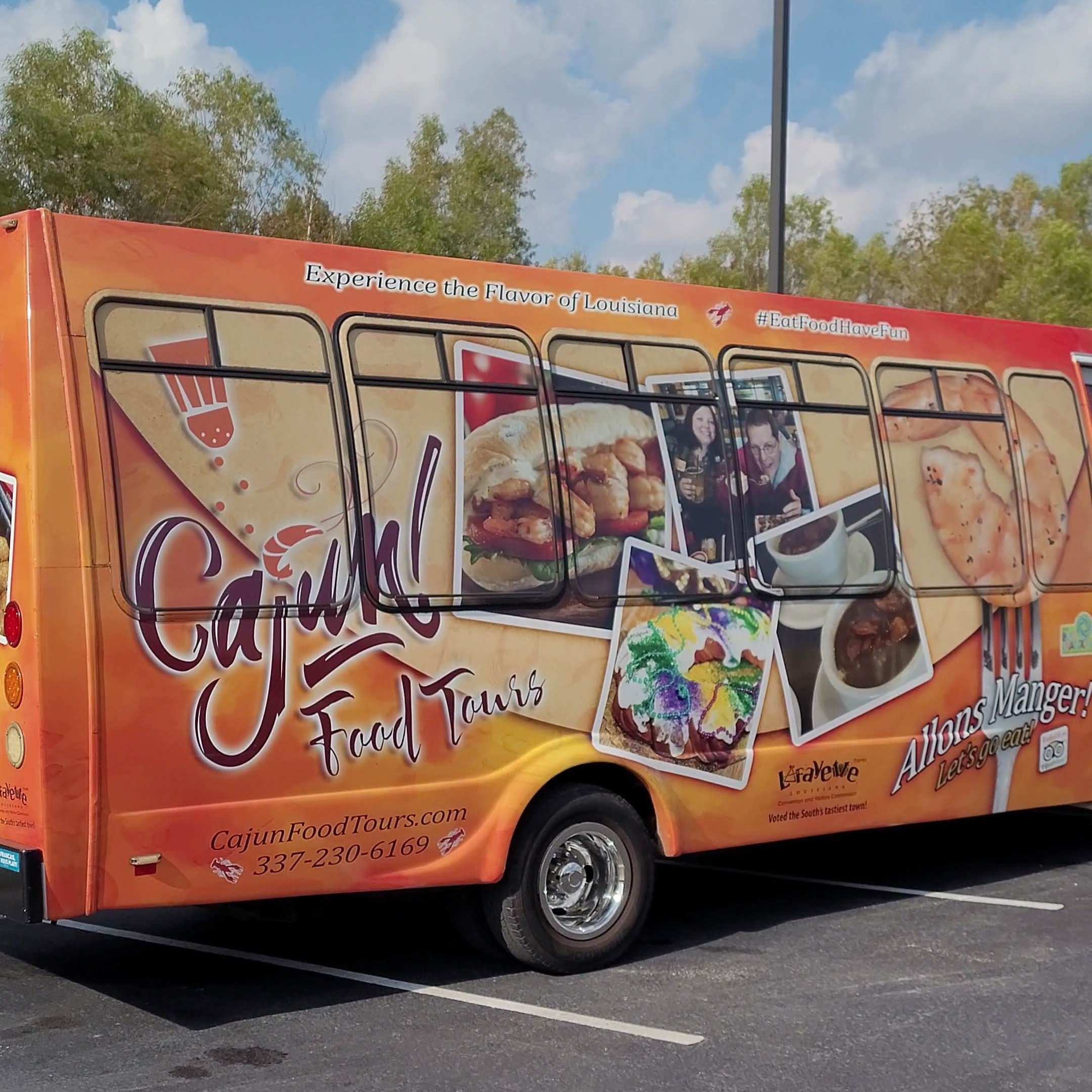
One day we joined a Cajun food tour that turned out to be part history lesson, part feast. We drove to the meeting point and climbed aboard a bright red bus decorated with cheerful Cajun touches. Our guide Marie, a former history teacher, quickly set the tone. As we rolled through Lafayette and the surrounding towns she told the story of the Acadians, Le Grand Dérangement, and how settlers from Europe and Nova Scotia shaped the food culture of southern Louisiana.
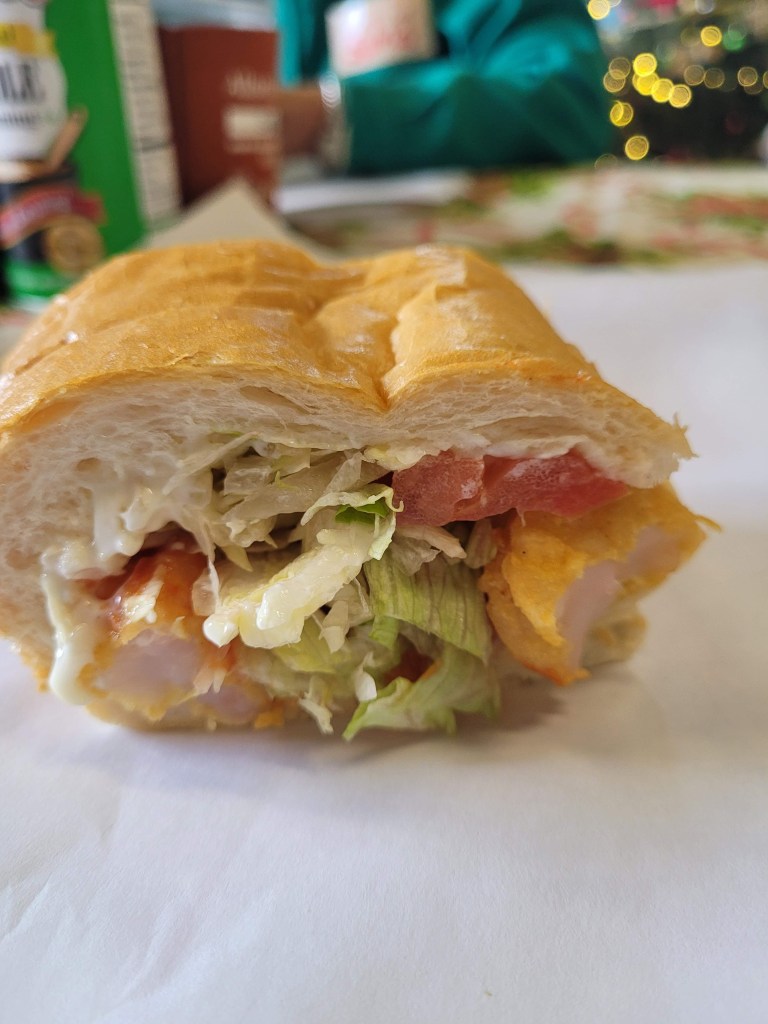
Our first stop was Broussard and Ton’s Drive, where we tried gumbo served with potato salad. This sparked one of the great Cajun debates. Do you keep the potato salad separate, mix it into the gumbo, or dip each spoonful? (In case you’re curious Chris and I are both dippers.) Next came BJ’s, where we sampled a shrimp po’ boy. The sandwich itself carries a bit of history.
During a streetcar strike in New Orleans in the 1920s, restaurant owners created large sandwiches to feed the unemployed workers who came in for free meals. They would call out, “Here comes another poor boy,” and the name eventually stuck.
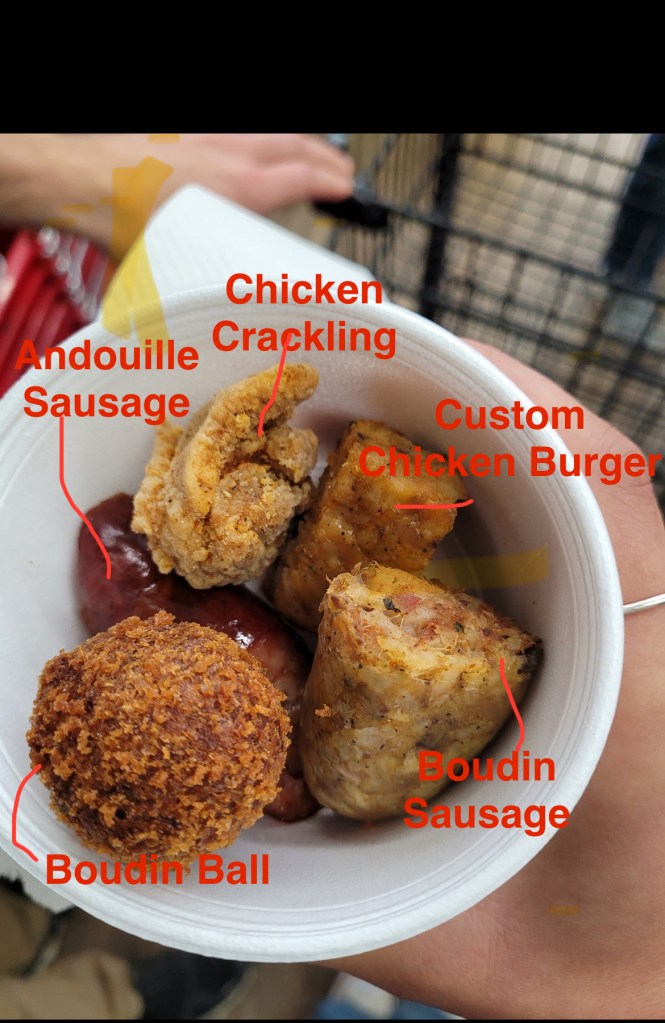
At NuNu’s Fresh Market, we sampled crunchy cracklings, smoky andouille, warm boudin balls, boudin sausage, and chicken patties.
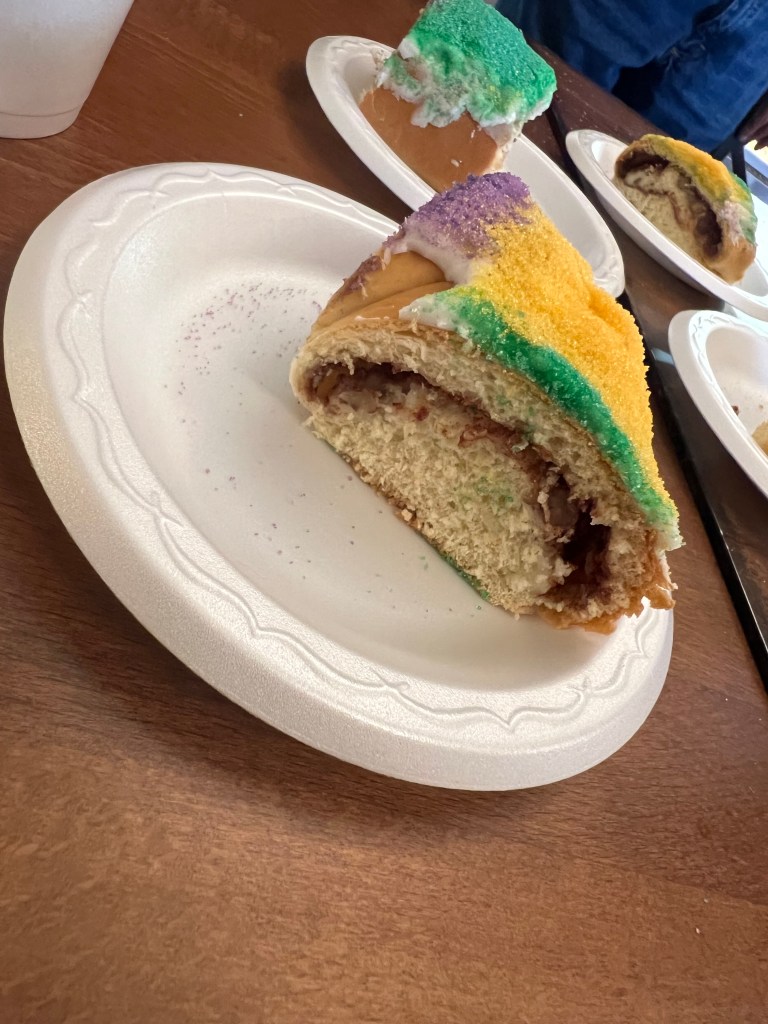
In Carencro, we stopped at Frezzo’s where we tried incredibly tender gator bites along with fried oysters. The tour ended on a sweet note at Poupart’s Bakery with slices of colorful King Cake.
It was a delightful way to experience the area. We came home sated and filled with appreciation for Cajun culture and its vast array of spices and flavors (that would literally set the tone for my cooking over the next couple of weeks).
You Can’t Say You’ve Been To Cajun County If You Haven’t Seen Alligators.
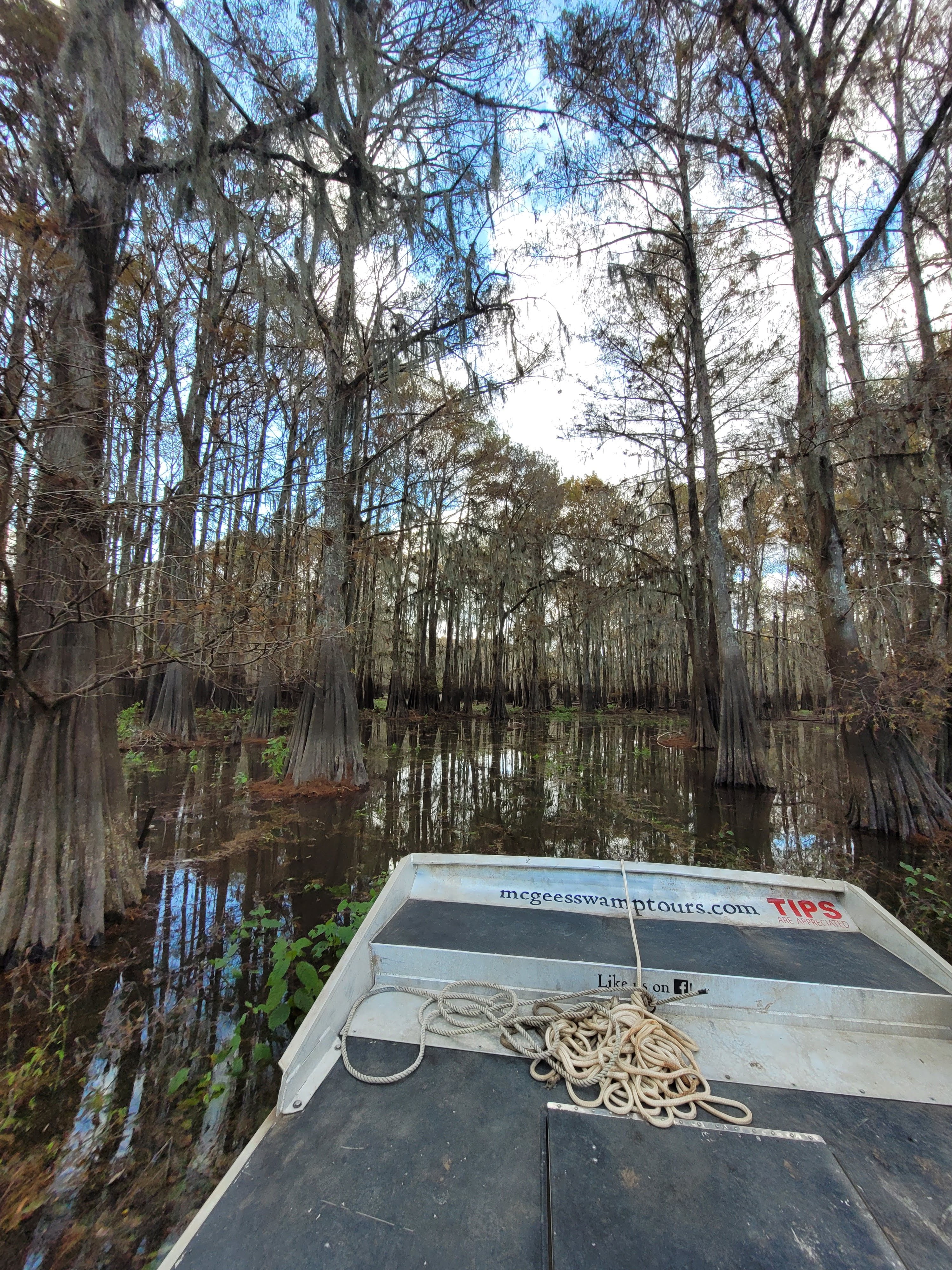
To experience the landscape that shaped so much of Louisiana’s culture, we spent an afternoon with McGee’s Swamp Tours, drifting deep into the heart of the Atchafalaya Basin.
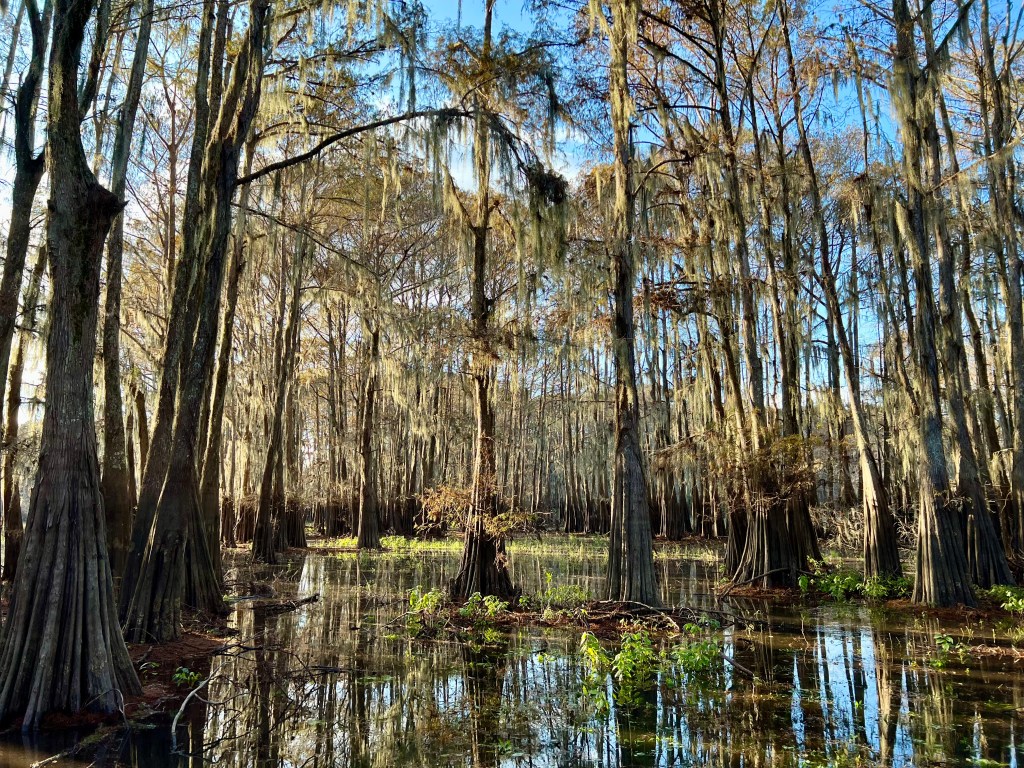
The boat glided through a maze of waterways. Towering bald cypress trees rose straight out of the dark water, their trunks flaring at the base, draped in long strands of Spanish moss that swayed gently with the breeze. According to our guide, this is part of the largest river swamp in the U.S., a vast and complex ecosystem teeming with wildlife and history.
Our guide, a local Cajun, who clearly knew these waters by heart, narrated the entire ride with stories of his childhood and professional experiences as a fisherman. He pointed out birds tucked into the branches, explained how people have lived off this land for generations, and what it’s really like to call the swamp home.
Sad but interesting fact: Rising salinity levels are beginning to reshape parts of the Atchafalaya Basin, placing stress on plant species that have long defined this freshwater ecosystem. Runoff from the spreading of salt on roads during the winter in northern states eventually travels downstream into southern waterways where it does not naturally belong. Over time, this shift in water chemistry can suffocate vegetation that depends on delicate freshwater conditions.
On top of having had rain, it had also been cold over the last few days, so the alligators were mostly in hiding. Even so, we spotted a few juveniles near the banks. Just small ripples at first, then the unmistakable shape once you knew what to look for. It made every bend in the water feel like a quiet search.
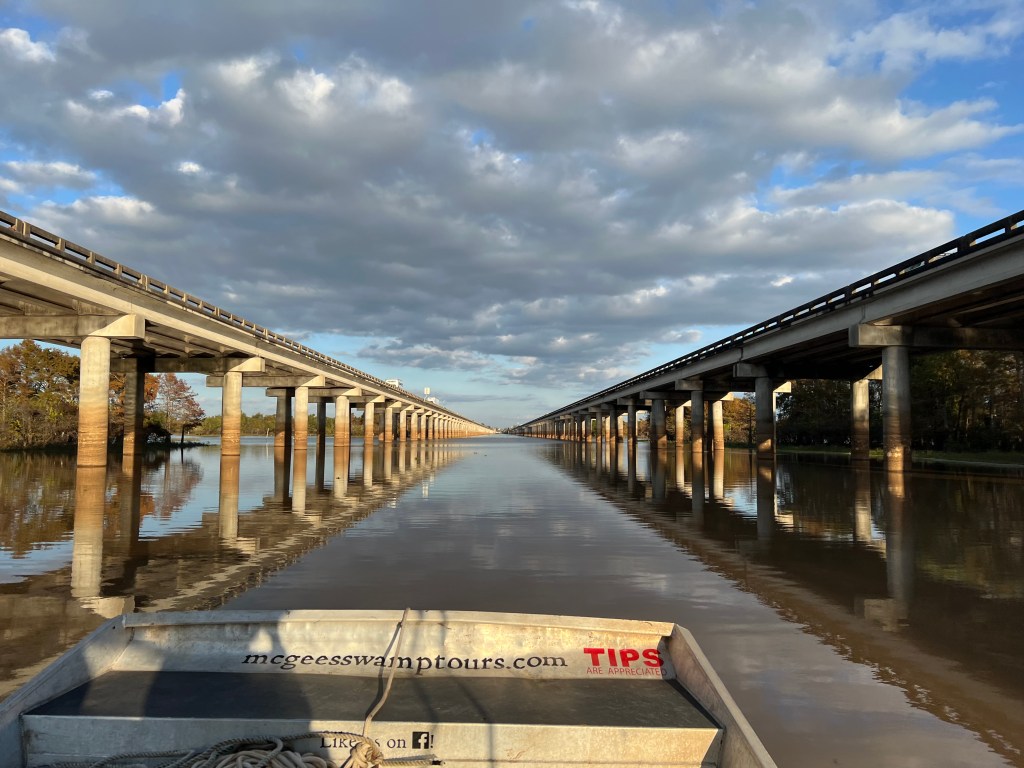
At one point, we passed beneath the longest bridge in the area, its concrete stretch cutting across the wilderness in a way that felt almost surreal. And then just as quickly, we were back winding deeper into the still, green labyrinth.
One of the most fascinating parts wasn’t the wildlife but the “cabins”. Scattered along the water were houseboats, perched on stilts and adapted to a way of life completely shaped by the swamp. It felt like an entirely different rhythm of living. It was so different from anything I’d seen before.
The whole experience felt less like a tour and more like entering an ecosystem, a culture, and a way of life that exists quietly, just beyond the edges of what most people see.
Exploring By Self-Guided Tours
A self-guided walking tour through Breaux Bridge unfolds less like a checklist and more like a series of open doors. Beginning near the bayou, the route carries you into a downtown where history is not preserved behind glass but lived in. You can step inside spaces like the old hardware stores, including the historic Begnaud’s and Broussard’s buildings, where original wooden storefronts and shelves hint at a time when everything from wagons to tools was sold under one roof.
Just a few steps away, other storefronts invite a slower kind of browsing. In buildings like the Potier and Pellerin structures, now home to antique shops, cafés, and boutiques, you can walk beneath pressed tin ceilings that have remained intact for over a century, their metallic patterns catching the light in a way that feels both industrial and delicate.
It is this mix of function and character that defines the walk. One moment you are in a former mercantile space, the next in a boutique or gallery where the architecture tells as much of the story as the items for sale. The experience becomes less about what you are looking for and more about what you stumble into, each doorway offering a small, tangible connection to the town’s past.
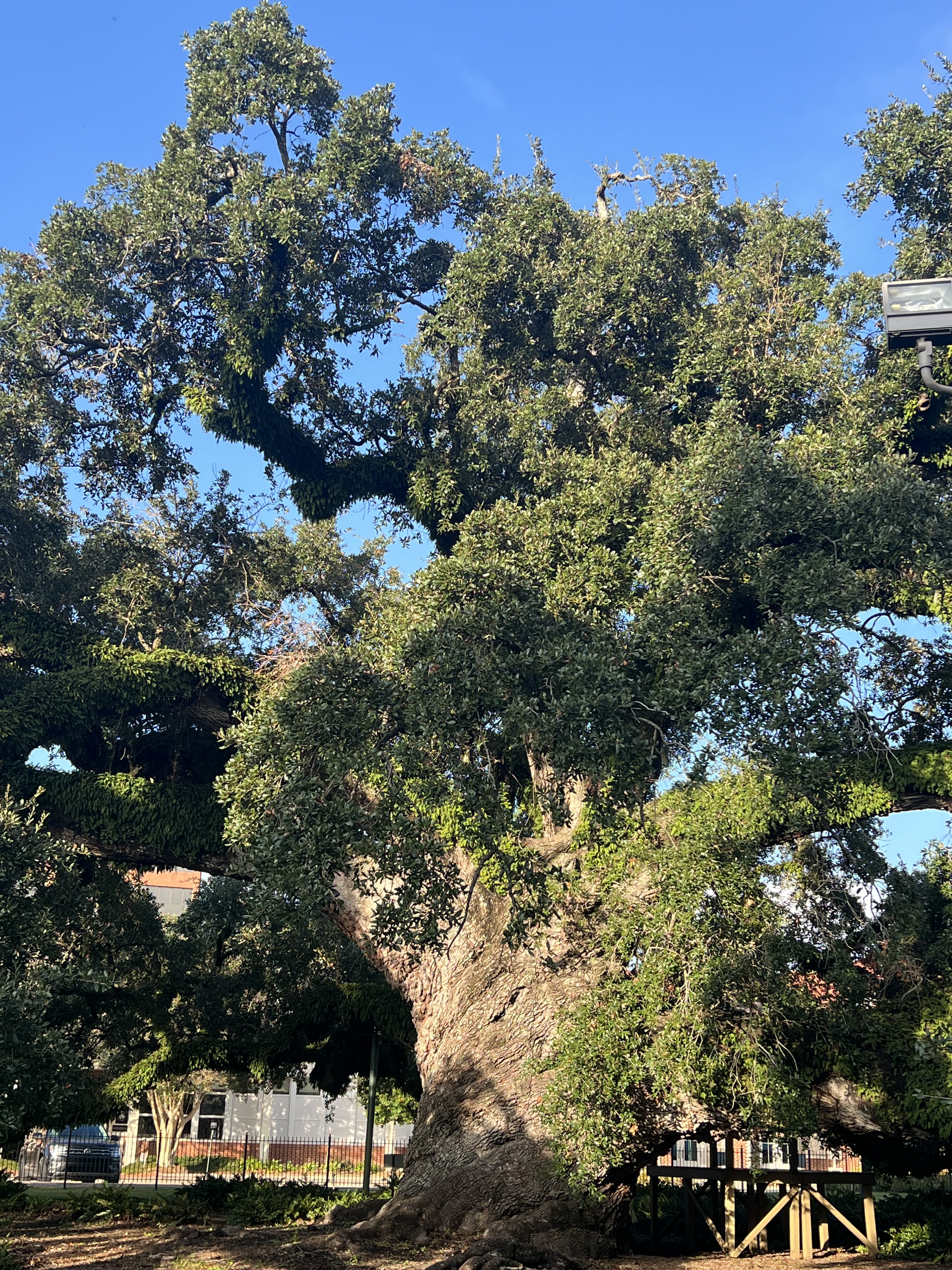
In Lafayette, history also reveals itself in quiet ways. Just beside the stately Cathedral of St. John the Evangelist stands one of the city’s most enduring landmarks, a 450 year old sprawling live oak whose massive branches stretch low and wide, as if shaped by centuries of watching life unfold around it. Believed to be among the oldest in the area, the tree offers a natural counterpoint to the cathedral’s symmetry. Standing beneath its canopy, it feels less like visiting a site and more like stepping briefly into the long, unhurried rhythm of the place.
A Day In New Orleans
New Orleans has always felt like a city that belongs as much to the dark as it does to the light. Perhaps that is why it has long been the perfect setting for stories of vampires, ghosts, and restless spirits. Although we’re not usually ones to visit big cities, I’d been looking forward to getting in as much site seeing in our day in New Orleans as possible. Having grown up reading novels about the supernatural and watching popular vampire shows, I knew this was what I would base my itinerary on for the day. Chris was fully aware that he was along for the ride.
On the day we arrived, I decided to lean fully into that atmosphere and treat our visit like the pages of a gothic diary.
As we found parking near the edge of the French Quarter and walked toward the historic French Market, the air carried the scent of sugar and fried dough long before we even saw the stalls. Rows and rows of booths with trinkets and t-shirts lined the tin-roofed walkway, their colors spilling out beneath the soft shade. The narrow aisles buzzed with energy: Vendors calling out greetings, music drifting in from somewhere unseen, and the steady shuffle of visitors moving from table to table. Handmade jewelry caught the light beside stacks of local spices, artwork, and souvenirs, creating a mix of textures and colors that felt both lively and quite chaotic.
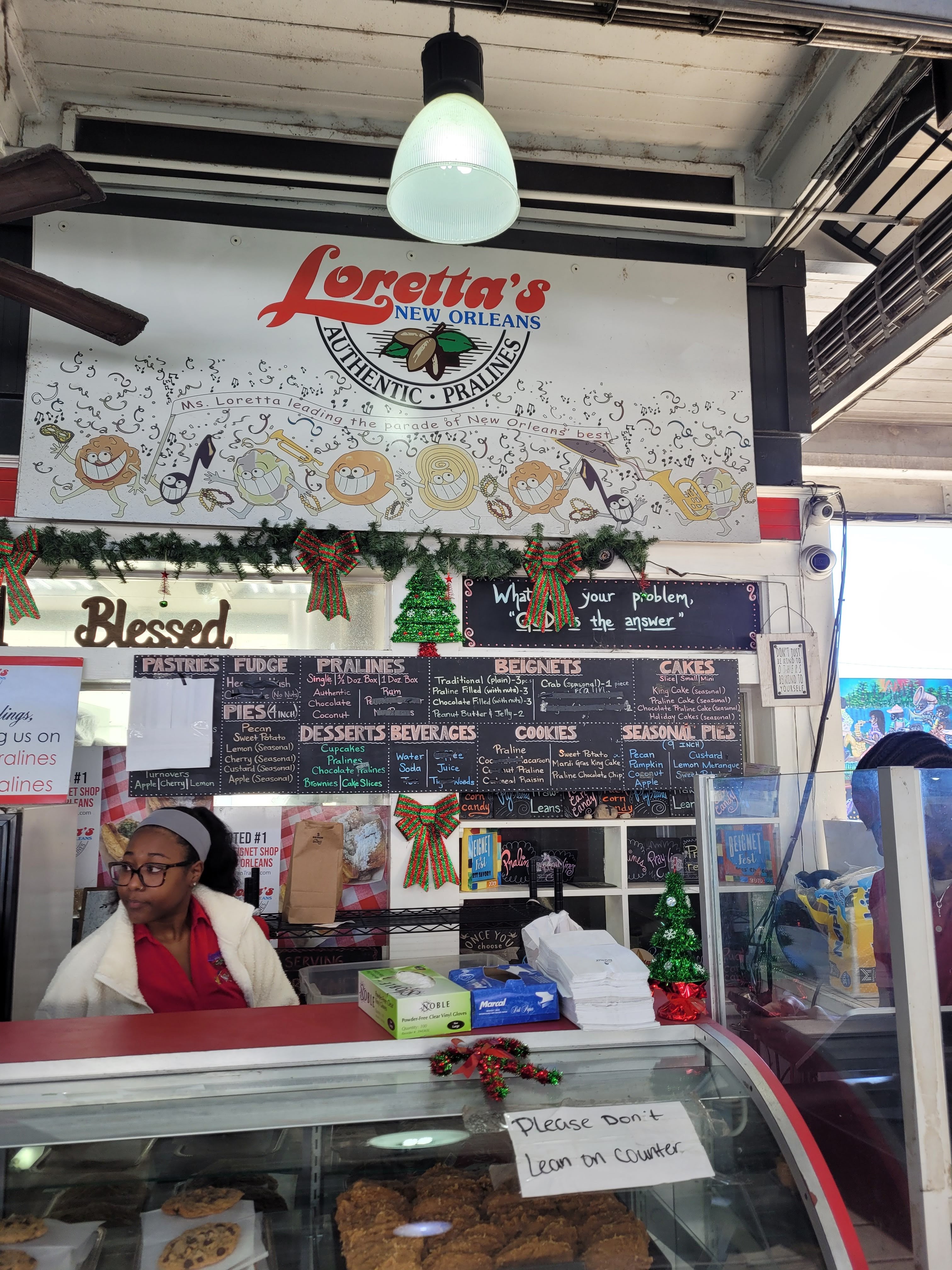
Naturally, we made a stop at Loretta’s Authentic Pralines. Their praline beignets are something of a legend. Imagine a traditional beignet, but filled with the sweet, nutty richness of Louisiana pralines. Warm, powdered with sugar, and impossibly indulgent. For comparison’s sake, we attempted to visit the famous Café du Monde. But the line stretched far beyond our patience, and the tourists swirled around the entrance like moths to a lantern. We decided instead to let mystery linger and continued wandering.
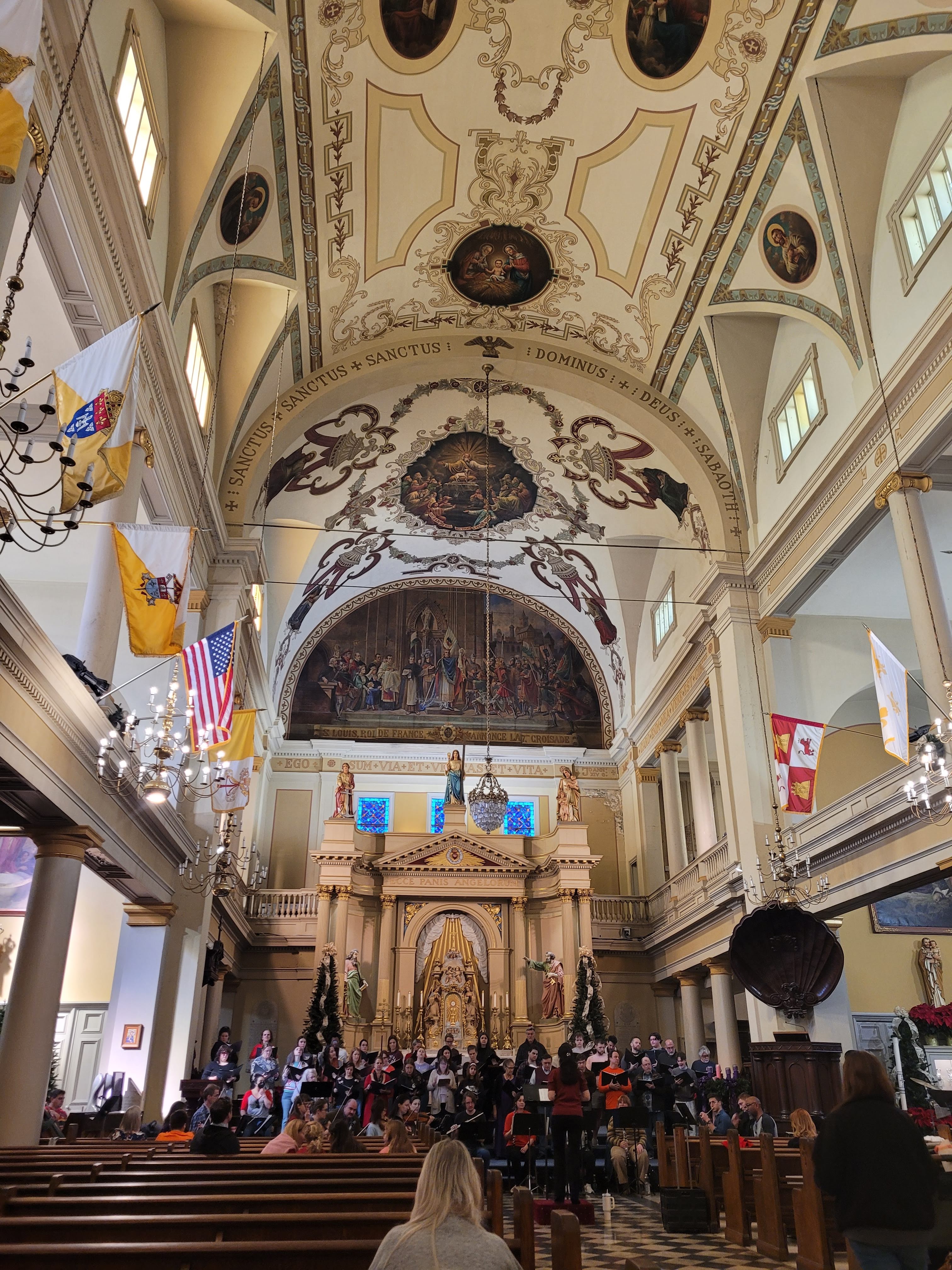
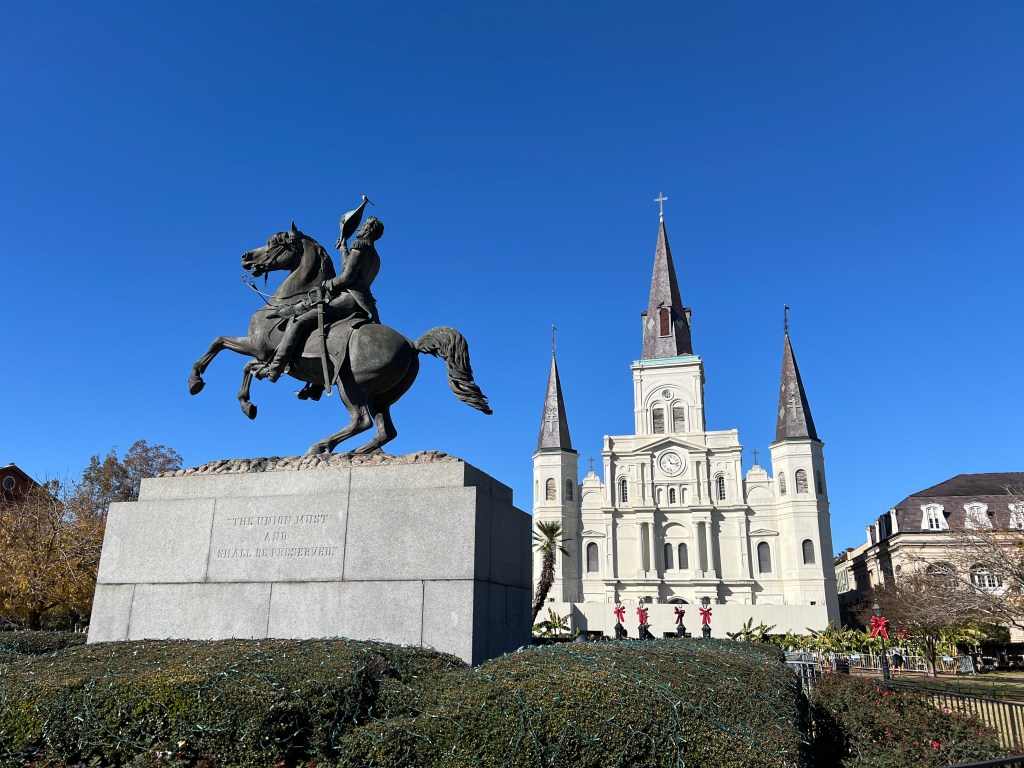
The heart of the Quarter pulled us toward Jackson Square, where artists displayed their work beneath the shade of old trees and musicians filled the air with melody. At the far end stood the towering white spires of St. Louis Cathedral. Inside, we slipped quietly into a pew just as a choir began to sing Christmas hymns. Their voices echoed through the vast space, rising toward the painted ceilings with an almost otherworldly calm.
Outside the cathedral, however, the mood shifted. A group of street performers had gathered a crowd and were performing athletic stunts that bordered on the impossible. Flips, jokes, crowd participation. It was chaotic, hilarious, and perfectly New Orleans.
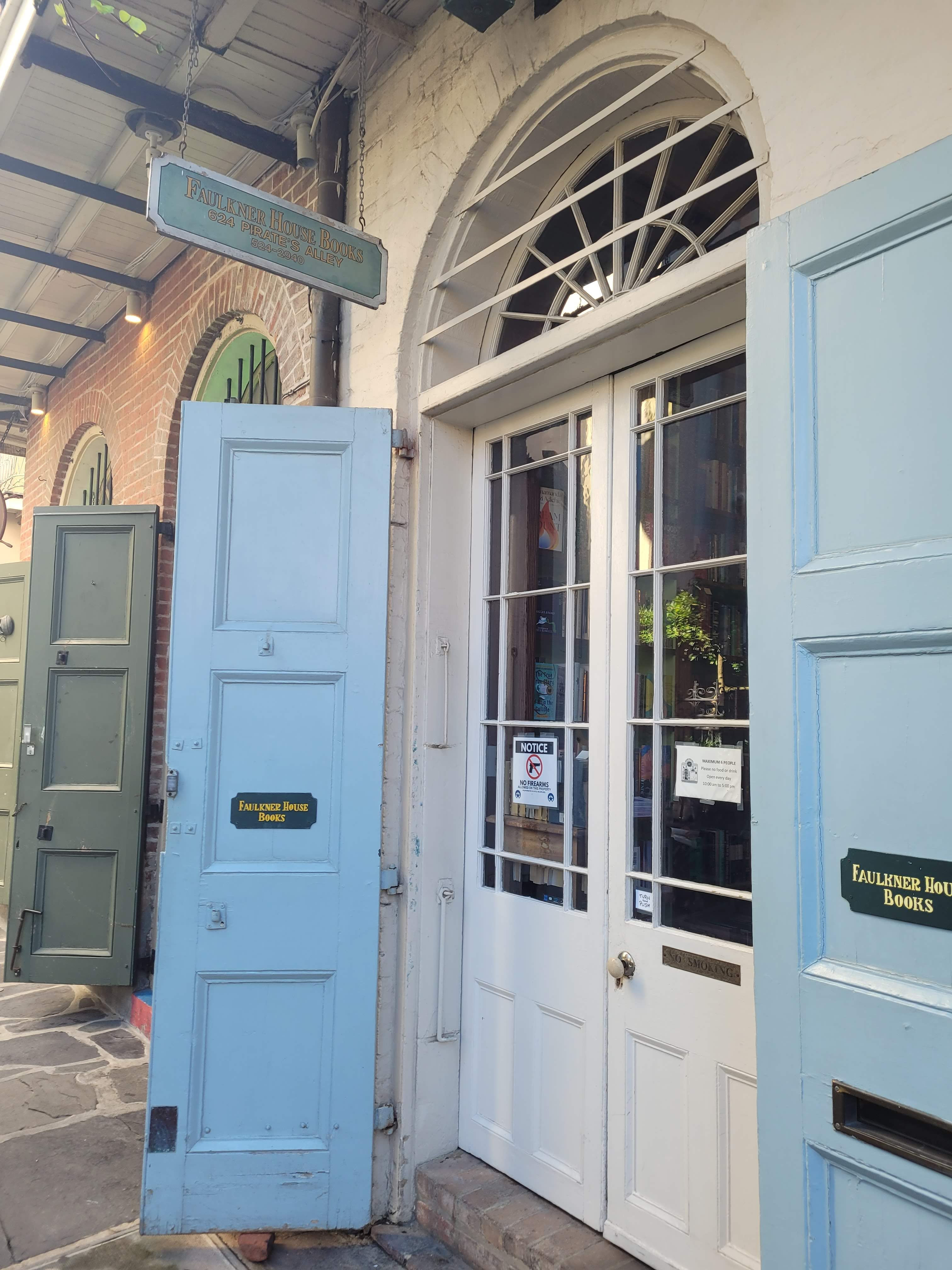
From there we wandered through quieter streets until we stumbled upon Faulkner House Books, a tiny literary haven tucked into a historic building where William Faulkner once lived. The narrow aisles and towering shelves felt like the kind of place where forgotten stories might still linger between the pages.
Not far away we stepped into the peculiar world of the New Orleans Pharmacy Museum. Inside were shelves of antique bottles, strange instruments, and relics from an era when medicine was as much superstition as science. It was equal parts fascinating and slightly unsettling. It really makes you grateful for modern medicine and current technologies.
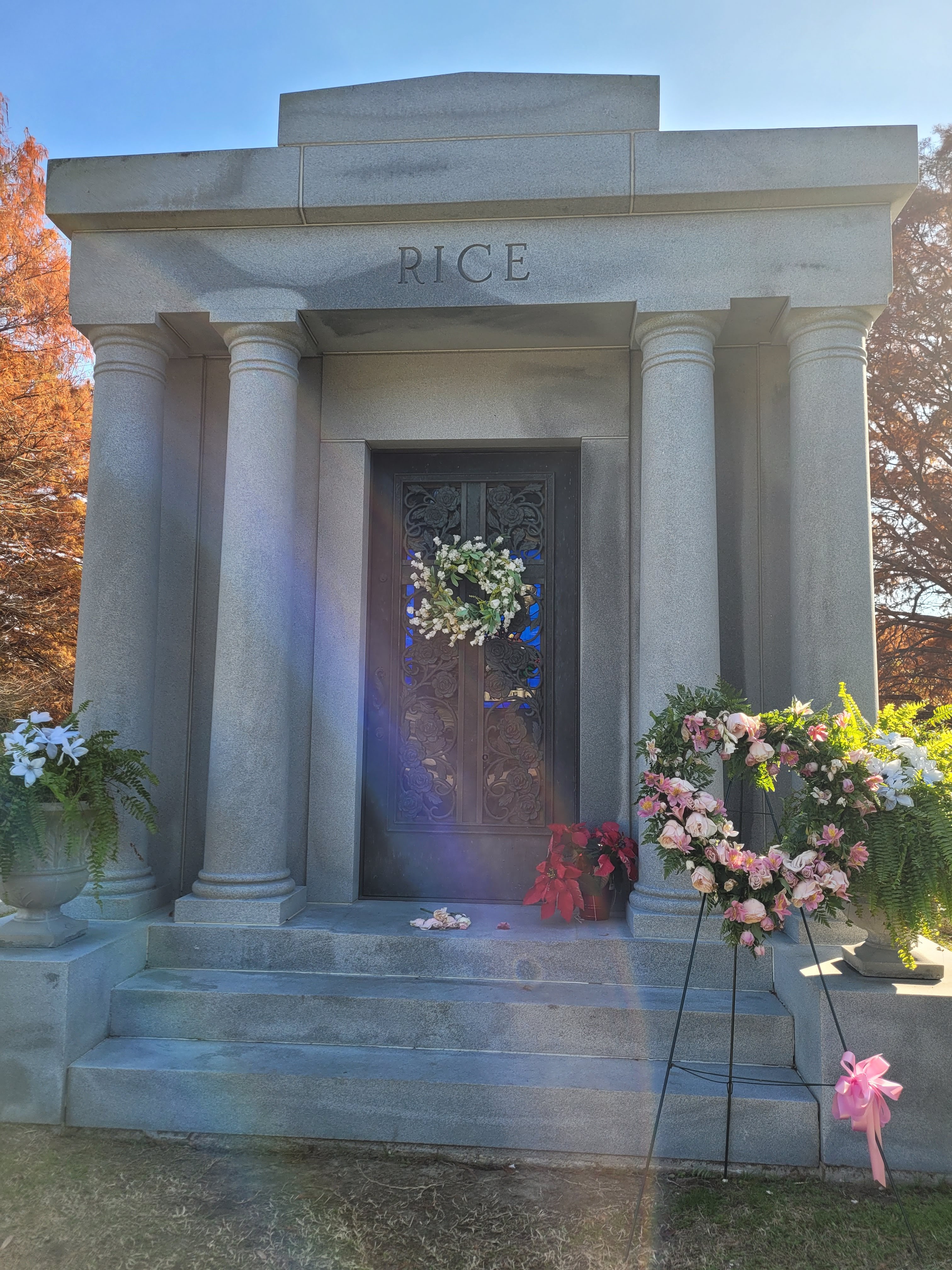
By mid afternoon we decided to cross the city using the Canal Street streetcar. It rumbled across the less touristy areas of the city until it reached Lake Lawn Metairie Cemetery. Known locally as one of the many “Cities of the Dead,” the cemetery holds ornate above ground tombs and mausoleums. Among them is the resting place of Anne Rice and her family. Standing there felt strangely fitting on the day we spent wrapped in the gothic atmosphere of the city she immortalized in novels like Interview with the Vampire.
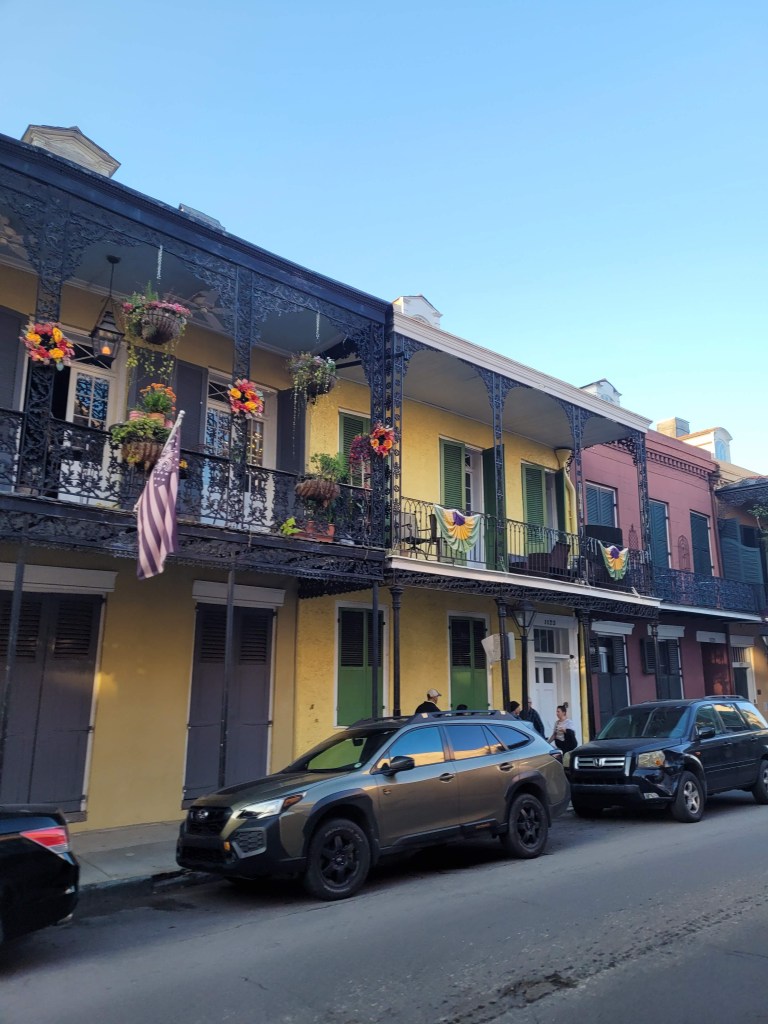
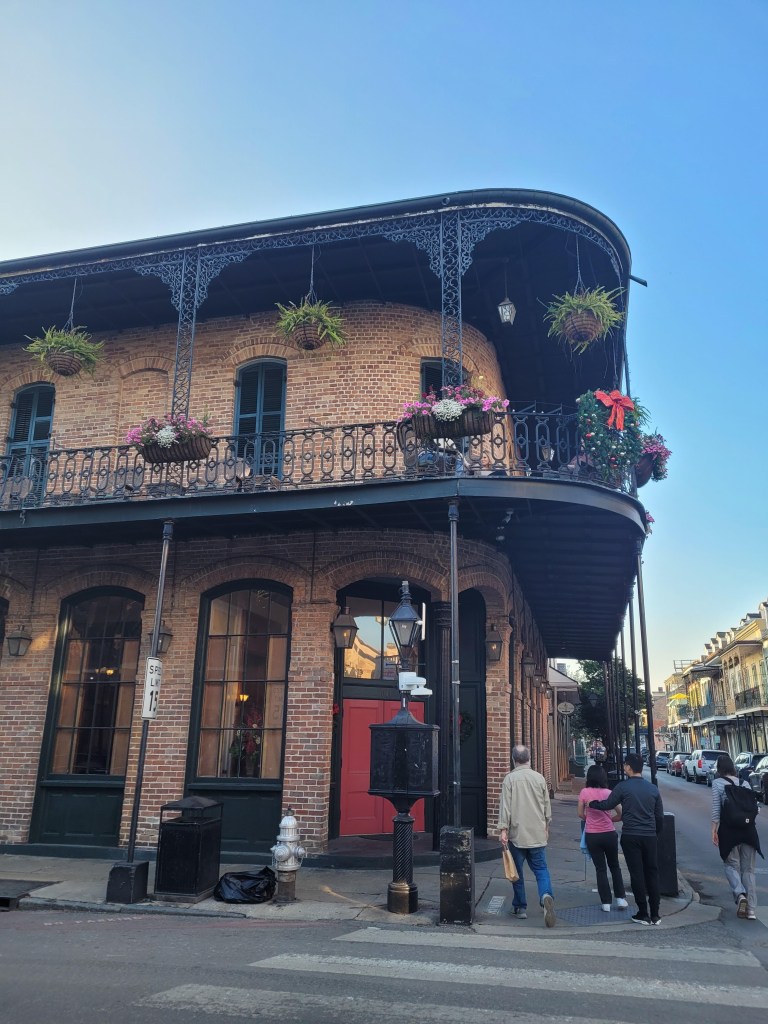
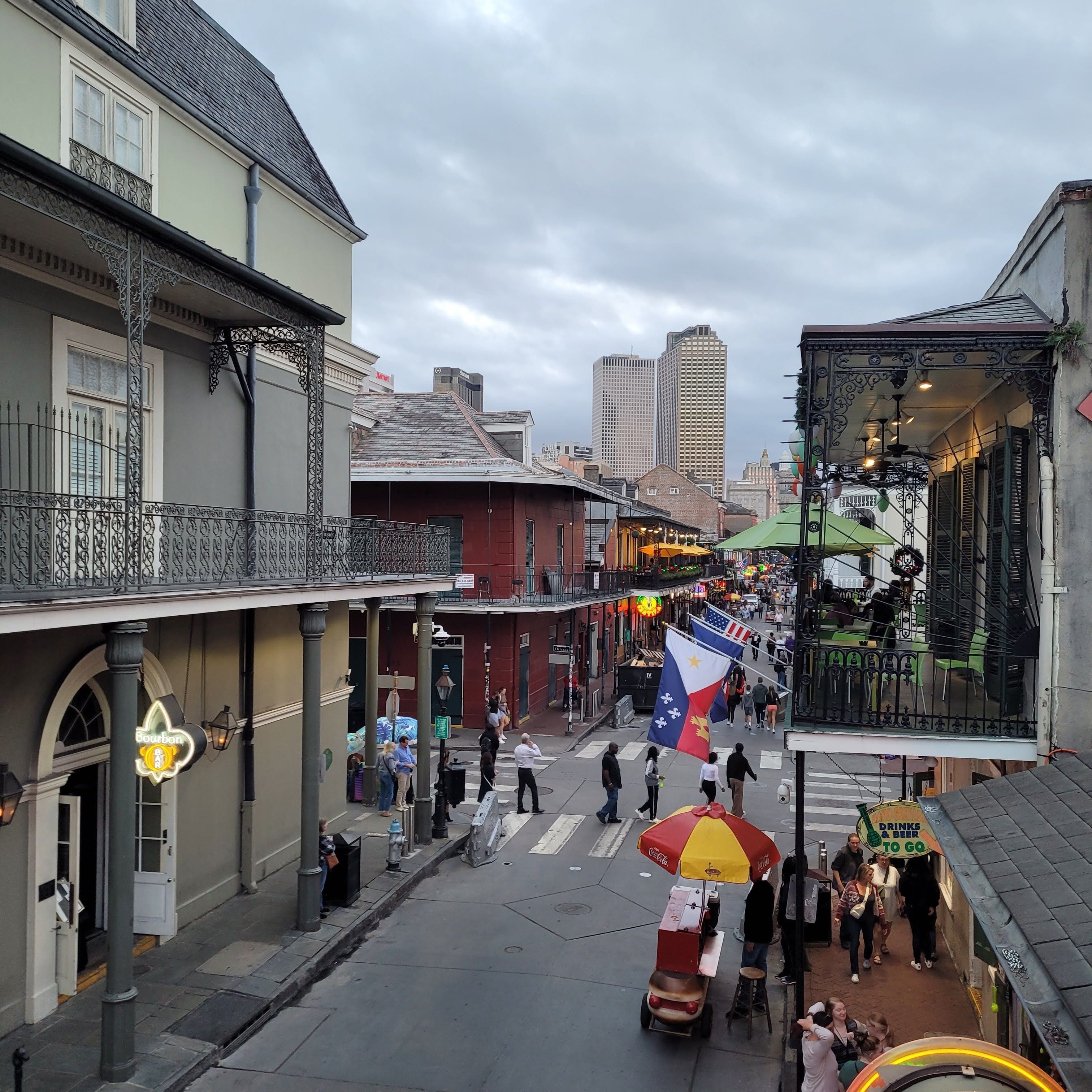
When we returned to the Quarter, we walked down the infamous Bourbon Street. It was only two in the afternoon, yet the street already hummed with life (a mild way of putting it, I suppose). Music spilled from every doorway. Jazz, rock, brass bands, just to name a few. The sound layered itself into a constant roar of rhythm and intoxicated laughter. This became a little overwhelming so we turned onto some adjacent streets. Just beyond the buzz of Bourbon Street, the streets unfolded into a quieter kind of magic: Rows of pastel-hued Creole townhouses glowing under the sun. Adorning the old houses, wrought-iron balconies curled like lace above shuttered windows, while hidden courtyards whispered of another time. It’s a place where Spanish influence meets Caribbean color, and every doorway feels like the beginning of a story.
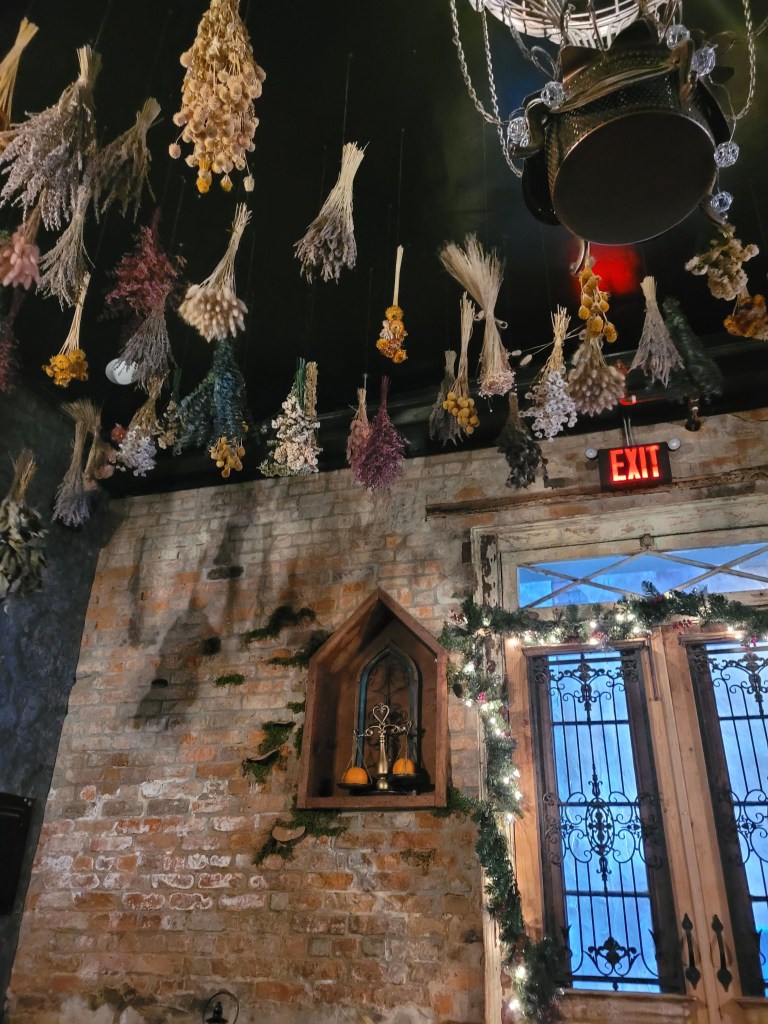
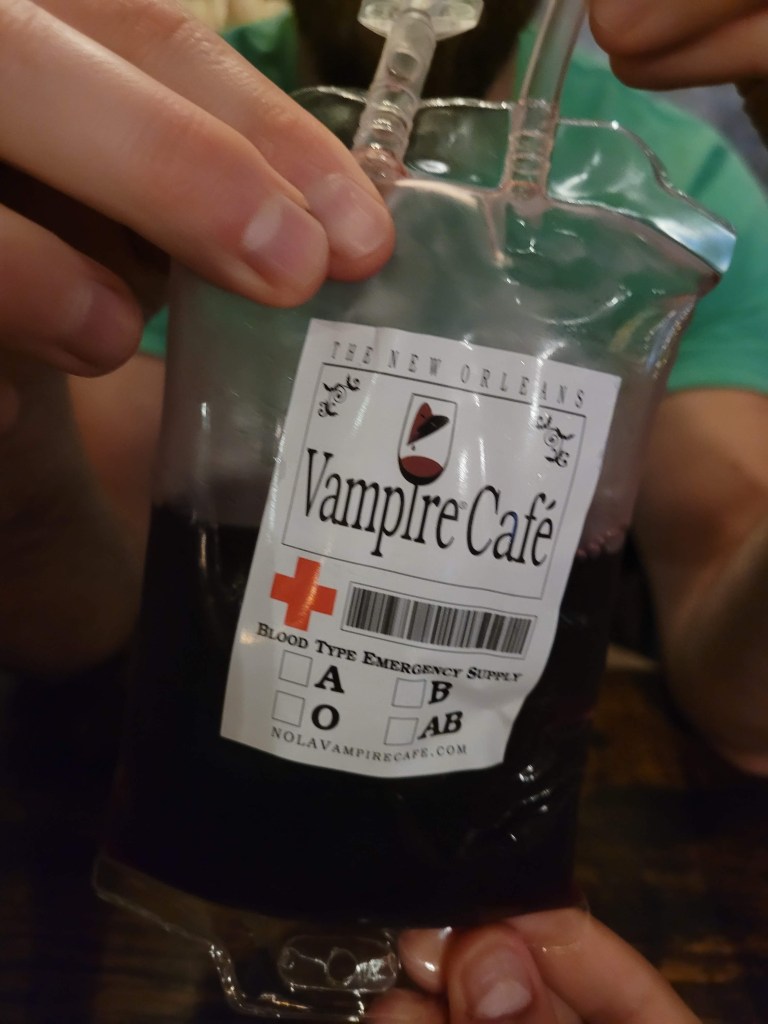
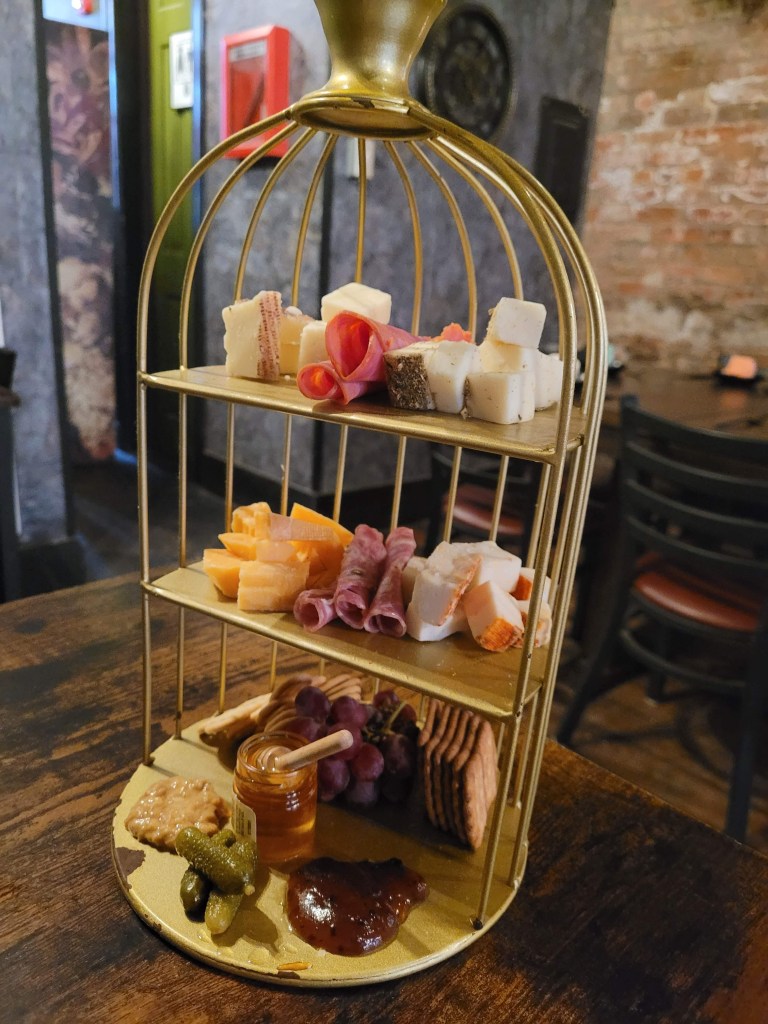
Eventually we stepped into a place that felt perfectly on theme for the day: The Vampire Apothecary Restaurant & Bar. There we ordered a “blood bag,” which despite its appearance was simply sangria, along with a charcuterie board.
Just as we were getting ready to leave, the waitress handed us a small card.
“This is a private invitation,” she said quietly. “A vampire speakeasy.”
She gave us a few directions and a password.
Naturally, we accepted the mission.
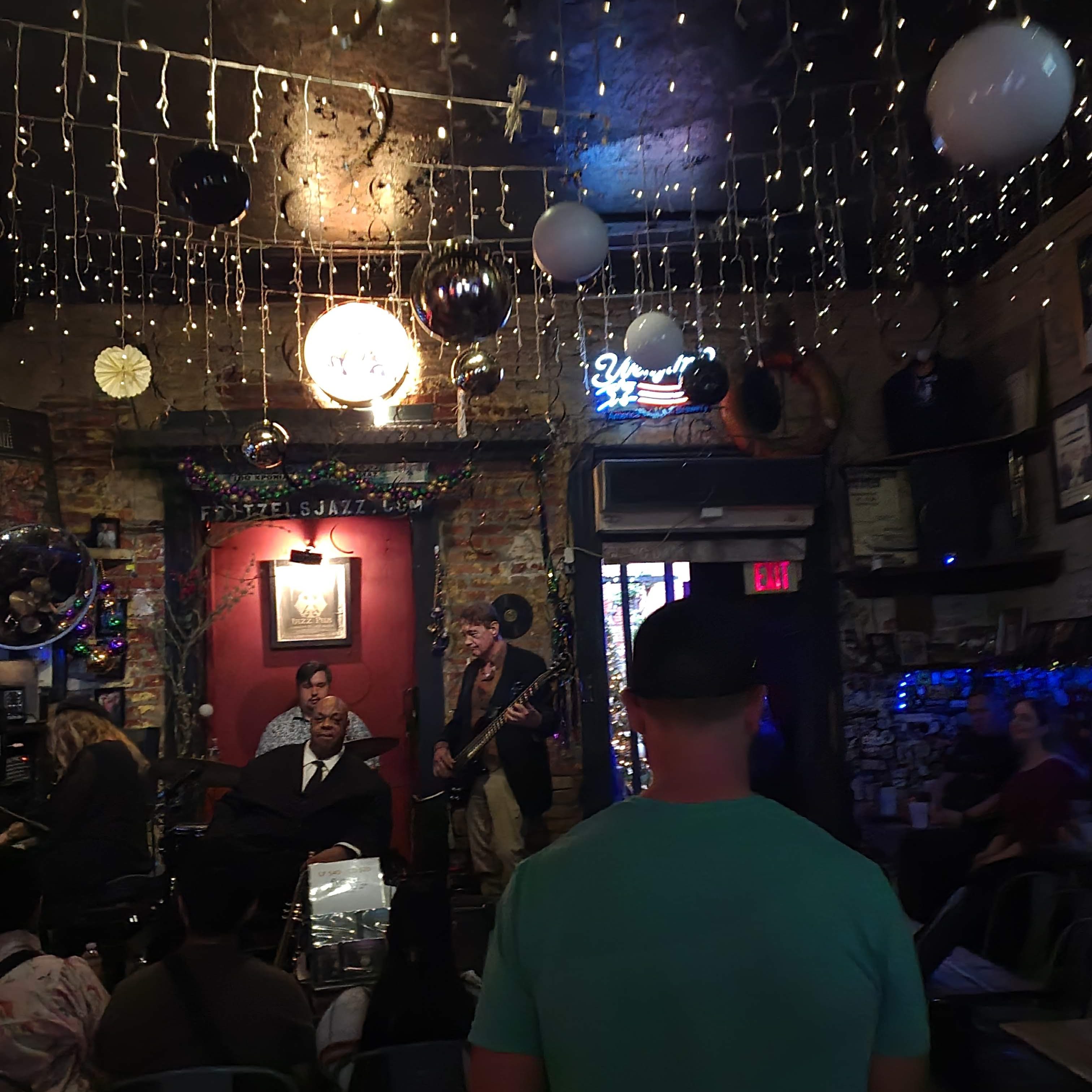
A few minutes later we followed the instructions on the card and made our way to the back of Fritzel’s European Jazz Pub. A dark hallway led us into a courtyard where the sounds of jazz slowly faded behind us. The space opened into a narrow, tucked-away patio framed by warm terracotta walls, strung overhead with soft, glowing lights that crisscrossed between a weathered tree and the surrounding buildings. Small metal café tables and mismatched chairs dotted the cobblestone ground, giving it an intimate, almost secret-garden feel. Potted plants clung to the walls, and a quiet stillness settled in. Chris looked confused.
I, however, immediately spotted him.
A man with long straight black hair sat beneath the dim courtyard lights, wearing a dapper vest and reading a book. For anyone who has ever read fiction, it was almost painfully obvious.
As I approached, he looked up.
Bright amber eyes stared back at me. Yes, I am fully aware they were contact lenses. But in that moment the theatrical illusion worked perfectly.
“The vampire sent us,” I said, giving the password.
He closed his book, stood, and gestured for us to follow.
Chris was still trying to figure out why I was talking to strangers as we were led through a service door and up a narrow, shadowy staircase. When the door at the top finally opened, we stepped into a dimly lit bar that looked as though it had been pulled straight from a gothic novel.
Candles flickered. Velvet furniture lined the room. Another elegantly dressed “vampire” welcomed us inside.
We ordered cocktails and stepped out onto the terrace overlooking Bourbon Street just as the sun began to set. From above, the chaos of the street below became almost entertaining. We watched the crowds swirl while enjoying the calm distance of our hidden perch.
Our final stop brought us to the Voodoo Lounge, where we joined a vampire and ghost tour through the French Quarter. As darkness settled over the old streets, our guide led us past flickering gas lamps and wrought-iron balconies, weaving through hidden courtyards and quiet alleyways where the city seemed to hold its breath. We paused outside centuries-old buildings as stories unfolded—tales of restless spirits lingering in former homes, whispered legends of vampires said to roam the Quarter, and eerie accounts tied to New Orleans’ deep-rooted voodoo traditions. At times, it was hard to tell where history ended and folklore began. We listened wide eyed, enthralled as we sipped on our hurricane cocktail while walking and taking in all this exciting and slightly terrifying storytelling.
By the time we finished the tour, the city felt even more alive with secrets. As if somewhere in the shadows a pair of amber eyes happened to be watching. Well… that would only be fitting in New Orleans.
(In Other News) The Less Than Ideal Situation When Living In Temporary Places
At our campground, one unexpected “side quest” unfolded just a few feet from our campsite. For several days in a row, we had heard the same neighboring camper erupt into loud arguments well past dark. The scene itself was puzzling. Over the course of a few days, we had spotted a rotating cast of people coming and going from the same worn, Breaking Bad-looking bus. A young couple, an older woman, maybe another young adult. It was never entirely clear who actually lived there.
By the fourth night, after being woken up yet again around 11 PM, Chris had had enough. He stepped outside and walked over, catching a glimpse through the back window as he approached. Inside, an elderly-ish woman with mousy brown hair and a cigarette in hand was mid-argument with a man he had never even seen before. For a brief second, they locked eyes, but Chris kept going and knocked firmly on the door.
When it opened, a young man stood there. Shirtless, slightly disheveled, pants half-buttoned, he carried himself with a casual indifference that made the whole situation feel unbothered. As Chris was about to start talking, he noticed a toddler along with a young woman sitting on the couch in the background. His tone shifted instantly. What could have been a confrontation turned into something more measured as Chris simply asked, “What’s going on here?” The answer came back dismissive. “You’ll have to take that up with them, bro,” before the door shut again.
Moments later, the attention shifted back to the rear window, where someone inside urged another to handle it. “Now he’s at our window, talk to him.” Chris hears right before a middle-aged man finally appears looking detached as his head pokes out the small camper’s window. When told the entire campground could hear them, he offered a casual apology, as if it were all far less disruptive than it felt.
And just like that, the window closed, the noise stopped, and silence returned. Still, the night carried a lingering unease. By morning, the decision felt obvious. We asked to move campsites, choosing distance, and leaving that strange unfortunate story behind us.
Flying Home For The Holidays
By the time this post goes live, we are well into March. (As my mom, who also happens to be my blog editor, lovingly told me the other day: You’re slacking!) But rewind a little, because our time in Louisiana actually overlapped with the holidays, which meant pressing pause on life on the road and hopping on a flight from New Orleans to Montreal to spend Christmas with my family.
Christmas and New Year’s in my family are not just calendar dates. It’s a full production. And while Louisiana gave us charming moments, like a Cajun Christmas market and towns dressed up in twinkling lights, I will admit… the lack of snow made it all feel slightly off-script. Festive, yes. But missing that white, cinematic touch if you know what I mean.
Cue our arrival in Montreal. As we made our way out of the airport, there they were. My parents, hopping out of the car with a handmade “Welcome home!” sign like we were long-lost celebrities returning from tour. Honestly, 10 out of 10.
Being back carried this warm layer of nostalgia, even though we hadn’t been gone all that long. Familiar stops quickly made their way into the schedule. A visit to Milano’s grocery store, then wandering through Marché Jean-Talon, with its rows of fresh produce and local vendors stretching in every direction. And of course, the essential stop at Alati-Caserta for cannolis and Italian pastries that somehow taste exactly like childhood.
Food. Drinks. Festivities. Repeat.
Thursday night supper, a sacred family tradition, set the tone. Cold cuts, Italian cold pizza, cheeses, salad, and wine. Lots of wine.
Christmas Eve brought midnight mass and was followed by Christmas Day, which meant gathering again. More food, more wine, and the annual emotional rollercoaster of watching old family DVDs. Nothing humbles you quite like early 2000s footage of your teenage self, full of chaotic energy and questionable fashion choices. A true reminder that growing up without social media was a gift.
Naturally, the one day Montreal decided to stage an ice storm was the exact day we had plans. Chris and I were meeting my uncle and aunt for lunch at Pizzeria 900 on Fleury Street. We parked the car and quite literally ice skated our way across the street, clinging to balance and dignity, before settling in for, you guessed it, more food and wine. There is a very clear theme to my visits home, and I stand by it.
During these visits, Chris is not only my husband and travel partner, he is also the official family IT department. Because if you work in tech, you do not simply visit family. You troubleshoot. Within hours, he found himself on the phone with Videotron customer support, trying to solve the mystery of my parents’ unreliable Wi-Fi.
To be fair, the real issue might be less about the internet and more about my dad’s… commitment to outdated technology. The man operates on a strict “if it still turns on, it’s fine” policy, only considering upgrades once things have fully collapsed. The term of endearment is “the Camplani way” for these instances. Thankfully, my tech-savvy uncle has been slowly dragging him into the modern era over the years, including the legendary moment he gifted my dad his first flat-screen TV approximately two decades after the rest of society had made the switch.
All in all, it was the perfect holiday intermission. A little snow, a lot of wine, and just enough chaos to remind me exactly where I come from.
Driving Back To Minnesota
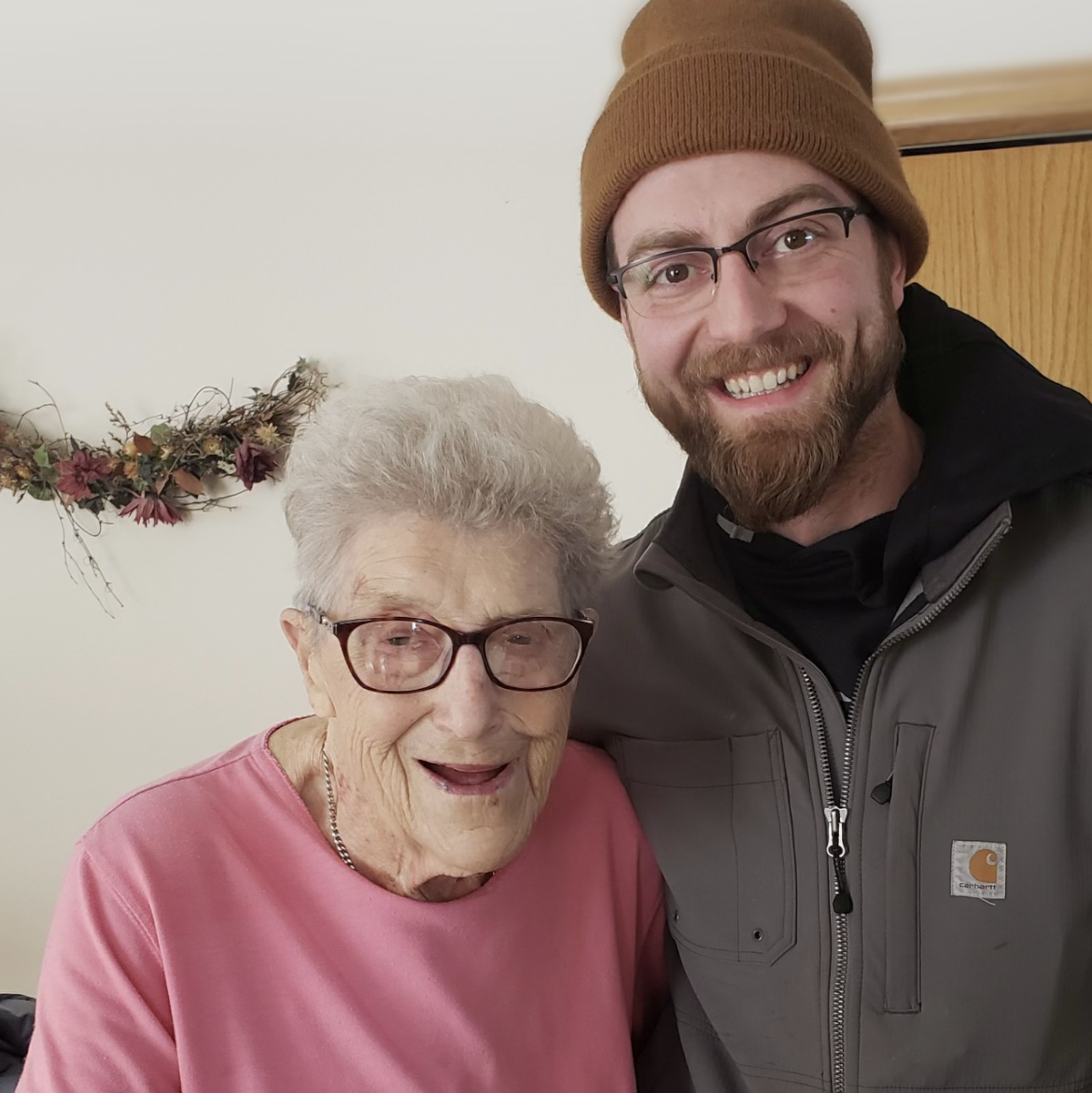
During the holidays, we received the call that Chris’ grandmother, Dorie, had passed. Ninety-six years old. What a long, full, and deeply lived life she had.
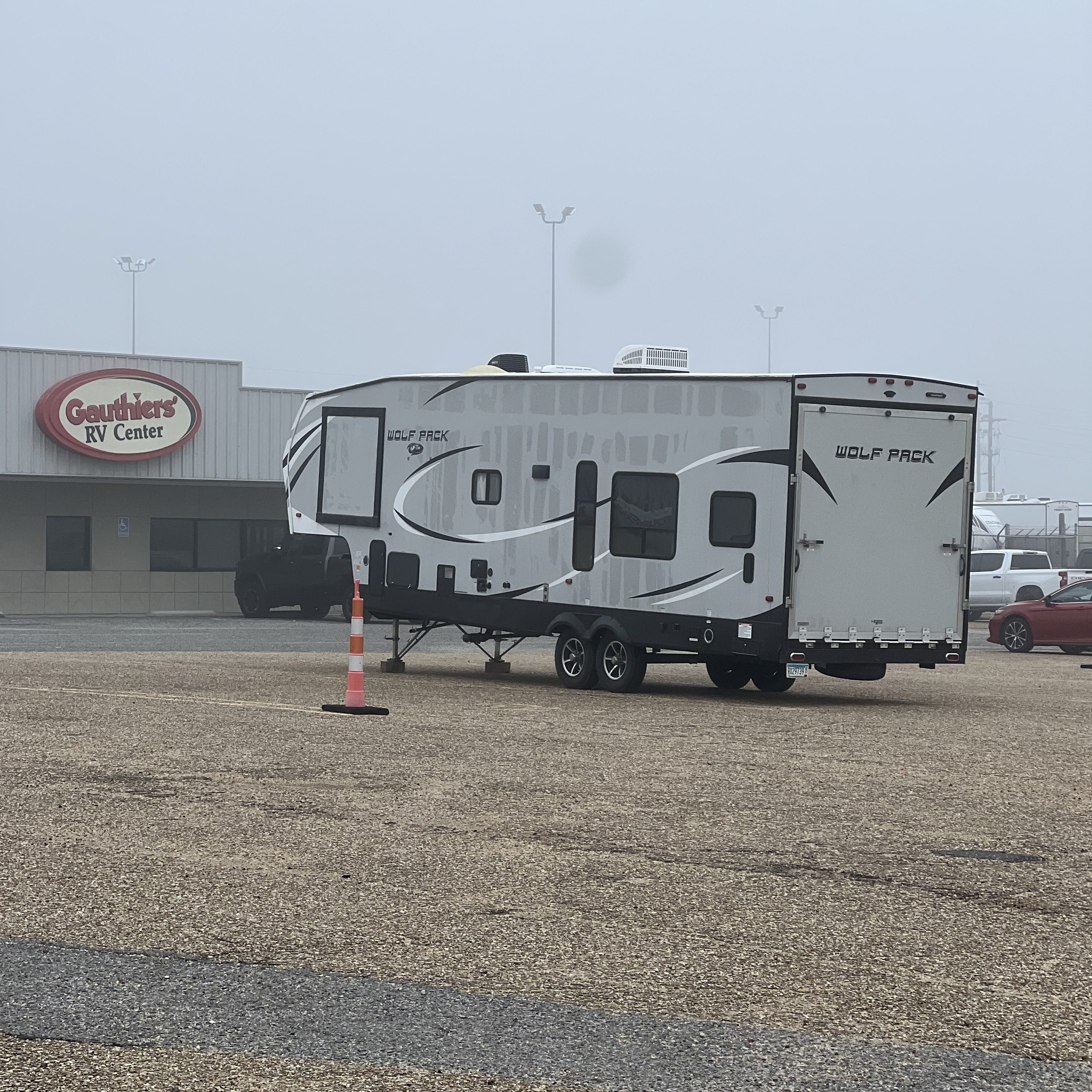
There wasn’t a moment of hesitation. We immediately shifted into logistics mode, figuring out how to get back to Minnesota in time for the funeral. Our campground dates were about to expire, but somehow everything fell into place. We found an RV repair shop that could take the Bus in for bearing maintenance1 while we were gone. There was no way we would be driving it through a Midwestern winter.
Gam Gam, as we called Dorie, was the heart of the Sundeen family: the matron in every sense of the word. A stubborn and fiercely independent woman, she was always there for others: her family, her church, her community. She loved sewing and spent countless hours making quilts and garments, many of which she donated to organizations supporting people in need. It was just one of the ways she cared for others.
She always welcomed you into her home and made sure you never left hungry. Her pickle spread, a steady supply of sweets, and coffee were simply part of the experience of being with her.
What always amazed me was her memory. She was unlike any person I’d ever met. She could recall stories, names, connections across an incredibly large family tree. The kind of family where you half-jokingly request everyone wear name tags.
The service was held at the Catholic Church she had attended for so many years. Before entering, we gathered in the main entrance and I observed an entire family dressed in formal black. For a group that usually abides by a casual dress code, it quietly spoke volumes about the respect and love everyone had for her. The priest shared stories of her life, highlighting the many ways she had touched those around her. Several of her grandchildren, including Chris, read passages she had chosen herself; some of her favorites, we later learned. It was a lovely service in honor of a wonderful woman.
At the cemetery, the Minnesota wind was sharp and unrelenting, the kind that cuts right through you. We gathered closely under the tent as the casket was lowered beside her late husband. One by one, the grandchildren and great grandchildren stepped forward, each taking a flower from the bouquet and placing it gently onto the casket as we all said our final goodbyes.
In true form, she had planned every detail of her funeral. Even the meal that followed was made up of her favorite dishes, giving everyone a space to come together, share stories, and honor her life and legacy.
A final gesture. Simple, quiet, and full of meaning.
We received a call from the RV shop during our 3-day drive back to Minnesota informing us that they no longer were able to perform maintenance on the Bus. A rather disappointing turn of events, but that still allowed us to have the Bus securely store FOR FREE while we were away… So kind of a half win, then.
Maine and Nova Scotia. It’s surprising how two coastal regions along the same Atlantic stretch can be so different. The very air tells two stories.
In Maine, the salt in the breeze is clean, briny, and threaded with the faint scent of seaweed sunning on the shore. It’s the kind of classic “ocean smell” people picture when they dream of the coast. The contrast is small but unmistakable. Maine’s air feels gentler, mellowed.
Driving along, the coast reveals another set of differences. Maine’s houses have that iconic New England charm with weathered cedar shake siding, dark shutters, and an understated color palette shaped by storms, salt, and tradition. Many homes feature radiant “sun face” wall ornaments—technically called sunburst wall plaques—watching over wide porches. According to Wikipedia, they symbolize warmth, energy, happiness, and positivity, often inspired by ancient solar deities and cultural beliefs in good luck and abundance. It’s a look that feels old-school, nostalgic even, especially as the road winds toward each mountain peak.
Long Live The Daily Hike
When one gets in the habit of hiking, it brings you into an almost addictive headspace. Where the streak must be continued. Every day feels incomplete without at least a few miles on a trail. Your cardio gets better, your balance improves, and even the hiking sticks start to feel like extensions of your own rhythm.
With time, you begin to understand the personality of different trails—how “moderate” can mean anything from a pleasant forest walk to a full quad workout; how elevation gain written on a map never truly reflects how steep a climb feels when your breathing quickens. There were a few hikes I had planned that ended up taking much longer than expected. Some even pushed us past sunset, turning into careful nighttime descents lit only by headlamps.
Those after-dark hikes were a first for me. The forest shifts at night—the temperature drops, the birds quiet, and every rustle feels amplified. My knees, already a bit weak and jumbled from hours of stepping over roots and rocks, protested with every uneven stretch. The already difficult task of placing each foot over obstacles rather than into them became even more challenging as the sun slipped behind the tree line.
But there was something strangely calming about it too. With our headlamps cutting narrow beams through the darkness, the world shrank into a tunnel of light. Step, plant, breathe. Step, plant, breathe. Mile after mile, we made our way back to the truck—slowly, steadily, and somehow feeling more alive than we had at the start. Especially when the unmistakable howl of coyotes echoed in the distance.
Saturdays Are For Long Hikes
Then came the Saturday that will forever be known as THE LONG HIKE.
I had planned what I thought would be a challenging but reasonable nine-mile route. Nine miles didn’t sound like much, mostly because my brain still insists on converting everything into kilometers and convincing me it’s shorter.
The logic was simple: We had a full weekend to rack up miles and conquer peaks. And for some reason, it had evolved into this unspoken competition with ourselves—pack in as much as possible, squeeze every ounce out of daylight. So much for nature’s calming influence.
As we approached the trailhead I’d pinned on our map, two crucial factors had been conveniently ignored: the time and the day. We left for the trail at 10 a.m. on a beautifully sunny Saturday in Acadia National Park. Peak weather, peak season, peak foolishness. Naturally, the parking lot I aimed for was completely full.
Time for Plan B.
We kept driving up the winding road along the base of the mountains, searching for any sliver of available space. The next lot was also full—but there were cars neatly lined along the shoulder of the road. Perfect. We joined the single-file pilgrimage, creeping forward until we hit a stark sign that read: “NO PARKING BEYOND THIS POINT.” Because we are eternal optimists, we tried our best to wiggle our big truck behind the sign, but also dangerously close to the front bumper of the car behind us.The front cab and hood of the truck were definitely flirting with illegal territory, while the bed of the truck was defiantly sticking out. If you squinted, we were good. Technically. Kind of.
As it turns out, nine miles was actually fourteen miles once the full route revealed itself—twenty-two kilometers. That mathematical betrayal hit us only after the fact.
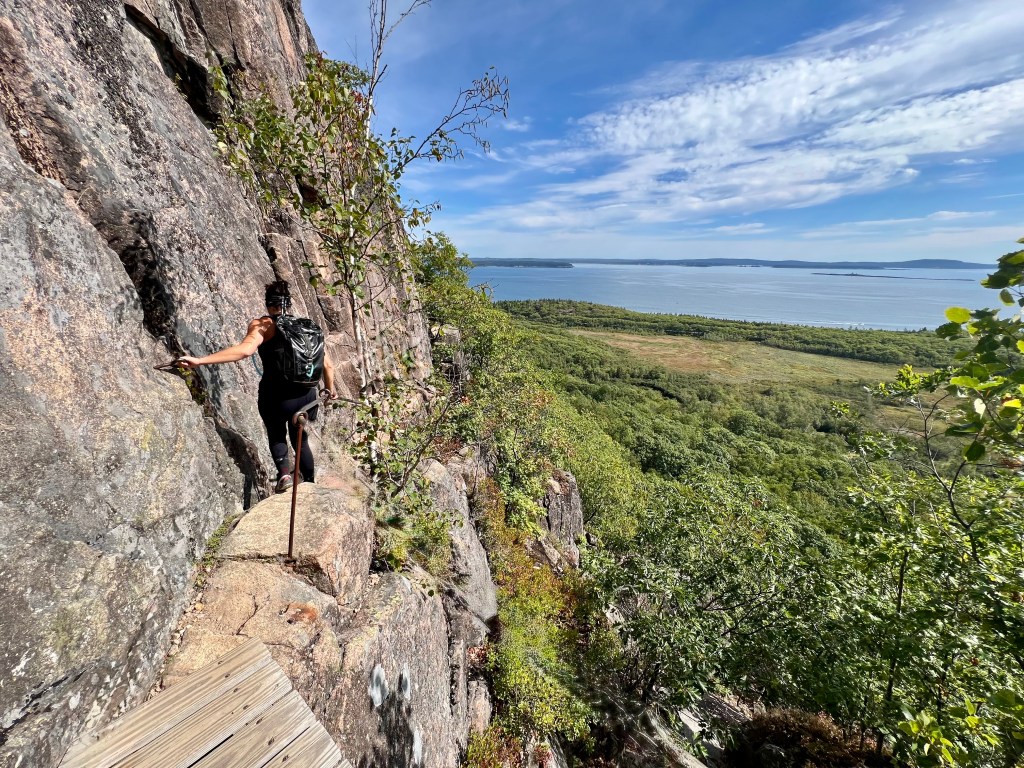
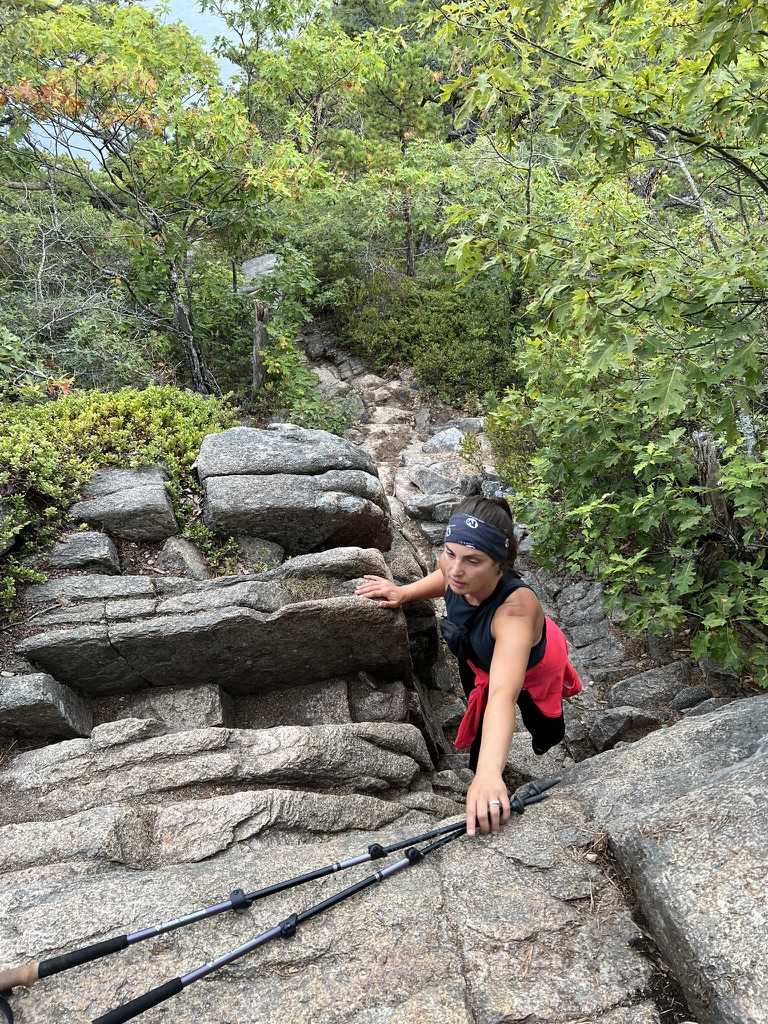
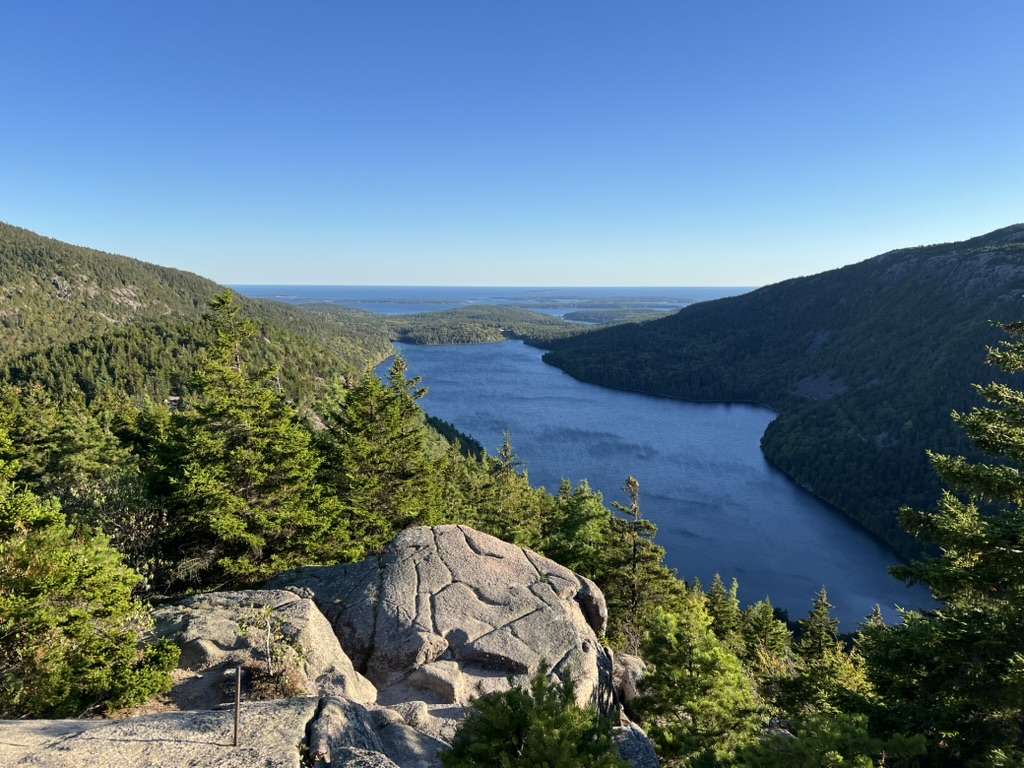
We began with the famous Precipice Trail, which turned out to be exactly what the name promises, with absolutely no false advertising. The route climbs almost straight up, rising over iron rungs bolted into the cliff face, threading narrow ledges that press your spine against granite and dare you to look down. The views are spectacular. Every downward glance delivered a pleasant surge of vertigo and the reminder that gravity is a very real concept.
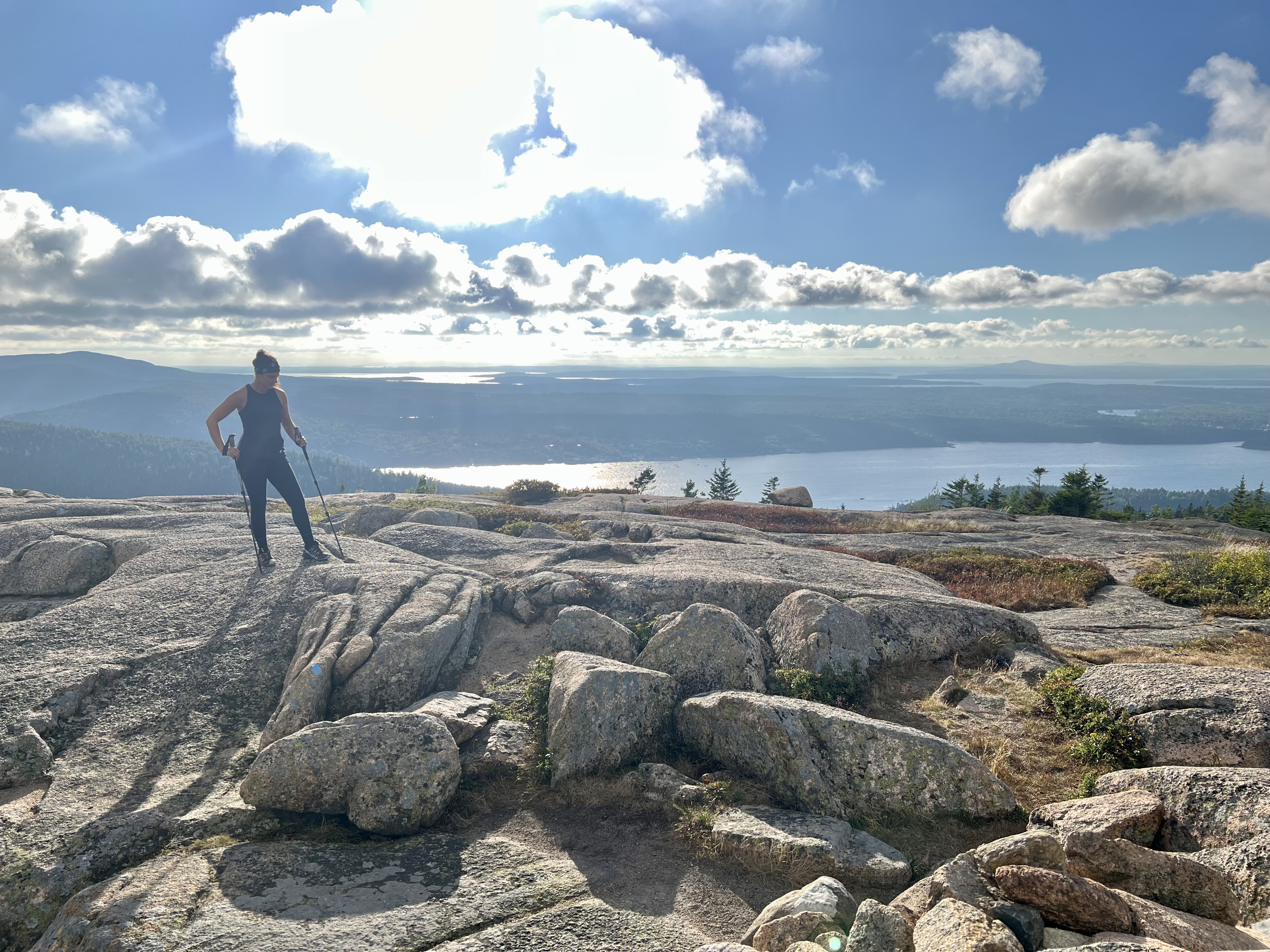
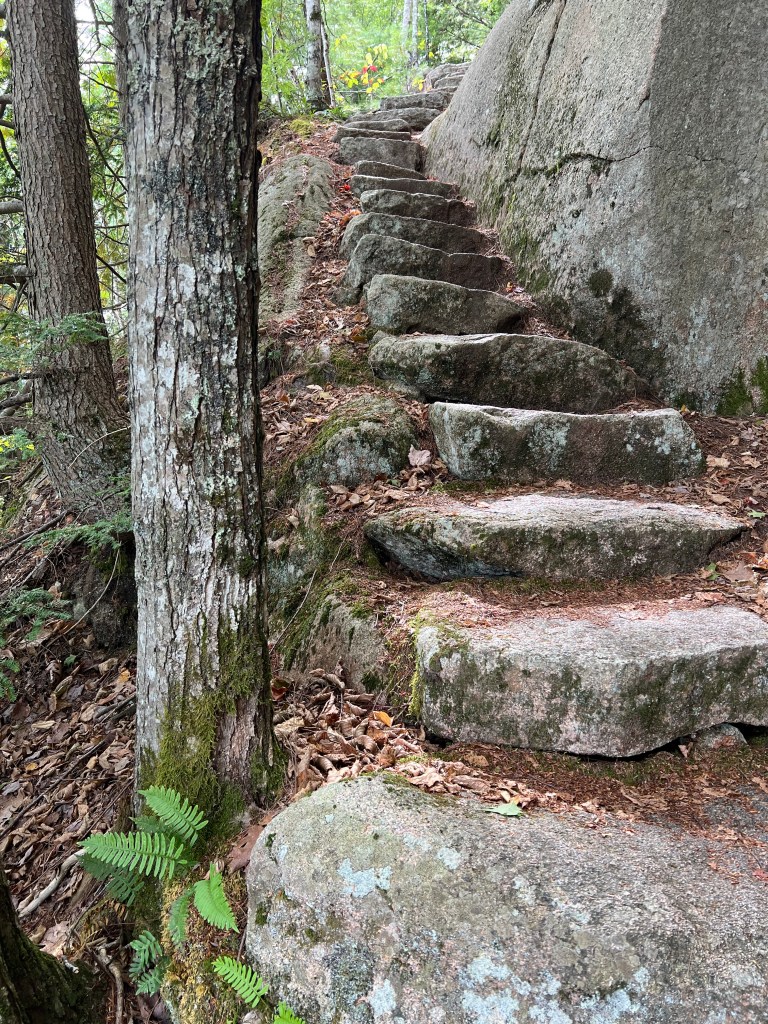
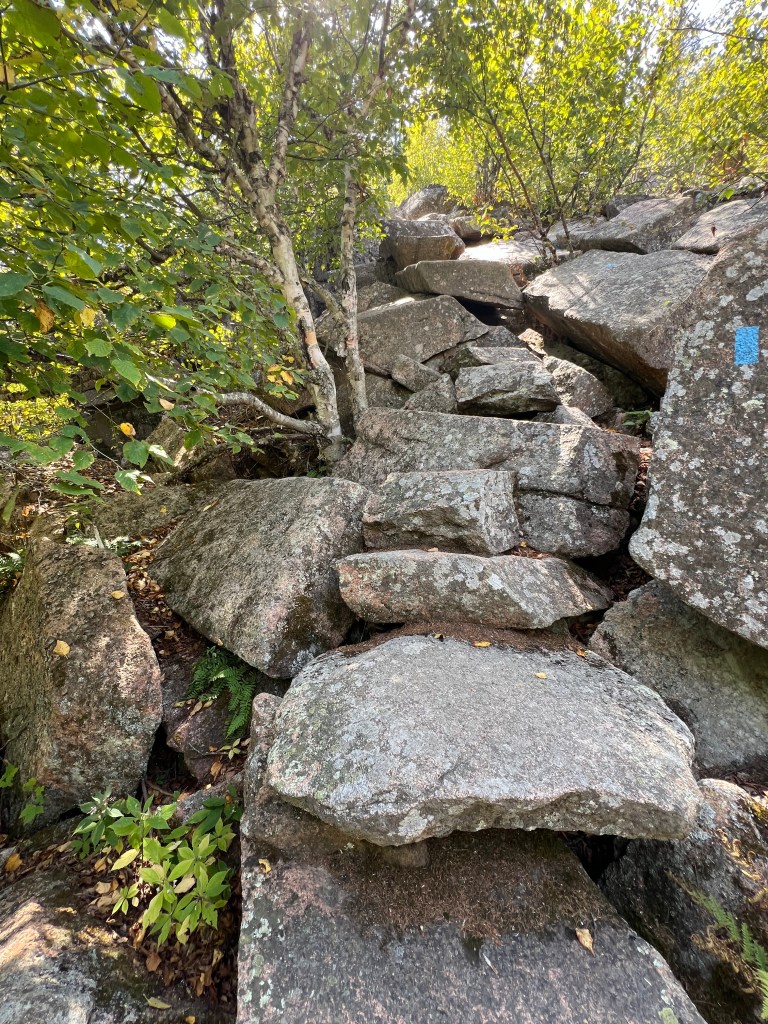
As we continued our quest for spectacular views atop mountain peaks, we had the privilege of hiking up various types of terrain. Among them, the rock staircases varied wildly—some neatly arranged like nature’s version of a gym circuit, others complete free-for-all scrambles. We followed the painted blazes, trusting that they knew where the trail was supposed to go even when our legs questioned why we were going there. Each step was a fresh reminder that glutes and calves are both heroic and dramatically petty when pushed too far.
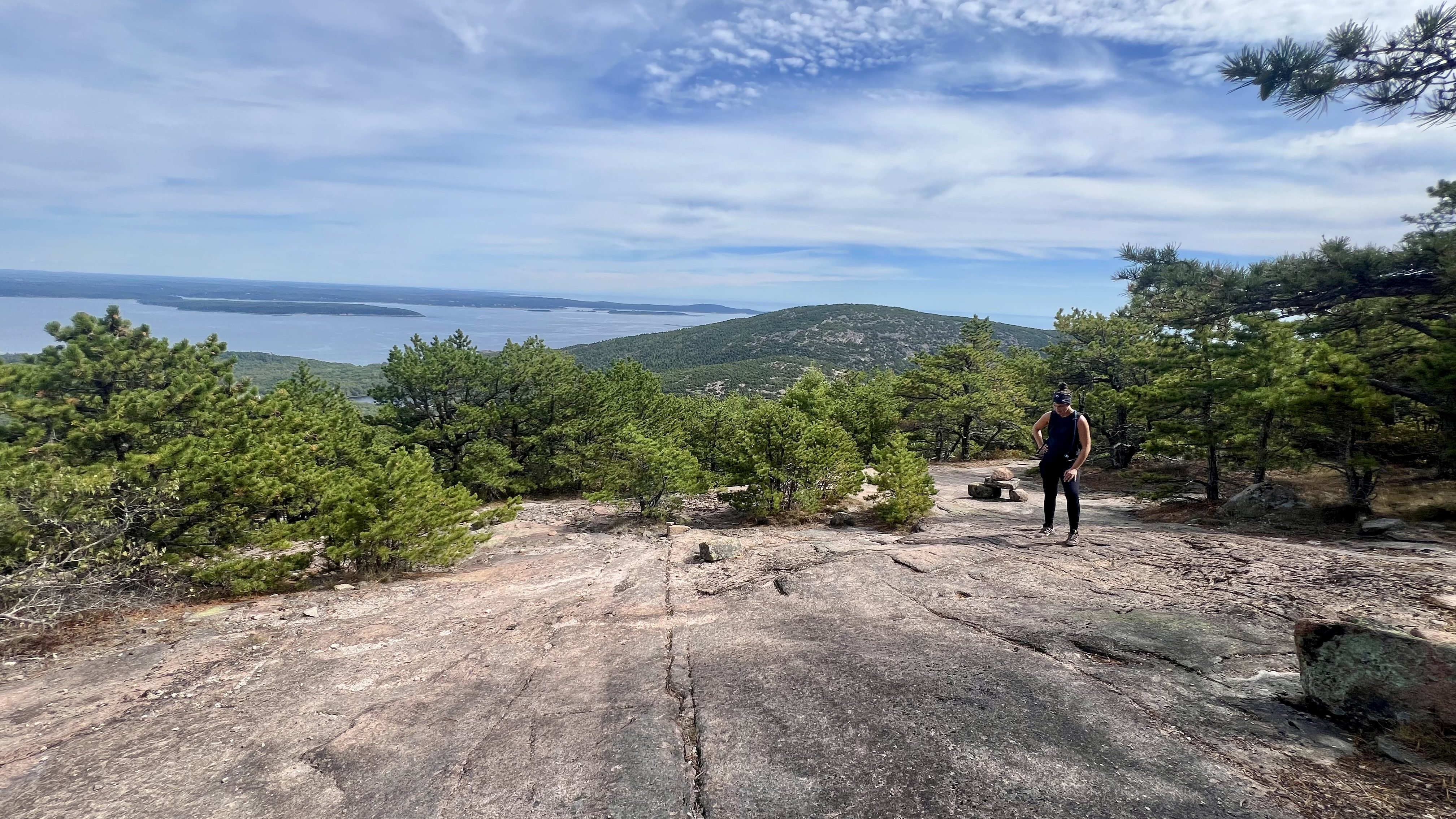
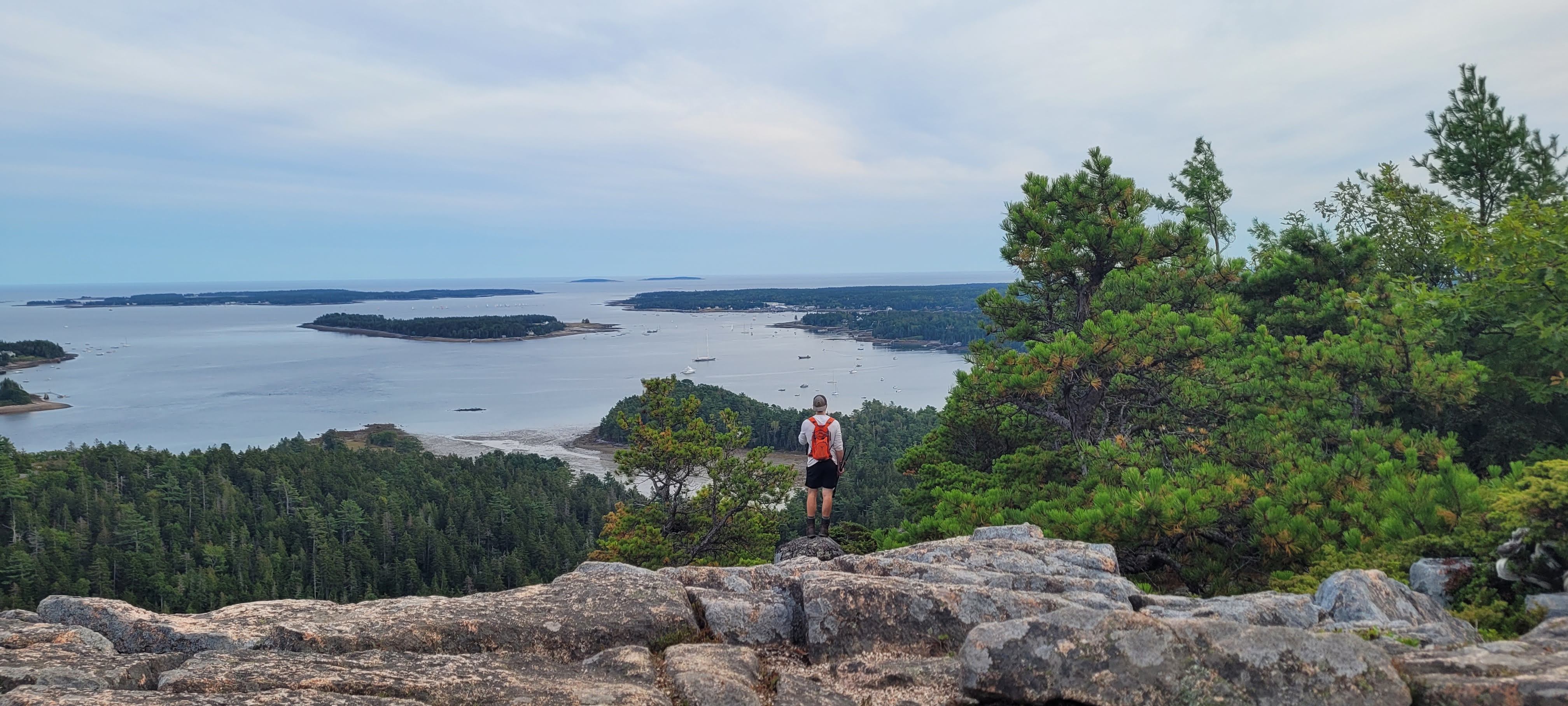
The trail stretched on far longer than expected. Every section seemed to open into yet another—another ridge, another scramble, another false sense of nearing the end. Hours passed. Eight of them, in fact. By the time we emerged from the last segment, every muscle in my body was trembling. But the vistas were indescribable, the kind that make you stop mid-sentence. The fellow hikers we met along the way were wonderfully kind with little bursts of camaraderie. Quick smiles, encouraging words, that unspoken “we’re all in this together” energy that happens when strangers become temporary teammates.
One man, cheerful and sweat-soaked like the rest of us, recommended a brewery near our campground. “Great pizza. Great beer,” he said. “If you’re into that kind of thing.” Well. He spoke directly to our souls.
The scenery almost erased the discomfort (almost) until we climbed back into the truck and my legs staged a mutiny. The photos taken that day capture the entire emotional arc: hopeful excitement, mild concern, worsening concern, full existential questioning, then the hollow-eyed perseverance of someone who just wants a sandwich and a soft surface.
And while we’re on the subject of photos—how do influencers look effortlessly radiant at the summit? I look like I’m molting. The moment the incline begins, I turn into a sweaty, frizzy, tomato-tinted creature that no filter can save. Any action shot of me requires distance. Dramatic distance.
That’s me. Clearly in the “questioning my life choices” phase of the hike.
The final leg of the journey wasn’t even on the trail—it was the long walk along the pavement back to the truck, since to Precipice was a one-way climb. Every passing car was a temptation. A tiny part of my brain whispered, “Flag them down. Hitch a ride. No one will judge.” But then the stubborn part kicked in, and we marched on, fueled by the promise of beer and something carb-loaded. My internal mantra became a chant: pizza and beer, pizza and beer, pizza and beer. Sometimes survival looks like determination; sometimes it looks like food-based affirmations.
By the time we finally spotted our truck in the thinning row of cars, we remembered our questionable parking job. A group of hikers ahead of us noticed too—they paused, laughed, tried to take a picture. Chris, being the embodiment of Minnesota Nice, shouted a joking “Hey! That’s ours!” They burst into laughter, relieved to find the renegade parking belonged to someone whose day had clearly been as long as theirs.
Like us, they were coming to the end of a long day, some of them barefoot now because their shoes had surrendered earlier. Before I could blink, Chris offered them a ride to their campground. Five of them piled into the truck bed like a scene straight out of a feel-good movie. I could hear their laughter trailing behind us, wind tossing their voices around. When we reached their stop, one of them gave two taps on the roof (classic signal) before hopping out with heartfelt gratitude. In moments like that, the world feels small in a good way.
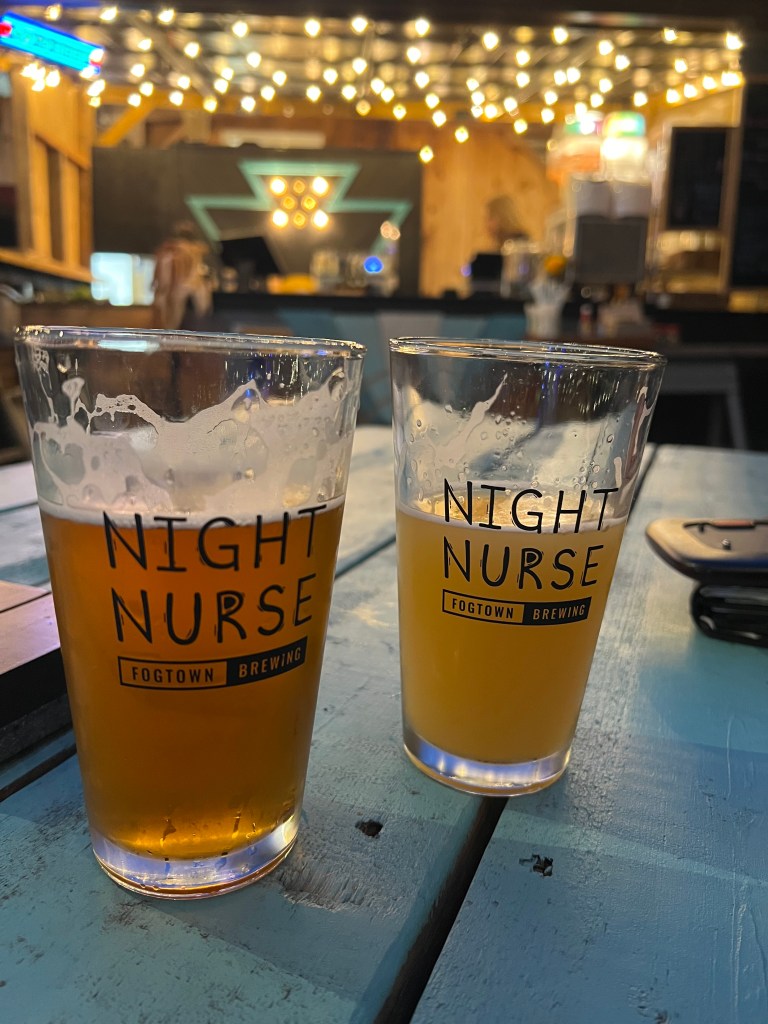
And then, finally, the reward: Fogtown Brewery. Live music drifting through warm air, tiny pixie lights hanging above the patio like glowing fireflies, the smell of pizza that could revive the dead. We devoured slices, sipped cold drinks, and let the day settle into memory.
That meal tasted like victory. Like exhaustion. Like pure contentment. It tasted exactly like THE LONG HIKE deserved.
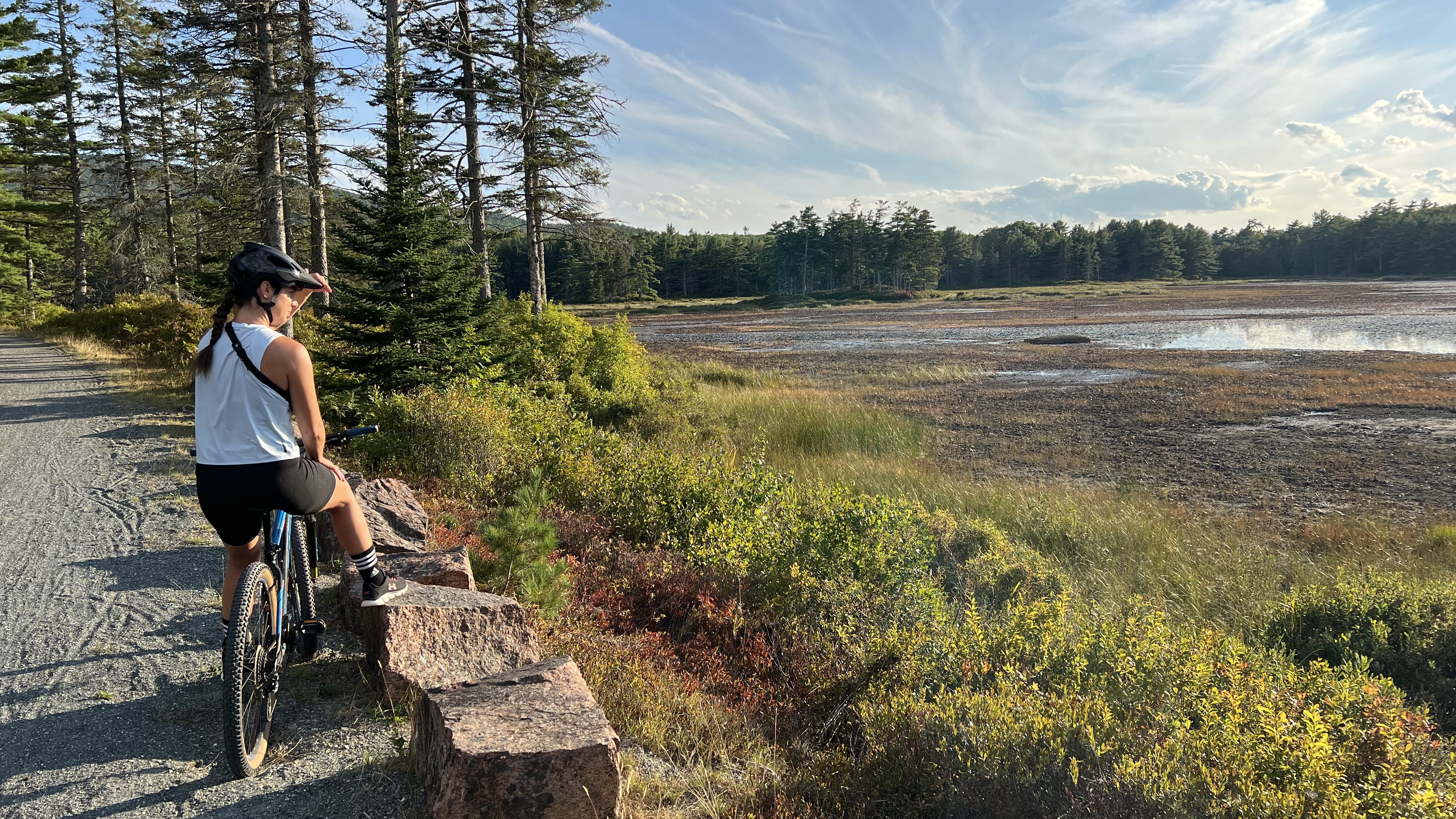
The next day’s planned hike was quickly forgotten and instead we decided to take a very leisurely bicycle ride on carriage road, where we gave our bodies some well deserved rest, but also kept ourselves moving to keep the streak going.
The Particularity of Our Campground
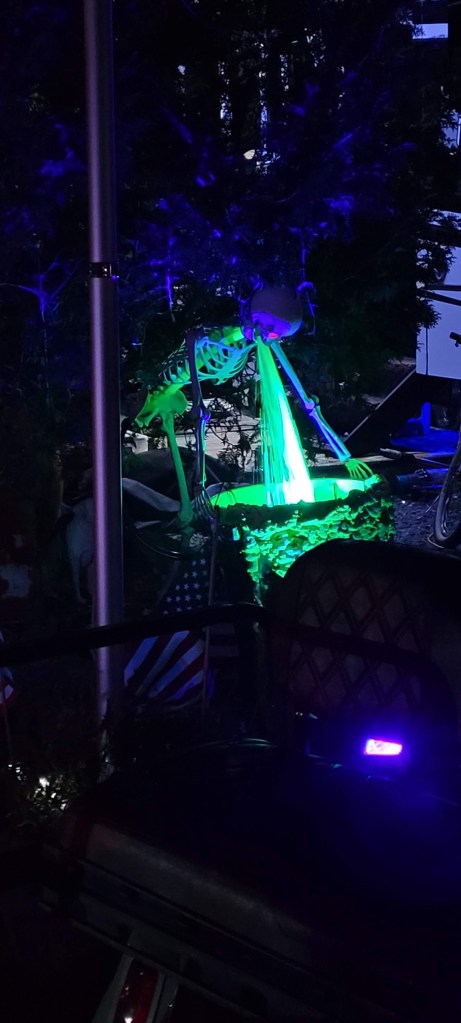
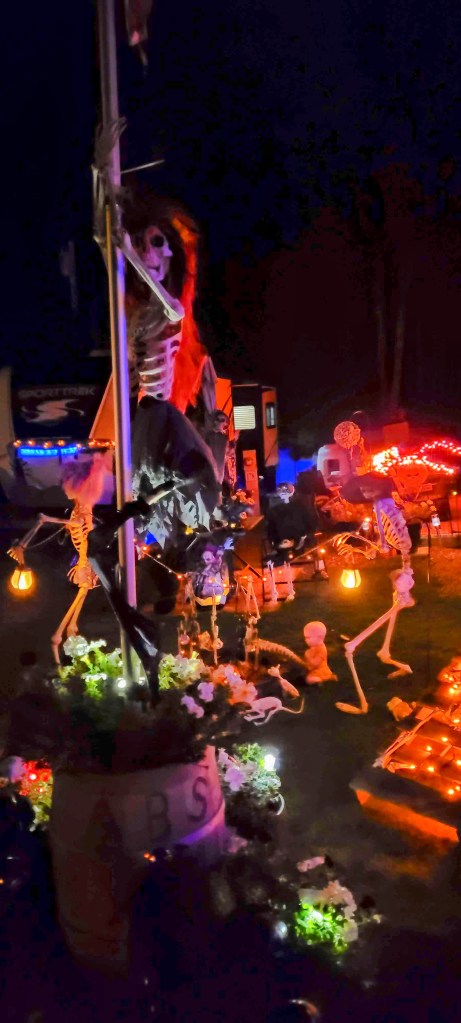
One thing we quickly learned about campgrounds in Maine is that the calendar runs a little differently—especially when it comes to Halloween. Apparently, Halloween happens in September. Not officially, of course, but in practice. And honestly? As a super-fan of anything spooky, eerie, pumpkin-themed, or glow-in-the-dark, it felt like a cosmic gift.
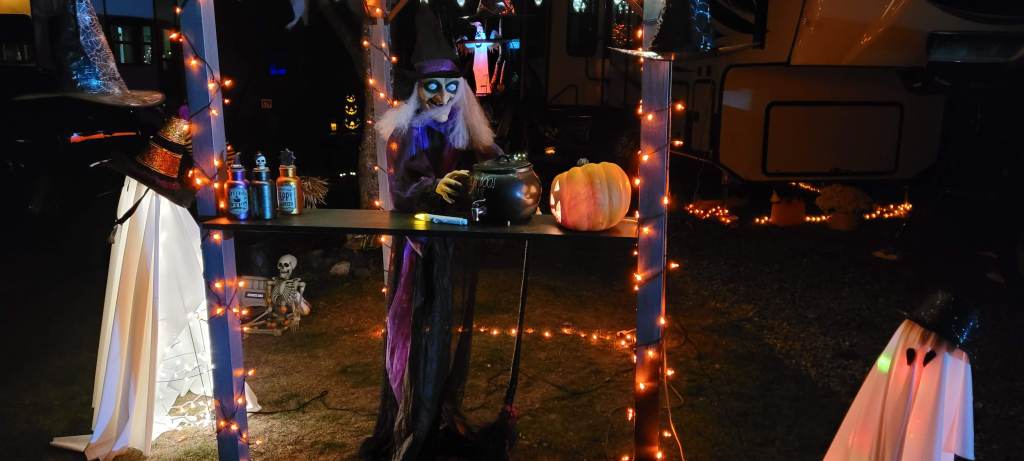
The first clue was subtle: a few pumpkin lights strung around a camper, a witch’s hat perched suspiciously on a picnic table. At first, I thought people were simply getting an early start. But then the decorations ramped up—fast. Campsites transformed into full-blown Halloween displays overnight. Motion-activated skeletons jerked to life as we walked past, their red eyes glowing like something out of a low-budget horror film. Ghosts swayed in the trees. A fog machine hissed to life in the evenings, rolling smoky tendrils across the gravel like a scene from a haunted carnival.
By the second night, it became clear this wasn’t just enthusiastic decorating—it was a tradition. Entire families returned each year specifically for “Campground Halloween,” a weekend of spooky lights, potlucks, costume parades, and friendly attempts to outdo each other. And honestly? It was magical. Something about being surrounded by twinkling lights, cackling animatronics, and grown adults who take their skeleton displays very seriously made the whole place feel like a cozy, festive micro-universe.
Maine Hospitality Comes in a Bowl of Mussels
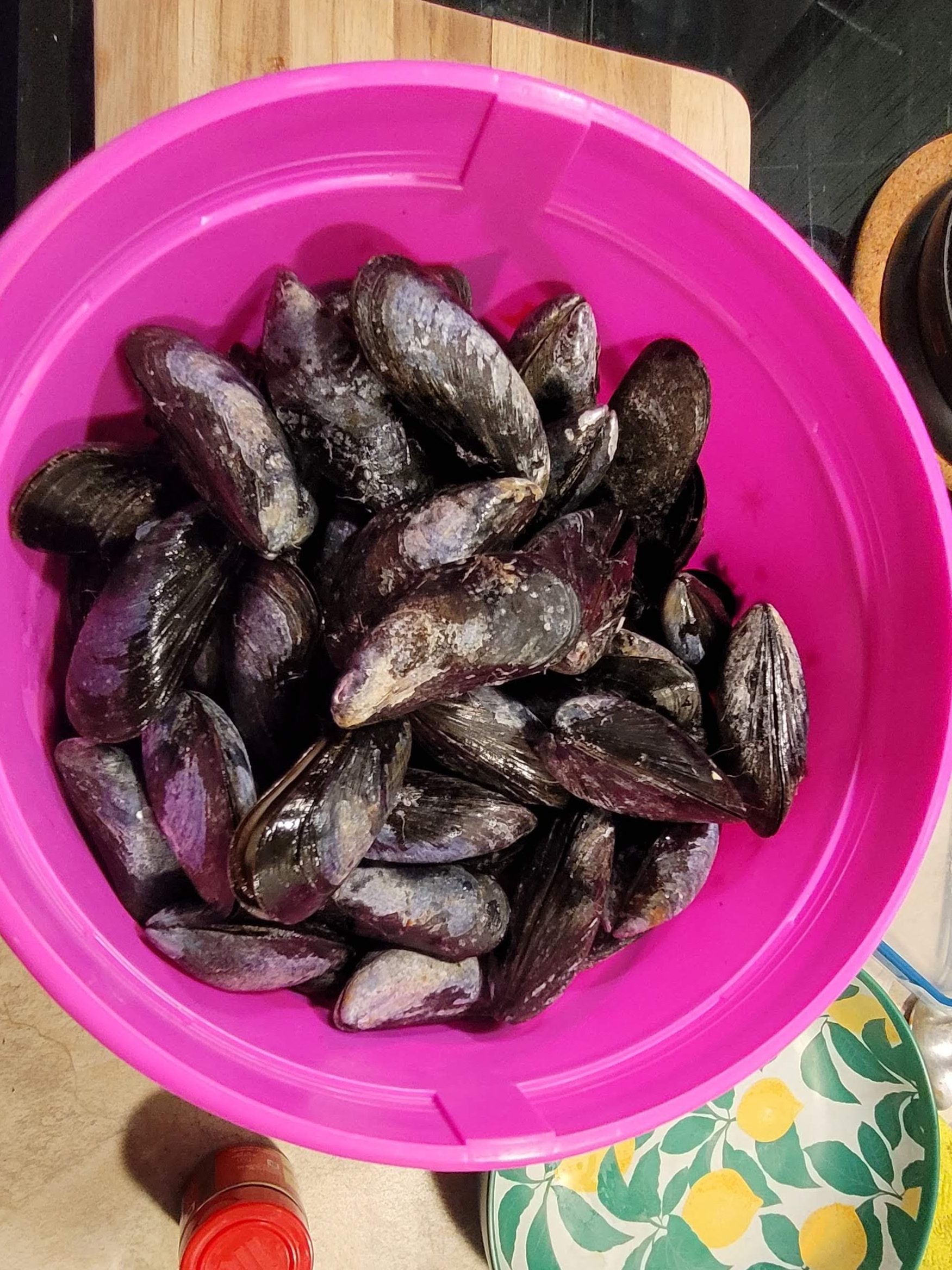
On our final evening, the universe handed us yet another surprise—this time in the form of food. One of our neighbors, who had been out fishing the day before, knocked on our door holding a bucket the size of a kid’s Halloween candy pail. Inside: mussels. A lot of mussels. Apparently, he had caught far more than he and his family could eat and figured we might be up for a fresh seafood feast.
Cue me speed-scrolling through Pinterest for a recipe while trying to remember what pots we actually had with us. Remember a few chapters back when I mentioned that we packed minimally? Well, that included bringing only three out of our four pots and pans. Thankfully, one of them happened to be the biggest pot we owned, and it just—just—fit enough mussels for two people.
The cooking process turned out to be wonderfully simple: clean, steam, and serve. I melted an embarrassing amount of butter, added garlic (for culinary confidence), and crossed my fingers. In minutes, the shells opened, releasing that salty, ocean-fresh aroma that instantly makes you feel like you’re doing something right.
We sat outside at our little campsite table, surrounded by the glow of Halloween lights and the faint echo of a distant fog machine, digging into a bowl of mussels that tasted like pure East Coast charm. Chris slowly acquired the taste—hesitant at first, then increasingly enthusiastic as he realized dipping anything into butter and garlic is practically cheating.
By the end, we were full, happy, and deeply grateful. Not just for the food, but for the generosity of strangers and the small, unexpected moments that make travel feel less like being on the road and more like being part of a community.
Little Motorcycle Rides in Maine
During our three-week stay, we didn’t end up venturing onto any off-road trails with the bikes—something we usually chase whenever we’re in a new region. But honestly, the paved routes around Acadia National Park, the Schoodic Peninsula, and even Deer Island had their own kind of magic. Sometimes a calm ride is exactly what the moment calls for.
Riding through Acadia National Park feels like gliding through a moving postcard. The Park Loop Road twists along rugged cliffs and dips into stretches of dense forest where the scent of pine becomes almost heady. Every few miles the trees open up to reveal glittering blue ocean, granite ledges, and distant islands that look like they’re floating. Even at lower speeds, the road’s gentle curves give that satisfying lean that makes a motorcycle feel like the perfect way to experience the landscape. There’s a peaceful rhythm to it—uphill, coastal view, downhill, forest shade, repeat.
The Schoodic Peninsula was a completely different vibe—quieter, moodier, and more remote. The roads here are wide and smooth, with long stretches where you hardly see another vehicle. It’s the part of Acadia that most people skip, which makes the ride feel like a secret you’ve stumbled upon. Black volcanic-looking rock lines the shoreline, waves constantly crashing against it. We stopped to enjoy the scenery and were greeted by grey seals in the distance. Just a small part of their heads were sticking out of the water. Their eyes followed our movements as we found a comfortable rock to sit on and quietly take in our surroundings. Riding with the sound of the waves in the background, and the salty mist occasionally brushing your face shield, made the whole loop feel cinematic. It’s a place where your mind slows down and your shoulders drop a little without you even noticing.
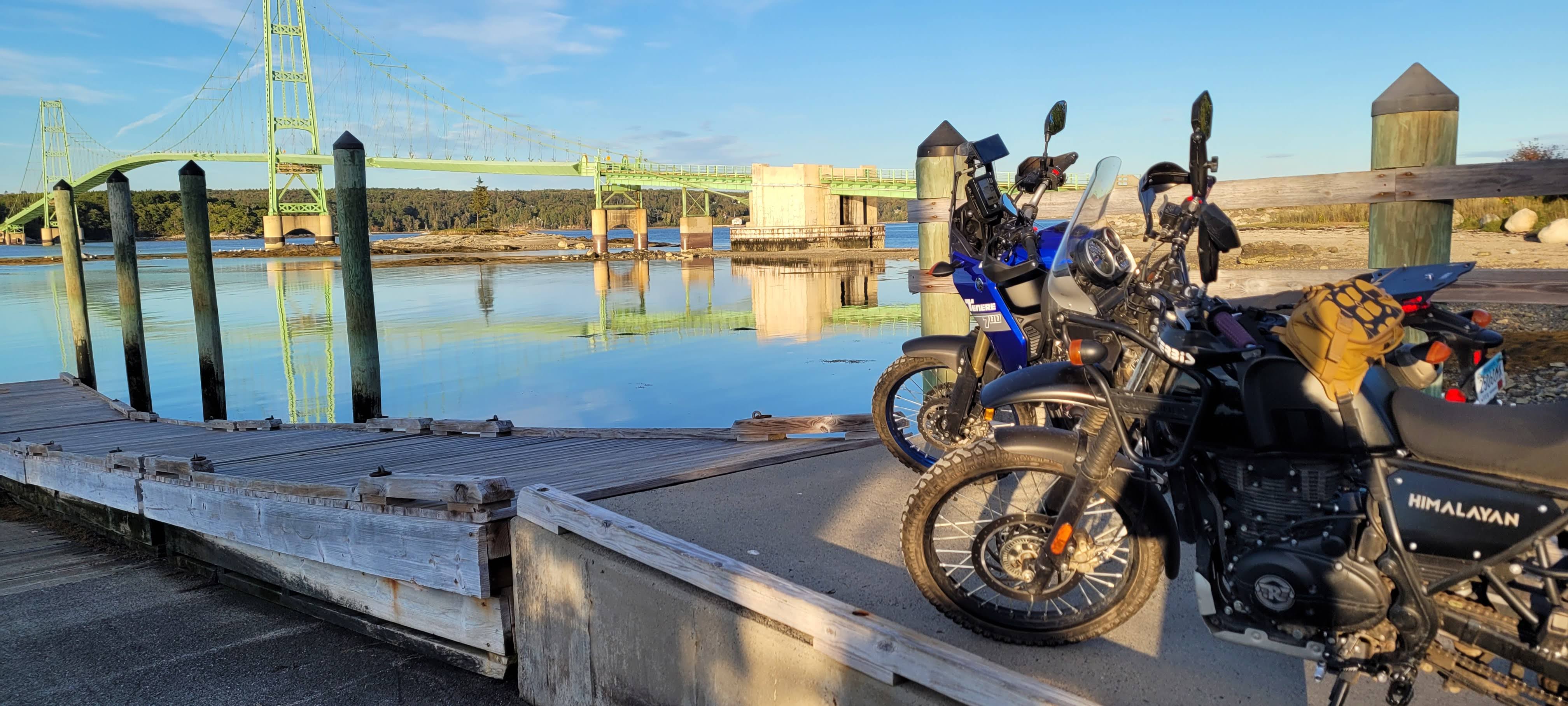
Our favorite unexpected ride was Deer Island. The route takes you through small fishing towns, over bridges that hover above quiet inlets, and past clusters of weathered boats anchored close to shore. It’s the kind of ride where you follow the road simply because it’s beautiful, not because there’s a particular destination waiting at the end. The island itself has a slower heartbeat—calm roads, gentle hills, and scenery that feels untouched. No rush. No noise. Just the hum of the engine and the soft roll of the Atlantic in the background.
Even without the thrill of off-roading, those weeks of riding were memorable for their easy pace. Each route offered something a little different—ocean views, coastal cliffs, fishing villages, forests—but all of them shared the same quiet, grounding charm. Sometimes the best rides aren’t the most technical ones; they’re the ones that simply let you breathe, look around, and enjoy the place you’re in.
And just like that, our stay in Maine came to an end. Between marathon hikes, coastal motorcycle rides, and unexpected seafood feasts, it’s safe to say the state kept us well-entertained. Tired… but entertained.
But the road doesn’t slow down for long. With the Bus hitched and the bikes strapped in, we’re pointing our compass toward Pennsylvania next—ready to trade ocean views for forest trails and ride the Backcountry Discovery Route loop we’ve been eyeing for months.
New terrain. New stories. Same two wandering souls.
Our final evening in Pictou crept in quietly, the kind of soft Maritime dusk that makes everything feel a little nostalgic.
We’d spent the last weeks slowly settling into this campground. Learning its rhythms, its people, and that signature sulfured salty breeze.
It was during one of those weeks that we met Kathy and Rob, our next-door neighbors who rumbled into their site with the kind of entrance you feel before you see it.
One moment the campground was peaceful; the next, the ground trembled like a small, polite earthquake. We peeked out the window and there it was: their massive semi-truck cab towing their fifth-wheel. It looked like something capable of hauling a mountain.
Over the days that followed, we got to know them. Two warm, seasoned travelers with endless stories. Rob, a retired long-haul truck driver, let us climb into the cab one afternoon.
The cockpit was a sea of switches, screens, and dials that looked honestly as complex as that of an airplane. He walked us through them with the ease of someone who had crossed countries more times than most people cross intersections. At their picnic table, he shared the gold we didn’t know we needed: border-crossing advice. What to declare, what to toss, what could cause delays. By the time we were finished, Kathy had relieved us of most of our fruits and veggies, saving us from an unexpected audience with customs officers (or so we thought).
Morning came quickly. Our last one in Nova Scotia. The Bus all packed up, we were mentally prepared for the next chapter of our travels as we headed toward Maine.
The weather was calm, the kind of steady that lulls you into thinking maybe today will be smooth. Mistake.
Just as we fired up the truck and started pulling out of the site, Chris decided to check the tire pressure “one last time.” Wouldn’t you know it: The head of a nail was sticking out of one of the tires. Perfect. Exactly the type of suspenseful plot twist we love to experience right before a long drive ahead.
Since when had it been there? Who knows. And because one problem is never lonely, two of the trailer tires looked a little low as well. Fantastic.
Before leaving the campground, we stopped by the main office to say goodbye to Cameron—our unofficial “8th wonder of the world.” His red truck was parked out front, and he was as reliably present as he had been during our stay. To us, Cameron had become the heartbeat of the place, the kind of person who greets you like an old friend within minutes of meeting. His hospitality set a new benchmark for campgrounds everywhere. We joke now about the “Cameron Meter of Hospitality” we carry with us. Spoiler alert: So far no other campground host has even come close.
Once we finally hit the highway, we made it as far as the town of Au Lac, New Brunswick before deciding to top up the tires. A big truck stop appeared on the left, and we naturally assumed the next exit curved that way. It did not. The highway looped in the opposite direction, sending us down a cloverleaf detour while Rascal Flatts shouted “Life is a Highway” through the speakers like it was mocking our choices. Ten bonus minutes added to the side quest before we found our way back.
At the gas station, Chris pulled up beside the air pump. A universal confidence-draining machine that transforms fully functioning adults into confused teenagers. No two pumps are ever the same, and this one had mystery energy. I watched from the passenger seat as he fiddled with the controls, then noticed a man approaching him. They talked briefly—lips moving, gestures evident—and then the man ran off. Just sprinted away. Okay then.
Moments later he returned carrying a big red Milwaukee box like a hero in the final act of a movie.
Curiosity won, so I hopped out and walked around. Turns out his name was André, and he was not only incredibly kind, but also a Milwaukee super fan. He had the most impressive portable air compressor we’d ever seen. With pride, he demonstrated how it worked, walking us through its features like a brand ambassador. No jokes—if Milwaukee ever stumbles across this story, they should find André immediately and hire him on the spot. He even proudly wore a Milwaukee baseball cap, I’m not even exaggerating.
(And yes, that exact air pump has been sitting in our online shopping cart ever since. Still waiting for it to go on sale.)
How to Successfully Import Your Motorcycle… but Have Your Potatoes Confiscated
Because honestly, what travel story ever goes exactly the way you imagine?
After a few hours on the road, we began approaching the border crossing into Maine. That’s always when your brain decides to play “Did we forget something?” on repeat. We pulled our passports out, double-checked our paperwork, and eased into the lineup. Thankfully it was Labor Day, which meant the crossing was steady but not chaotic.
We rolled up to the tiny booth, handed over our documents, and answered the first question: “Anything to declare?”
I reply, “Yes! My motorcycle, which needs to be imported.” So far, so good.
Then came the second question: “Any food in the vehicle?”
I confidently listed the easy items: Three bananas… a grapefruit… And then my mind went entirely blank. What do we have? Where did it come from? What even counts as food at this point?
The agent gave a small, polite smile, waved us through, and told us to park and head into the customs building for a secondary check. Perfect. Because this day needed additional suspense to spice up a border crossing.
Inside, we were greeted by a very kind officer who began the Great Food Review of 2025. We told him we’d given most of our produce away before leaving the campground, but weren’t certain what technically needed to be declared. With saint-like patience, he pulled out a printed checklist and began running through it with the gravitas of someone about to reveal whether we could keep our snacks.
Potatoes from PEI were a no-go because of soil concerns. I informed him that ours came from a grocery store in Nova Scotia but had no idea where they were originally grown. “Not a problem, he said. I’ll inspect them.” (Which is not a sentence I thought I’d ever hear at a border crossing.)
Frozen meat? Approved. We started to relax.
Then he asked the question that froze my soul: “Are you transporting any live plants?”
Anything but that.
We were. I had my little basil plant and more importantly my pothos. The very first plant I got when I moved to the United States. A plant with memories. A plant with personality. A plant I had successfully kept alive through multiple moves, a bus conversion, and my own questionable watering schedule. This was not just a plant; this was a green, leafy emotional support companion.
Chris saw my expression crumble and jumped in, asking if there were any workarounds—any permit, any exception, any universe where my plants could stay with me. But unless I had proof they originally came from the U.S., there was no option. Soil and pests are a serious deal.
Then, in a moment of pure plant-parent desperation, I asked, “Will the plants be… rehoused? Taken care of?” (Yes, I realize they are plants. But also: they are my plants.)
The agent hesitated—clearly weighing how to give an honest answer without making me cry in the lobby—and I followed his gaze to a large dumpster behind him. Oh no. No no no.
While the plant-confiscation mission was underway, the motorcycle importation process shifted gears. Literally. The importation agent asked me to bring him inside the camper so he could inspect the compliance stickers directly on my bike. As we stepped inside, we crossed paths with the food-inspection agent, who was now half-buried in our fridge, making sure everything left on board was approved for entry into the U.S.
Without looking up he asked, “Where are the potatoes stored?” Top left cabinet, I pointed. He opened it, pulled out the bag, and confirmed the verdict: they were indeed from PEI. Into the confiscation bag they went, their fate sealed.
Meanwhile, the motorcycle inspection continued. A few minutes passed as the importation agent crouched beside the bike, locating each required sticker and checking off his list. Once everything was verified, he looked around the space, and broke into a grin.
“This is a really nice trailer,” he said. “Is it new?”
And just like that, I started explaining that no, it definitely wasn’t new, and launched into the origin story of our renovations. Floors, paint, cabinets, the chaos and triumphs of converting a fifth-wheel into our home on wheels. Before long, I’m sharing our blog with him, giving a quick tour of the “before and afters,” turning the border-inspection moment into an unexpected mini open-house.
Back into the customs office, he stamped each page with slow, satisfying precision. THUMP. Next page. THUMP. It was the kind of bureaucratic rhythm that feels weirdly reassuring. Like yes, this is happening, this is official.
By the time we were done, the motorcycle was successfully imported, our bananas survived, and everything else—grapefruit, potatoes, and my beloved plants—had been claimed by the border gods.
Not quite the seamless crossing we’d imagined… But definitely one we’ll never forget.
Welcome to Maine
Off we went, back into the States and heading toward our next temporary home in Ellsworth, Maine. We chose this destination as we had wanted to explore Acadia National Park properly. We’d driven briefly through Maine and we’d promised ourselves that we would come back to hike it one day. That day had finally arrived.
We chose Timberland Acres RV Park for one very strategic reason: proximity. It was close enough to several trailheads without plunging us into the busy and overly touristy atmosphere of Bar Harbor. When we pulled in, the size of the campground struck us immediately. Rows of rigs stretched in every direction, almost like a small movable city. Fortunately, our site was tucked in front of a set of trees, offering a little pocket of shade that softened the midday heat. It was a small detail but it made settling in much more comfortable.
Once we settled, I drove to the main visitor center at Acadia National Park to get our entrance pass. What started as an in and out transaction, quickly turned into a travel-changing purchase when we acquired the America the Beautiful annual pass. With how often we planned to visit national parks, it felt like the smartest choice for the year ahead.
The visitor center was about thirty minutes from the campground, and a quick look at the park map showed that several trailheads were nearby. Between the official map and the AllTrails app, I started planning our daily mini adventures. Chris finishes work around 4:30, so we still had a couple of hours of daylight each day to squeeze in a short hike. The challenge was finding routes that would not overwhelm me. My fitness level lags behind Chris’, so I was searching for routes that were beautiful but manageable. I figured if we did a small hike every evening, I would unlock a new level of cardio in no time.
Of course, our first attempt did not go according to plan. AllTrails indicated the trailhead was in a specific spot, but when we arrived there was no parking area and no clear indication that it was an official start. We drove a little farther and found a designated parking lot, but it belonged to a completely different route. We abandoned our original plan and chose a safer option near Eagle lake. The loop was mostly flat and slightly rocky. It was not strenuous and offered beautiful views.
We quickly learned it is a multi use path that is also popular with gravel cyclists, something that we would definitely use on future visits.
By the end of our three weeks, we had completed an impressive amount of hiking. We reached nineteen of Acadia’s thirty-two peaks and logged just over forty miles. Not bad for a mix of weekend and after-work adventures.
What truly made the hikes unforgettable, however, were the forests themselves. Towering cedar trees lined many of the trails, their bark patterned like fingerprints, each one unique. Sunlight filtered through the dense canopy, casting shifting patterns of light and shadow on the forest floor. The air smelled faintly of pine and damp earth, a crisp, clean scent that seemed to slow time as we walked. Alongside, the cedars, maples, birches, and spruce added layers of color and texture, while patches of ferns, moss, and wildflowers created a soft, green carpet beneath our feet. It felt almost mystical; quiet and secluded except for the occasional bird call or the rustle of leaves in the wind. Walking among these noble giants, I finally understood the appeal of Tolkien’s lengthy forest descriptions in The Lord of the Rings. I used to scoff at the detail, but now I see it—these forests are magical enough to warrant every word. I should really give those chapters another read.
At every peak, Chris and I took a moment to pause, sit, and enjoy a small snack, usually a peanut butter flavored Cliff Bar, while admiring the views around us. From those heights, we could see hidden harbors glinting in the sunlight, distant mountain tops layered in shades of green and blue, and on the evenings we hiked late, spectacular sunsets painted the sky in shades of pinks, oranges, and purples.
These pauses became a ritual, a way to mark our progress, soak in the scenery, and let the quiet majesty of Acadia sink in. The combination of challenging trails, lush forests, and breathtaking vistas made each hike not just an adventure, but a deeply immersive experience in one of the most beautiful corners of the East Coast.
Acadia quickly became one of our favorite stops of this journey. The landscape is rugged, demanding, and rewarding, and we left knowing there was so much more still waiting for us to discover.
There’s Always a Learning Curve
Because we’d gotten used to filling up our water jugs at the local grocery store back in Nova Scotia—because of the slightly sulfuric smell of the campground water—we just assumed this would be the routine everywhere we parked.
So when we started running low on drinking water in Ellsworth, I headed to the main office to ask whether they had a fill station or if I needed to make a run to the local grocery store or big-box place.
I walk in and find four women: Two working behind the counter and two who look like they’re mid-conversation. I’m expecting some local wisdom or at least a straightforward answer. Never.
The minute I ask about getting drinking water, all four heads swivel toward me with the same expression you’d give someone who just asked where gravity comes from.
“Do you have a site here?” the woman behind the desk asks, her brow furrowed.
“Yah!” I say, smiling because I still think this is going somewhere helpful.
“And you’re asking about getting drinking water?” she repeats.
“Yah…” I say again, slower this time.
“Are you in a tent site?” she presses.
(Where is she going with this? Why is this so difficult?)
“No, we’re in a camper. On site 202,” I answer.
She leans slightly forward. “Do you have a sink in your camper?”
“Yes?” I reply, now fully confused. Is she serious?
Suddenly one of the other women jumps in, all warmth and Southern charm: “Oh, bless your heart! You want to know if the water is potable.” She places extra emphasis on “potable” as if that will solve everything. “Yes, you can drink the water right from your sink. Now, we drive home and fill up our jugs there because we prefer the taste of our well water. But you can absolutely drink it here!”
Great. Now I get to explain that we actually don’t have a “home” to drive to because the Bus is our home. But the good news is that we can drink straight from the faucet—something that absolutely did not require the level of interrogation I just endured.
As I walk back to the bus, shaking my head and laughing at the surreal exchange, I also remember that while I’m not American, I’ve lived here long enough to know that when someone begins a sentence with “Bless your heart,” it’s rarely as sweet as it sounds.
I could handle nail-studded tires, miles of steep trails, and border agents with more patience than me. But asking a simple question about water? Apparently, that was my Everest. At least now I know: in RV life, it’s never the mountains you climb but it’s the tiny questions that leave you questioning your sanity.
The road has paused for a while. Two unhurried weeks stretch ahead of us. The cabin is stocked with a mountain of food and the promise of loud and happy conversations. The first night sets the tone: Glasses clinking, voices rising, and the cabin already echoing with the kind of overlapping chatter only my family can produce. As the sun dips toward the tree line before supper, Chris wanders out to the dock with his fly rod, savoring the quiet rippling of the water. His patience pays off with a modest triumph: A bass so small it barely bends the line, yet it’s enough to make him grin like he’s landed a trophy.
Much needed family time
Being with my parents is never quiet; the air itself seems to hum with their forty-four years of lively sparring. They’re less like graceful dance partners and more like a bickering comedy duo—one part kitchen chaos, one part standup comedians. The night of the “pineapple incident” was peak performance.
Dad, intent on mixing his legendary piña coladas, clanged through cupboards with theatrical urgency. Mom, already exasperated, barked from across the kitchen: “Check the top shelf!” Within seconds they were arguing over the mysterious whereabouts of a can of pineapple chunks.
Chris and I were out on the deck, windows open, quietly listening as the volume climbed. Then the truth surfaced: the pineapple wasn’t even for the blender, just for the garnish. Mom’s voice sliced through the evening air, sharp enough to rattle the ice: “Is it just for decoration, Robert?!”
Later, Dad confessed half grin, half shrug that he’d left that little detail out on purpose. “If I’d said it was just for garnish, she wouldn’t have gone on the hunt,” he recounted, clearly delighted with the chaos he’d stirred. Chris and I burst out laughing, and we still laugh out loud every time we retell it, the echo of her outrage and his sly triumph replaying like our own sitcom rerun.
Seeing my sister in person, after a year of nothing but phone calls and awkward time-zone math (for some reason, the 1 hour time zone difference was difficult to comprehend) and hugging without a screen between us made me realize how much I’d missed her. One hug and we were right back to our usual nonsense, trading inside jokes before our bags even hit the floor.
We all gathered at their house, which she and her partner have remodeled into something out of a design magazine: clean lines, cozy corners, sunlight spilling across every room. We wasted no time popping open the Aperol and prosecco, clinking glasses of spritz that glowed like orange sunsets. The grill never got a break: skewers sizzling, vegetables charring, someone always sneaking “just one more” piece of bread off the cutting board.
The night stretched into a happy blur of laughter, teasing, and “try this, it’s amazing” bites passed across the table. After a year apart and a big move across the border, it felt ridiculously good to be loud together again, the kind of family evening that leaves you sticky with citrus, full of food, and a little giddy from both the cocktails and the company.
The Internet Debacle
As peaceful as the lake is, a reliable connection is our lifeline. The afternoon’s to-do list includes pointing the dish and checking speeds in time for tomorrow’s work calls. The reality of setting up an internet connection at every stop demands quite the imagination. Finding a clear line for the satellite is less about technology and more about choreography, I soon discover.
Considering what the equipment cost, I certainly didn’t expect us to audition for a connectivity dance recital. Yet there was Chris, circling the property with his phone held out, app open, muttering about signal strength and north-facing skies. Every few feet he’d stop, squint at the treeline, and sigh. The challenge escalated when we realized that the sacred direction was a solid wall of pine. That’s when the creativity dial went to full MacGyver mode. I turned away for all of five seconds, maybe to swat a mosquito. When I looked back, Chris had vanished.
“Hello?” I called, scanning the yard as though he were a runaway toddler. “Over here!” came the faint reply, like a voice drifting from another dimension.
It finally dawned on me to look up. And there he was: Balanced on the slanted roof, cellphone still in hand, walking slow circles like some tech-obsessed moonwalker in his camo crocs. The scene was straight out of those early-2000s cell-service ads: “Can you hear me now?” I have no idea how he even got up there, no ladder in sight, just the stubborn determination of a man promised decent internet connection.
At that point I surrendered to the inevitable. Let the rooftop satellite whisperer chase his bars. I retreated to the cabin, finished the unpacking and hoped our next stops would have unobstructed views of the sky, or at least, a less acrobatic tech support department.
A few hours later Chris comes back down and shares the accomplishment of having successfully set up the satellite internet. He had taken the foldable worktable, brought it up on the roof, had secured it with some green straps and cinder blocks. “Where did you even find those?” I ask. “Around.” is the answer I get. I nod, impressed. I retreat inside, marveling at how a simple need for Wi-Fi can turn a quiet lakeside day into an episode of Survivor. At this point, I’m convinced of two things: One, Chris has a mysterious talent for turning ordinary objects into engineering marvels; and two, I will never, ever, look at a satellite dish the same way again.
Mont-Tremblant Village
Mont-Tremblant really does feel like someone air-mailed a snippet of a European mountain town to the Laurentian Mountains. The pedestrian village unfolds in a cheerful palette with its buildings dressed in bright reds, yellows, and blues, while cobblestone lanes wind uphill like something out of an alpine storybook. Boutiques spill light onto the walkways, restaurant patios hum with people, and every turn seems to frame a new postcard view.
From the lower plaza, you can hop on the Cabriolet, a free open-air gondola that glides slowly above the rooftops. As the breeze catches your hair, you’re lifted toward the base of the mountain itself. Looking up, and the summit stretches skyward 932 meters (about 3,058 feet for my American friends), its slopes etched with evergreens and ski runs.
In the years we’ve been together, Mont-Tremblant Village never made it onto my “must-show-Chris” list. I always assumed throngs of selfie sticks and souvenir shops would be an automatic nope for him, the kind of place he’d give a single glance to before retreating to the nearest quiet trailhead.
The moment we rounded the corner and the Luge course came into view, my assumptions cracked. His eyes lit up, his shoulders straightened, his stride quickened and suddenly I was the one trying to keep up. The man who usually side-steps anything touristy was practically bouncing on his toes, scanning the track, already plotting which run would be fastest.
For those of you who don’t know, luging has two different definitions. On the one hand, it’s a scenic, fun-filled ride in a 3-wheeled sled that uses gravity and gives the rider full control. On the other hand, and as it pertains to my family, picture a pack of over-caffeinated sled dogs, launching themselves down the track as if a prize was waiting at the bottom, hollering for anyone ahead to move it!, while simultaneously plotting small acts of sabotage on each other. Every bend becomes an opportunity to run into one another’s bumpers and send the sleds fishtailing off the track. The only rule is: NO RULES.
Luging with my family circa 2006
One summer, fifteen-year-old me discovered just how ruthless my own father could be. He gave a perfectly timed nudge that sent my luge skittering sideways with me skidding, arms windmilling, across a strip of gravel. The sound of fabric tearing met the crunch of stones under my palms. My jeans ripped open at the knee, the sting immediate.
And yet we howled with laughter. By the time we reached the bottom, tears of hilarity mixed with the grit on my face. We waved down the on-site paramedics, who dutifully cleaned my scraped knee while we recounted the epic move like it was a family legend in the making.
When I think of it, I can’t believe I’d never thought to bring Chris here to try this activity before!
Flying high in Mont-Tremblant
Two days after our first luge victory laps together, the craving for another adrenaline hit was impossible to ignore. We called Ziptrek Tremblant, snagged a reservation, and spent the rest of the day with that delicious, restless buzz that comes from knowing something wild is waiting.
Back in the picture-perfect village again, our inner daredevils quickly spot the office. With our nerves already humming, waivers are signed and harnesses are cinched.
The afternoon is clear and bright, perfect for a ride on the mountain’s Panoramic Gondola. This is basically a floating glass elevator that glides over the treetops, lifting you higher and higher until the village below is the size of a toy town. At the summit, the view is pure postcard. The layered mountain sides fade from dark to pale blue. It’s the kind of 360-degree view that makes you wonder if someone’s turned the saturation dial just for you.
The sense of calm quickly dissipates as the first leap up ahead has you questioning your life choices. A tiny metal gate opens. You step down two see-through stairs and launch. Gravity takes the reins and the wind roars in your ears as you twist over an ocean of evergreens. Two of the five lines stretch more than a kilometer—long enough to wonder if you packed a spare set of nerves.
Three hours later, after five zip lines and a surprisingly pleasant trail hike between runs, we coasted back into the village, hair thoroughly wind-styled and grins we couldn’t shake. If you’re after heart-in-your-throat thrills wrapped in jaw-dropping scenery, Ziptrek Tremblant is worth every Canadian dollar.
First Off-Road of the Season
Our first off-road motorcycle adventure of the season took us into the Laurentians’ Réserve faunique Rouge-Matawin, and, I’ll admit, I was feeling a little nervous. My heart thumping, I eased onto the first stretch of gravel. The bikes crunched beneath us as we rolled into the wildlife reserve. Right out of the gate, I was questioning my confidence—what kind of terrain would greet us?
Turns out, it was everything a short day-trip should be: soft, rolling gravel roads, hills packed hard enough to give traction but still a little bounce, and a few rocky sections that demanded full attention and careful line choices.
A covered bridge arched overhead, like an old friend welcoming us to the dirt, and the forest opened up to glimpses of wild camping spots tucked in among the pines. Streams glittered in the sunlight, cutting across the track and offering the occasional playful tire splash.
By the time we headed back to our cabin, the nerves had melted into pure satisfaction. Short, sweet, and just the right mix of challenge and scenery, it reminded us exactly of why we chase these little adventures on two wheels.
After two weeks, the road pulled us onward again, the cabin shrinking in the rearview like a photograph you’re not ready to put away. Homecoming is sweet, but the horizon has its own pull as we continue to our next destination.
Making our way back to the campground after what we considered a moderately successful soft launch around Northern Minnesota, it was time to pack up and head back home. Being that we’re still not used to loading up the camper, it still took us a couple of hours of disorganized scrambling. We should really think about having a written checklist to minimize the back and forth. 1
“But wait, Julia!” You’re probably asking, “You said you had given your notice to the apartment and that you were living out of the Bus now. Where is this home you speak of?”
Let’s call this phase of the trip home purgatory. It’s where there are a few loose ends we need to tie up and certain additions we need to make to our setup before setting sail for real. So back to central Minnesota at Chris’ family lakefront lot we go.
For the second time, we load up our two motorcycles, double and triple check all the attachments, lock the doors and we’re ready to go. This time doubt doesn’t creep in, and this becomes THE MISTAKE. We’re overly confident in our skills too early in the game! We don’t check in the cargo area as much, thinking that everything is under control.
We discover the crime scene at the end of our 4-hour drive. Literally. We were 23 minutes away from our destination, when we realized that one of the straps holding my motorcycle had loosened and she had tipped and fallen onto Chris’ bike.
At this point I’m thinking there should be an entire segment on this blog about how my poor motorcycle has been mishandled by my inexperience and its ever-growing list of broken parts needing replacement. In this instance, the already partially broken front blinker came completely undone and looked eerily similar to an eye out of its socket. The right mirror became even more bent, rendering it completely useless in seeing anything behind me (the left mirror had already broken off earlier in the season when Chris tried using vice grips to fix its already bent angle).
I will also add that seeing my motorcycle leaning against Chris’ felt like a metaphor for our relationship. My husband is such a calm and dependable person while I have a chaotic personality and appreciate being able to lean on him for support in times of need. Truth be told it all seemed very poetic. But also horrifying, thinking that some of the narrower straps can get loose during transportation. This was a very clear sign from the universe that things can go wrong. It didn’t have catastrophic consequences yet, but if we didn’t change something, we might not be so lucky next time. Add “more straps” to the list of expenses.
Shout out to Brothers Motorsports for all the straps.
Minnesota summer weather is on the unpredictable side. Before arriving at the lake there had been quite a bit of rainfall, making us wonder how difficult the grassy terrain was going to be to navigate without getting our wheels stuck. Just what we needed. Another source of anxiety as we drive around with the Bus. I can’t help but wonder if everyone who owns a trailer is driving around in a perpetual state of angst? No wonder the world has such a severe anxiety crisis.
As we were arriving right before the July 4th weekend, Chris’ uncle was already on site with his tractor to better assist us in placing the Bus in our selected spot with the least amount of damage possible. Worked like a charm! During our stay here, we woke up to the view of a calm lake. “This is something we could get used to,” we tell ourselves one morning while having coffee and looking out into the distance.
What a phenomenal long weekend filled with family fun, boat rides, fishing excursions, floating around on the lake and making smores by the campfire. The weather was definitely on our side, as we found out just how hot a camper gets when being hit by the midday sun.
Side note: I grew up with Italian grandparents who believed that air conditioning or any form of draft on a person is the root cause of all illnesses (un colpo d’aria, commonly called in Italian). This, combined with the fact that none of my apartments before moving to the States had A/C have translated into a love-hate relationship with the buttons on the thermostat. Although, I’ve been known to secretly turn on the A/C in the truck when no one is around and basking in the relief that the cool air provides. Deep shame follows for letting down my ancestors, who are probably yelling about how I’m going to catch a cold or a pneumonia breathing in the processed air. Yes, I know this is not how catching a cold works. But the old European ways hold a tight grip on me.
In order to keep the air flowing in the Bus during the hot summer days, one must develop techniques to remain comfortable. Keeping the back door of the toy hauler open is the most effective. However, this leaves a gaping hole that exposes us to every insect with wings becoming interested in visiting the inside of our space. The subtle sound of buzzing wings quickly activates Chris’ primal hunter instincts. His initial weapon of choice was a rubber band. Because who owns a fly swatter under the age of 45? After a few days of having to duck and cover to avoid the wild rubber band hitting me in the forehead, I expressed my concern over this erratic behavior to a friend.2
She, who has been married a good deal longer than I have, clearly holds secret survival strategies I’ve yet to discover. Today’s gem: the perfect fix for my fly-swatting misery. She casually pulls a salt gun from her garage (basically a shotgun for flies) and hands it over like it’s the most normal gift in the world. I can’t decide if this is peak practicality or peak comedy, but either way, the flies don’t stand a chance.
When I get home and give the salt gun to Chris, his face completely lights up. His inner child had been awakened, and I couldn’t have expected a more luminous smile. It all escalated so quickly from there: Commando style, war paint, helicopters, explosions. Death surrounds us and he feels a pang of delight for the carnage that unfolds as he shoots down these winged intruders. Like a wild child playing space invaders, he has that crazed look in his eye and I express exasperation over the ungodly number of carcasses left to be disposed of in such a small living quarter.
To clarify, when we bought the Bus a bug screen was already installed, but we didn’t like the old “zipper-vinyl-roll up-mesh” system. We ordered a retractable rear screen door and the arrival date was right before our departure date. We were required to send in the exact measurements with no refund possible should the installation not work. We hoped that our previous experience with measuring twice and cutting three times didn’t happen. Way to live on the edge.
Speaking of living on the edge. In order to get back on the main road from the lake, we needed to back the truck and trailer all the way down the single lane dirt road before being able to drive off into the sunrise. To those who have seen me attempt to back up a vehicle with any sort of trailer, you won’t be surprised to hear that I wasn’t considered for the role of main driver for this adventure. I am the equivalent of that person on the construction site, who stands on the side and holds the sign while maybe looking in the direction of the workers every so often.
The 1200 miles to our next destination
The first thing Chris noted after our first day on the road was that 8-10 hours in the vehicle is way too long. I believe that this statement shouldn’t even have to be uttered out loud —it’s a no brainer. Our first pit stop was in Michigan: Pictured Rocks RV Park. As we near, we see Lake Superior to our left with lovely sandy beaches. At this point my main focus is to sink my toes in the sand as fast as possible. Since we are only staying the night, no major set up is required and this saves us the remaining daylight hours for a nice sunset walk along Sandy Public Beach. The sand sounded squeaky as we walked along the shore. It was delightful. These “singing” sands are caused by vibrations in the sand and require a combination of round sand grains, silica content, and humidity to emit a variety of sounds. A strong urge to run across the sandy beach and into the water overcame us. I mean, if you haven’t stripped down to your underwear and jumped in a frigid lake at least once in your life, have you even lived at all?
The next morning it was time to make our way to the Canadian border by crossing the Sault Ste. Marie International bridge: A 2.8-mile steel truss arch bridge where the long line up of cars spanned all the way from Michigan to Ontario. Once at the border, we didn’t know what they would ask about the Bus. Should we have taken out the registration papers? What did we need to declare? Was the frozen pack of chicken in our freezer going to be considered a national threat and be confiscated? Nope. Instead, it was a simple “How many bottles of alcohol do you have with you?” Confounded by such a question, we stuttered: “Eh, 2 or 3?” The agent asks again: “More specifically, how many bottles of alcohol are you bringing with you?” Oh my! Why is this so difficult? Do they have to be full or do you have to count the halves and make a whole? Or does a half count as one? “Three.” Chris finally says, “ish” He sheepishly adds. This must be because we are driving to Quebec, and the customs agent assumes we are transporting enough wine bottles to put an army into a coma. We should probably check on the customs website what is the maximum quantity of alcohol one can import into a country. 3
Another mistake we made on this trip was blindly listening to the GPS route. As we drive away from customs, we notice that the roads we are taking are not going towards a highway. The residential streets are getting narrower. And then it hits us. We are approaching downtown Ottawa. Here we go with the breath holding again. Because aging 10 years between 3 blocks of sky rise buildings isn’t enough, there are traffic poles that make the streets even narrower. If there were 3 inches on each side of the Bus as we passed them, it was a stretch.
After another full day of driving, our second stop was in North Bay, Ontario. Although I’d called to reserve our spot a few days earlier, I should have seen the red flag. I never received a confirmation email.
As we rolled into the dusty campground, a figure shuffled out to meet us. He was all angles and shadows—tall but rail-thin, his clothes hanging loose like like they’d been handed down to him by a much larger, older brother. His long arms swung awkwardly at his sides, and a cigarette smoldered between his fingers, sending up a thin thread of smoke that curled around his hollow cheeks and sunken eyes. He greeted us with a quick, twitchy smile and immediately launched into a ramble, words tumbling over each other as he tried to make the place sound better than it was. He waved his cigarette toward a crooked patch of dirt and gravel, insisting it would be perfect, though the guilt in his voice gave him away. “Yeah, yeah, you’ll be good here—sorry, we’re a little overbooked, y’know how it is—but this’ll work out just fine, real fine.” His tone was overeager, almost apologetic, like a man desperate to sell a lie he didn’t believe himself.
We backed up into this unleveled site that at least had a pretty view of the lake. He dragged deep on his cigarette and pointed down the lane, talking fast, his voice all reassurance. “Easy out in the morning,” he said, flicking ash without looking. “You just turn right, follow the nice gentle curve through the campground—no problem about your rig, it’ll for sure fit—and off you go through the exit.” He grinned like he’d just handed us a golden secret.
But when the smoke cleared and we traced his directions with our eyes, the “gentle curve” he promised was anything but. It was a hard turn that led straight into a steep upward slope, low branches clawing overhead like they were waiting to tear strips off our roof. The aisles were pinched tight, hemmed in by crooked curbs and parked rigs. Worse yet, the only way to swing wide enough meant dragging wheels across the edge of someone’s permanent-looking site—right over the patch of lawn where they’d set up patio lights, lawn chairs, and a ceramic gnome staring blankly at the chaos to come.
By six in the morning, the “gentle curve” our chain-smoking campground greeter had promised us looked more like a booby trap set for unsuspecting RVers. No way were we feeding the trailer through that angle of doom. Instead, we invented our own exit plan. A back-and-forth shuffle that probably looked like we were trying to parallel park a semi in a phone booth.
Every shift from drive to reverse was loud enough to wake the dead—or at least the poor souls whose camper window we were idling directly in front of. Curtains wide open, lamp still on. We couldn’t see them, but you just knew someone was in there, sipping coffee and silently judging. Honestly, they had front-row seats to the show: “Watch as this couple attempts to escape a campground designed by a sadist.” Finally, after a few nerve-wracking shuffles, the truck and trailer lined up straight. No branches overhead, no curbs, no neighbors’ lawns. Just a clean shot out the gravel lane. We eased forward, the tires crunching louder than seemed possible in the morning quiet and rolled back onto the open road—half relieved, yet half certain someone was still watching us through that open window.
And then we crossed into Quebec. There’s no mistaking it—your rig tells you before the road signs do. Everything starts rattling like a tin can full of bolts the moment the tires hit those legendary potholes. It’s almost like the province is saying “Bienvenue (welcome), now let’s see what your suspension is made of.”
The driving style shift is instantaneous too. As a native Quebecer, I say this with love: we drive like it’s a competitive sport. Blinkers are more of a suggestion, tailgating is practically a handshake, and if you don’t accelerate like you’re escaping a crime scene, someone will let you know. And then there are the bridges. I don’t know what civil engineer declared them “finished,” but clearly nobody tested them in an actual vehicle. Every overpass comes with its own personal launch ramp at the start, followed by a bone-rattling drop on the other side. I’ve started to believe it’s less poor construction and more public safety strategy: Jolt drivers awake at the beginning and end to make sure they don’t doze off while crossing. Cheap caffeine, Quebec-style. All the while, the memory of my motorcycle tipping over in transit was still fresh. The PTSD of watching my trusty steed fall still makes my stomach drop. So, we turned it into a ritual—stop every hour, walk the rig, tug on the straps, check and re-check that everything is upright. The trailer probably thought we didn’t trust it. We didn’t.
And then there was the gas. My God, the gas prices. Every stop felt like feeding a teenager who’d just discovered the carnivore diet comprised only of filet mignon. Add in the fact that the hills got steeper, the climbs longer, and suddenly our truck was roaring like it was dragging the whole province behind it. That’s when we realized: This is why everyone kept asking if we’d bought a diesel. We should have gotten a diesel. Regret is loud—about 4,000 RPM loud.
But the road, as always, eventually led us where we needed to go. The pavement gave way to winding forest roads, and then—just like that—the lake appeared. Lac Bélanger. My parents’ cabin. My favorite place in the world. The sight of it never gets old. The still water reflecting the sky, the trees leaning close as if to guard it, the smell of pine carried in the air. This was the place of childhood summers, of campfires and swimming until the sun went down, of quiet mornings with coffee and loons calling across the water. Every bump, every jolt, every drop of overpriced fuel—it all faded the second we pulled in.
Backing up the Bus into one of the lots was still a comedy routine, of course. And yes, carrying essentials down to the cabin meant another round of unloading, hauling, and moving. But this time it wasn’t just a chore. This was a homecoming. Each trip down the path to the cabin felt like stepping back into memory, a return to the one place in the world that never seemed to change no matter how far we’d gone or how long we’d been away.
As I write this article, 2 months later:
1 A written checklist has still not been produced. We somewhat still struggle our way through the process, albeit much less than in the earlier days, but still.
2 Thank you, Abbie, for the gift that keeps on giving as Chris continues to hunt every fly that dares to enter our personal space.
3 We still haven’t looked it up. We probably should do that soon, as we prepare to cross another border.