From YouTube Content to Reality
The Backcountry Discovery Routes—BDRs for short— had become a regular feature on our YouTube feed as we planned the places we wanted to see during our full-time travels. Watching other riders tackle long stretches of dirt, gravel, and forest roads gave us a sense of what was possible. BDRs are a network of long-distance, mostly off-pavement motorcycle routes that run through different regions of the U.S. Each one highlights public lands, small towns, and remote backcountry areas, offering riders a safe, legal way to experience wilderness travel without guesswork.
Now we were finally moving from screen to real life. Rolling out of Maine, we followed the last hints of summer southward. The first signs of fall greeted us along the way: cooler air, shifting light, a sense that the season was turning. As we crossed state lines into Pennsylvania, the landscape widened. Farmland opened on both sides of the road, hills rose and fell in long, steady waves, and the rhythm of riding felt effortless.
Ahead of us was the PA Wilds BDR, the next route on our list. This particular stretch winds through one of the largest undeveloped forests in the eastern United States, connecting state forests, fire roads, small communities, rivers, and overlooks. Riders talk about its mix of terrain—graded gravel, forest lanes, rocky sections—and the way it feels both accessible and remote at the same time. For us, it marked the beginning of a new chapter: more dirt, slower days, and the chance to settle into the kind of travel we’d been preparing for.
To really slow down and savor all 500 miles of the route, Chris took a full week off from work. We were riding the BDR on its terms: no rushing, no clock-watching, just letting the trail set the pace and allowing ourselves the unhurried joy of stopping whenever something caught our attention.
Up to this point, the weather had been almost suspiciously cooperative. Warm days, cool nights, clear skies stretching ahead. Which, of course, should’ve been our first warning. A quick forecast check revealed a wall of rain perfectly timed for our start. Classic. Gear would get damp, roads slick, and we would laugh at the universe’s impeccable timing. Bad luck? Maybe. But it had become part of our rhythm. A trademark, if you will. Nearly every story we tell later, over campfires or coffee, begins with clouds gathering behind us.
So we ride—rain or shine. Because these are the conditions that turn ordinary days into legends.
Day 1: Weedville to Milroy (164 miles)
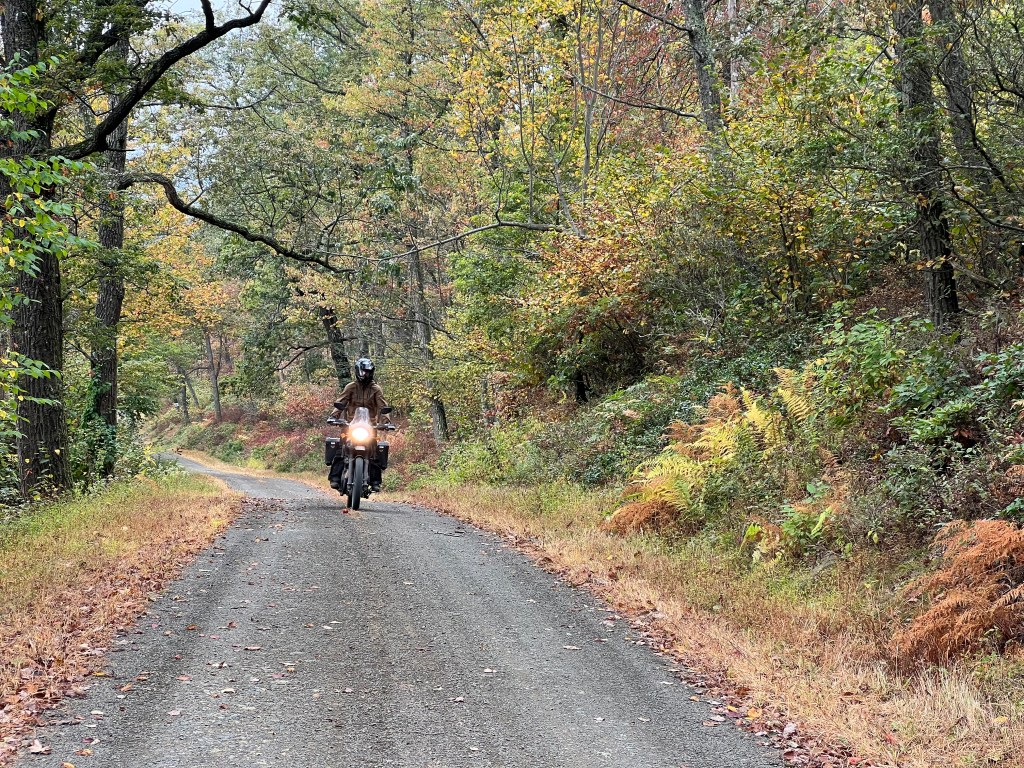
On the first morning of our Pennsylvania adventure, we rolled out fresh and eager. The sun climbed over forested ridges, casting a warm glow across the valley. Today, we start with Section 3 of the PA Wilds BDR: 164 miles of gravel, forest roads, and hidden valleys. Fall was in full swing; maples and oaks flickered reds and golds in the sunlight. Rolling hills and distant ridges appeared and disappeared as the road folded back on itself in a hypnotic rhythm.
The ride started smoothly, tires skimming over loose stones and nicely maintained gravel roads. Then, just as the rhythm sets in, a road sign appears: “Road Closed – 5 miles ahead.” Classic foreshadowing. Closure, as we know, is rarely absolute. “Road closed?” Chris says. “How closed can it be?”
Not long after, the answer reveals itself. Bridge construction sprawls across the path: Cement barricades litter the road like abandoned chess pieces, rebar juts skyward like skeletal fingers, and a dormant crane crouches in the distance, prehistoric, Jurassic Park–ready. Loose gravel skitters under our boots. Chris becomes pure momentum, sending the bike over rogue construction panels like a hero in a DIY montage. My bike’s turn comes—commitment unwavering as he runs back, jumps right on and does an encore performance. Boots tap, tires slide, adrenaline hums. Meanwhile, I narrate silently from the sidelines, prestige-documentary style, until the inevitable: the walk of shame as I traverse the scene on foot.

The forest gravel road stretches onward, and that’s when I notice it: a square opening in the remnants of an old stone foundation. Out of the corner of my eye, it looks like nothing. Then suddenly, my imagination kicks in: hobbits, rituals, haunted mini-homes.
Chris hears my exclamation over the helmet intercom:
“Oh wow, I wonder where that goes!”
I quickly park on the side of the road, hop off and jog towards the hobbit hole. Torchlight engaged—phone flashlight trembling like a nervous Android candle—I peer inside. It’s dark, damp, unhelpful. Shadows crawl across jagged stones, soil hints at abandonment, a perfect set for a low-budget horror flick. Chris encourages:
“Go on inside.”
“Looks like one of those haunted spaces you see in the movies.”
I promptly sprint back to the bike. Zero out of ten for comfort, ten out of ten for story potential. Miniature hobbit hole of horrors: highly recommended.

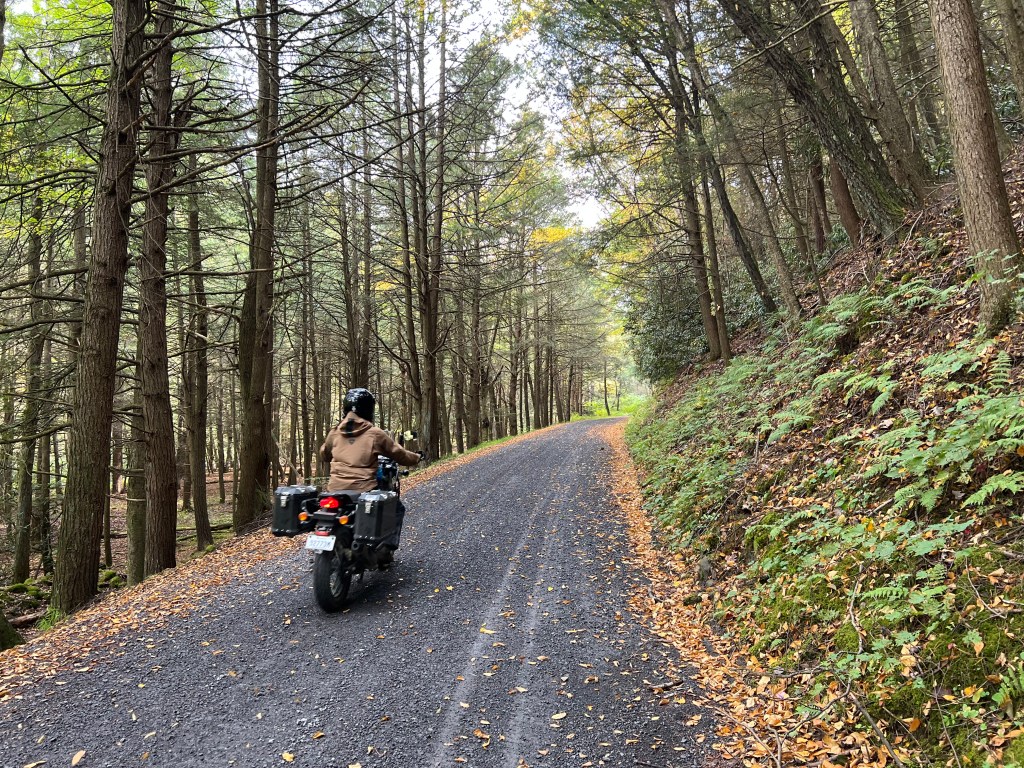
The afternoon sun is slowly starting to come down. The landscape opens up quickly, and before long the road runs straight through a set of cornfields. It’s flat, smooth riding—just a simple farm road with rows of cut corn stocks on both sides. It’s a brief section, but it stands out because it feels so open compared to the rest of the forested route.
Once you reach the end of the fields, the terrain changes almost immediately. The road narrows, the gravel gets rougher, and the first rocks start appearing. Within a few minutes, the route becomes a steady uphill section with a mix of loose rock and embedded stone. The climb continues through the trees, with a few spots where the surface gets chunkier and you feel the rear tire slip slightly before catching. A consistent, rocky uphill that keeps you focused until you reach the top.
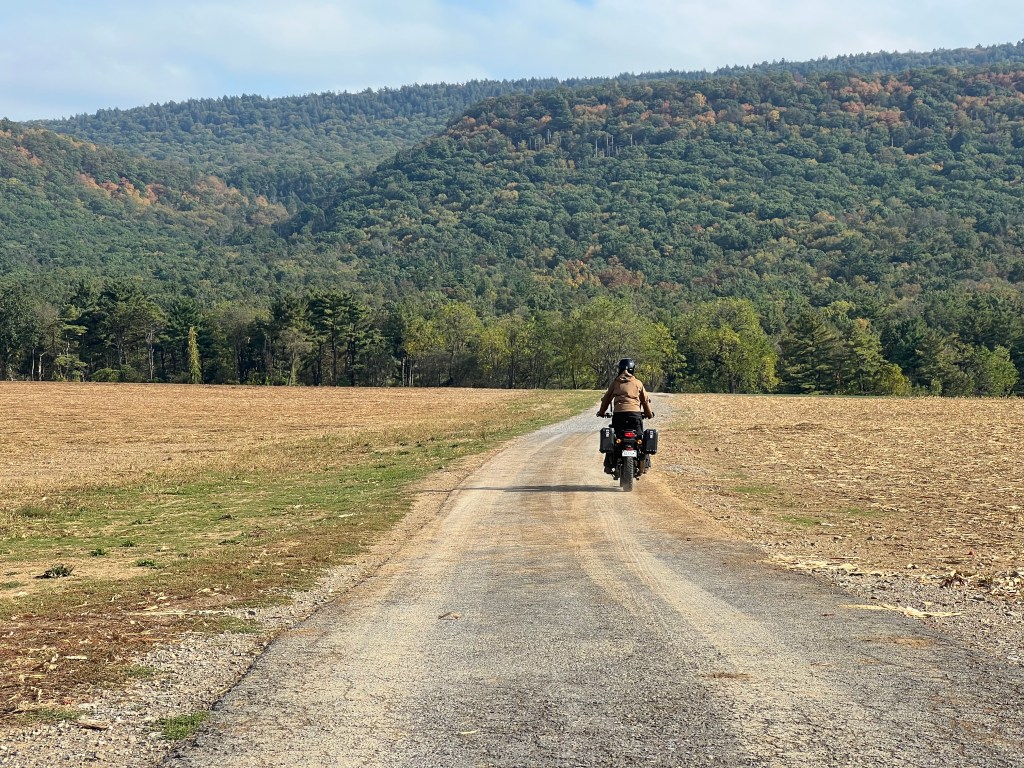
After the climb levels out, the road becomes easier again. I stop the bike to catch my breath and take a moment to celebrate the accomplishment of having conquered this section. To the average rider, this isn’t overly difficult, but it does require a bit of line-picking and keeping steady momentum. Being able to see my skills improving is encouraging and gives me some much needed confidence for what the next few days could throw at us.
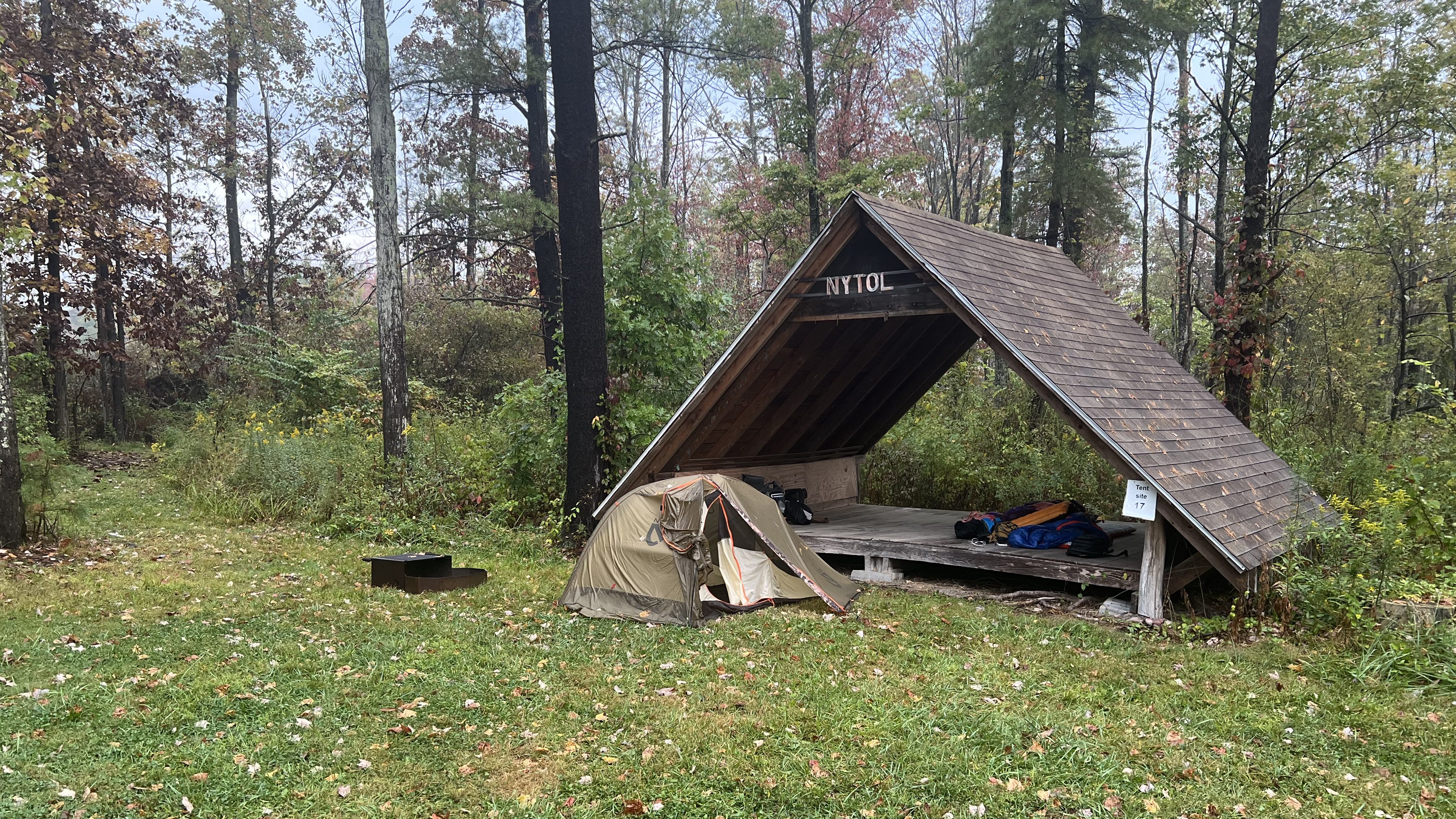
By late afternoon, the miles have carried us past forested ridges and narrow valleys, rolling farmland opening the view as we approach Milroy. First order of business: find a place to stay the night. The website promised mini cabins, hot tub included, for $89. However, when we contact the campground management, it turns out that there is an additional $50 cleaning surcharge. Our dream is crushed, in order to respect our budget. Instead we decide to go for a classic tent site for $47.
Hunger propels us into town. It’s Monday; not much is open. Across from a trailer‑park‑vibe stretch, we spot a bar. Perfect. We clomp inside in full ADV regalia—dusty jackets and boots, helmets under arms. While Chris walks to the bathroom, I head towards the bar area to ask if we can sit on the outside patio. A man sitting on the nearest stool turns towards me and with a sweeping up/down glance asks:
“What kind of horse did you ride on into here?”
His accent catches me completely off guard: Since when does Pennsylvania cosplay the Deep South? My brain responds on autopilot:
“A really dusty one.”
My response is promptly rejected with a shoulder turn. He resumes his original position and continues drinking his beer. Okay then.
We step onto the patio, order our meals and get to witness a corn hole tournament in full swing. It’s live, loud, and fueled by enough beer to make the rules optional. It’s glorious in a National-Geographic-meets-drunk-backyard way. Our burgers devoured, beers gulped down, we hear thunder rolling in like a cinematic audio cue. If we don’t get back to our campsite soon, the rain will get the better of us.
By the time we retreat to the tent, the sky is darkening and occasional raindrops are pattering on the canvas. Dirt under finger nails, dust in every seam, adrenaline fading into tired contentment. Day one of the PA Wilds BDR: complete.
Our next morning’s verdict is… Sore. Unrested. Questioning life choices. We ride past the tiny hot‑tub cabins and wave politely, mourning silently. If there is one regret we will have during our adventure, it’s not having taken advantage of a hot tub after a long day on the motorcycles. This is the price to pay when living on a budget.
Day Two: Milroy to Waterville (126 miles)
The second day greeted us, not with a sunrise, but with fog so thick it seemed to blur ambition and destination alike. We packed our gear and made a beeline for the nearest breakfast spot, desperate for caffeine to stir our minds. A hearty morning meal at The Honey Creek Inn did more than fuel us—it sharpened our focus and gave the day ahead a sense of purpose.
From there, we plunged into the desolate expanse of Bald Eagle State Forest. The gravel twisted and climbed, rising and falling across mountain gaps like the undulating back of some ancient creature. Here, the roads flow with a gentle, forgiving rhythm—perfect for those seeking adventure without the aggression of technical trails.
Mist clung to us like a living presence as I eased to a stop on the dirt road to take it all in. The forest around held its breath. Every leaf shimmered with the remnants of rain, trembling under water still undecided whether to fall or hold on. The air was thick with the unmistakable scent of damp earth, pine, and something primal I couldn’t name. It filtered through my helmet like a whisper from a dream, both familiar and strange.

Above, the trees arched in sweeping vaults, their limbs intertwined like the ceiling of a forgotten cathedral. Shadows lingered in their upper reaches, while the forest floor glowed faintly, a diffused light reflecting off the mist. The peace was absolute, yet edged with something sharp, a quiet that felt as if the woods were watching. Beauty here demanded stillness—it pulled you inward, slowed your pulse, and forced reverence.
For a moment, I stayed there, suspended between calm and unease, breathing in the wet air, letting the hush after the rain sink in. When the engine beneath me rumbled, a low hymn in this sylvan sanctuary. I dropped into gear, twisted the throttle, and let the towering trees swallow me as the trail carried me deeper into the PA Wilds Backcountry Discovery Route.
The winding gravel roads alternated between ascents, ridge lines, and descents, each offering glimpses of the Pine Ridge Creek valley before climbing back toward the ridges. By early afternoon, the rain had turned relentless. We were approaching Waterville, eyes scanning the GPX map for the Waterville Inn.

At first, hope faltered: the inn was closed on Tuesdays and Wednesdays. A glance at the other local inn brought no relief—it sat permanently shuttered. We returned to the Waterville Inn, soaked but undeterred, huddling under the porch and pleading with the mist, “Anything but canvas.” We couldn’t handle another sleepless night on the hard ground.
Then a grey pickup rolled in. A man stepped out, keys in hand, moving toward the locked entrance with the air of someone who belonged. “Who ARE you, rain-key-hobbit-sir?” I muttered under my breath. Minutes later, he returned and looked towards us. “You waiting on a key?”
We stared. Did he even work here? Not quite. He was a restaurant supplier, and better yet, a friend of the owners. He personally guided us to the country store next door, helping us get in contact with the Inn owner. Within minutes, we secured the last available room. Ritchie, patron saint of last-minute budget redeemers, had saved the day.
Supper followed, courtesy of Ritchie’s recommendation: homemade deli subs from the Country Store “so good that the Amish boys love them.” Cultural endorsement accepted. While we waited for our subs to be assembled, we wandered the country store aisles—a survivalist candy land of fishing gear, camping necessities, hunting paraphernalia, and taxidermied squirrels in mid-victory poses. A tiny boxing raccoon grinned up at me. Roadside Americana at its finest.


Soon, the inn owner appeared. We paid for the room and were led upstairs to a space that Pinterest would classify as “Rustic Luxe Meets Log-Cabin Aesthetic.” Gear and baggage were piled near the warmth, a small comfort against the forecasted rain.
Then came the moment I had imagined all day: collapsing onto the mattress.
It… boinged.
Betrayal. Too springy. Too firm. This was supposed to be my night of restorative glory. Chris, meanwhile, was already asleep—lights out, no commentary, a mystery of manly endurance that science may never solve. I lay there instead, listening to the rain drum a steady rhythm on the roof, the forest’s hush now translated into a lullaby of droplets and distant wind.
Day 3: Waterville to Crossfork (140 miles)
We leave Waterville behind and dive back into the forest roads. Pine, oak, and hemlock scent the air, a damp, earthy perfume mingling with the faint tang of moss and fallen leaves. Each twist of the road reveals another ridge or hollow, rolling topography that makes your body follow the bike instinctively—lean, lift, a fleeting moment of perfect flow.

The gravel alternates between smooth stretches and loose patches that keep you honest. Small streams gurgle through rocks, their edges lined with ferns glistening like tiny emerald carpets. Mist clings low in the valleys, wrapping the hillsides in a secretive veil.
By midday, a bridge became our impromptu rest stop. We unpacked oats and stirred a pot of oatmeal on our Jetboil stove beneath misty trees. Birds trilled overhead. For a few brief moments, the calm made me consider abandoning civilization entirely, embracing the life of a nature columnist, utterly absorbed in the quiet babble of the brook below.
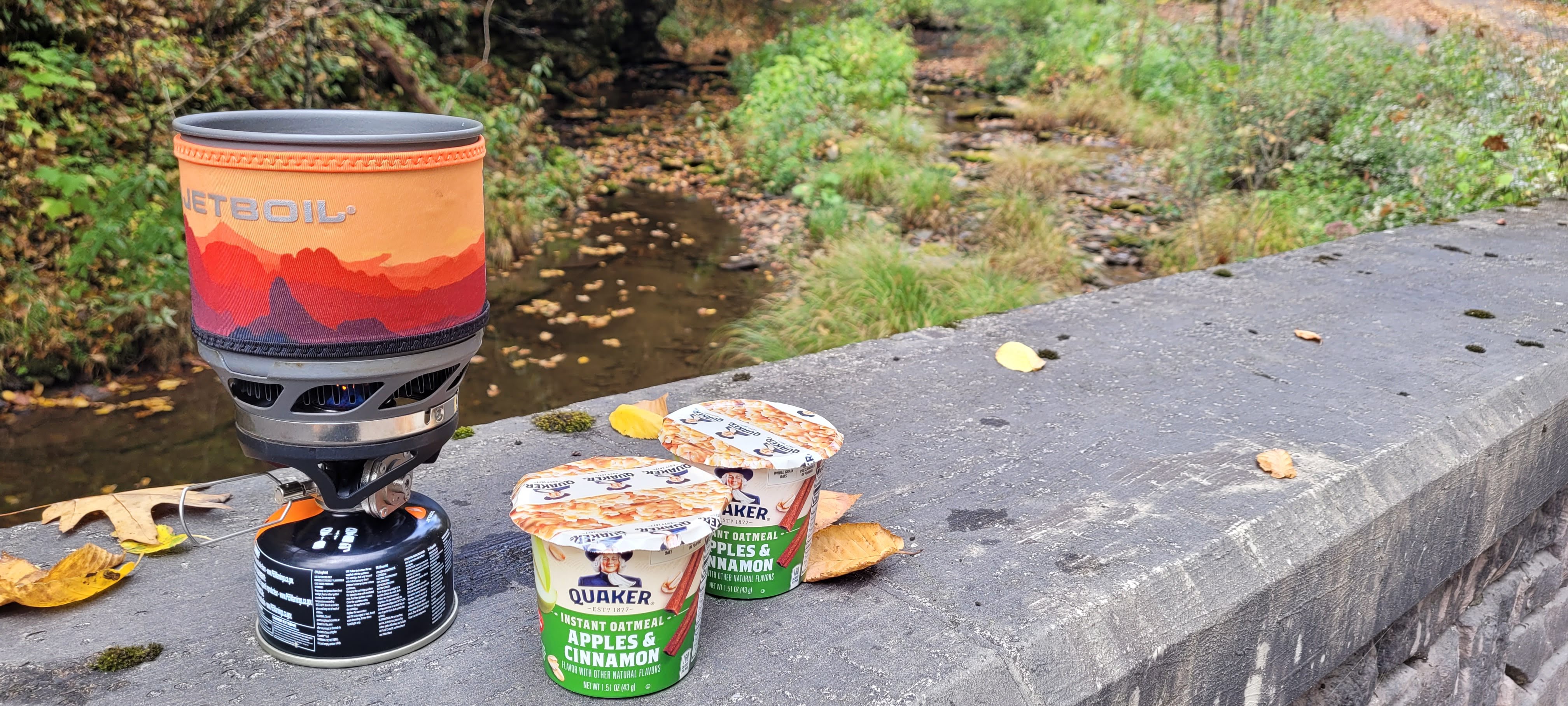
As we wrap up our break and head back on the road, we see wildlife flit in and out of sight. A flash of copper marks a red fox; further down, a white-tailed deer freezes at the roadside, weighing our presence before vanishing back into the trees. Bird songs echo faintly, a soundtrack to the solitude. Towns are rare: Duncan is little more than a quiet cluster of homes and a general store—a brief human punctuation before the forest reclaims the road.
Every mile here is a study in contrasts: steep climbs that test endurance, followed by descents that demand attention and reward riders with glimpses of hidden valleys. The road’s twists mirror the hills’ undulations, a natural choreography that makes you feel less like a visitor and more like a participant in the landscape.
There’s a small detour to the Colton Point State Park overlook. Before all this, I’m blissfully unaware of what’s about to unfold. Our comm systems are still on, and Chris barely has time to park before he notices me trying to back up like an ungraceful duck attempting to waddle backwards with all 400 pounds of my motorcycle. He sees the disaster forming before I do. Through the headset I faintly hear, “…you’re falling!” which I find ridiculous, because my left foot is already pushing down the kickstand. But then I feel it—that slow, undeniable gravitational pull. Before I can make sense of anything, the bike tips right, taking me with it, and I end up sprawled across the parking lot. How is this happening again? All I can think to say, staring up through my rectangular visor at the tops of the trees, is: “How did you know I was falling!?” The parking lot is barely off-camber—maybe a couple of degrees—but just like on the Cabot Trail, it’s apparently my nemesis.
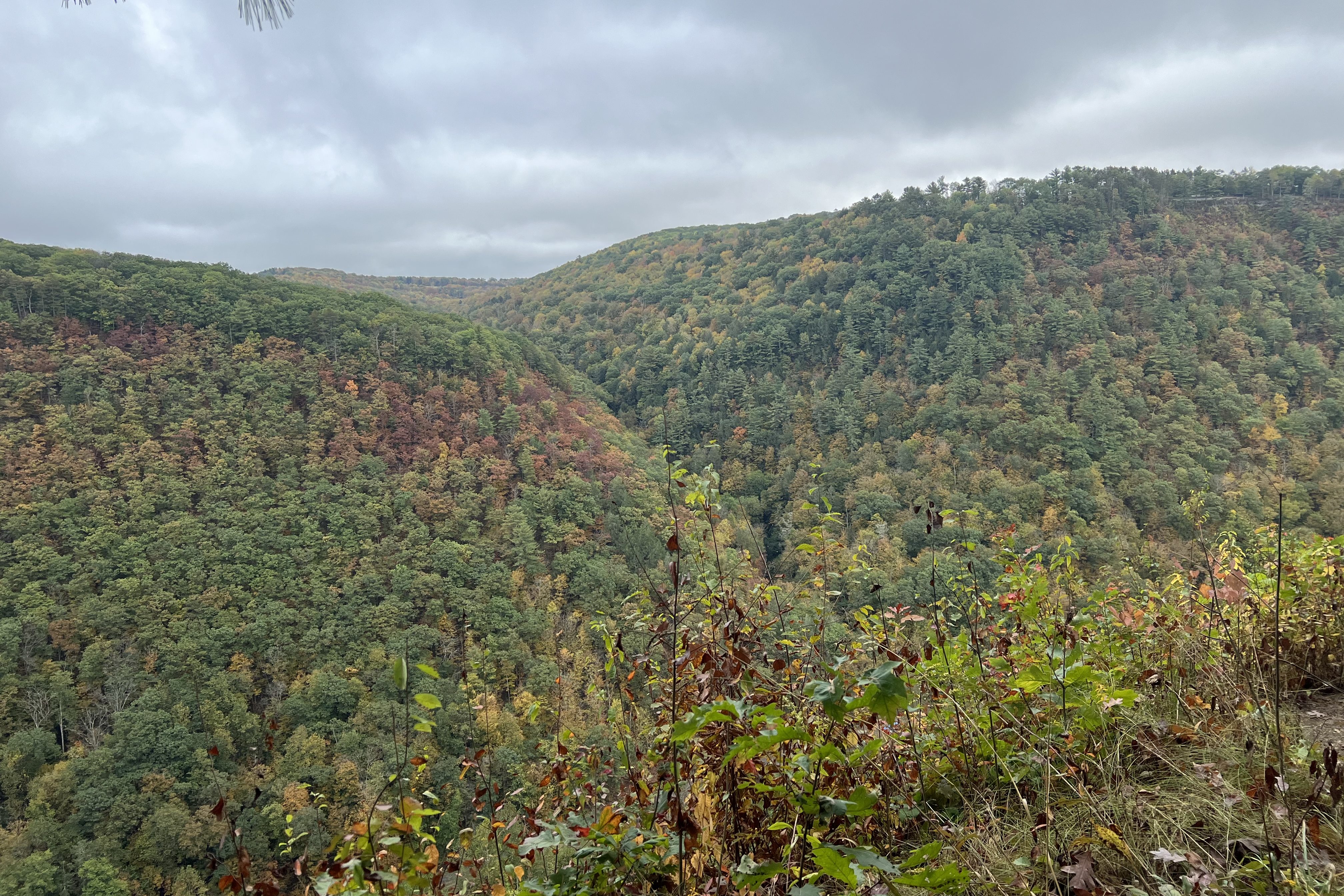
We walk to the overlook afterward. It’s beautiful: Pine Creek winding far below between two mountain ridges, families scattered along the railing, everyone taking in the view. I try to keep up a strong front, as if I didn’t just tip over in a perfectly normal parking lot, silently hoping no one noticed (at least no one rushed over like during the Cabot Trail episode). To this day, I barely remember the overlook itself—just the flood of adrenaline and the photo that proves I was actually there.
By the time Cross Fork appears, the forest thins just enough to reveal glimpses of sky and distant ridges. Solitude lingers like a shadow, even as signs of settlement whisper that civilization has not entirely abandoned this stretch.
Outside the bar, we met a man enveloped in a cloud of cigarette smoke. Paul, owner of the modest motel we had passed—its mid-century façade a relic that could belong in a roadside anthropological archive labeled Hunting Grandpa Chic—offered more than a room that day. He offered a rescue arc.
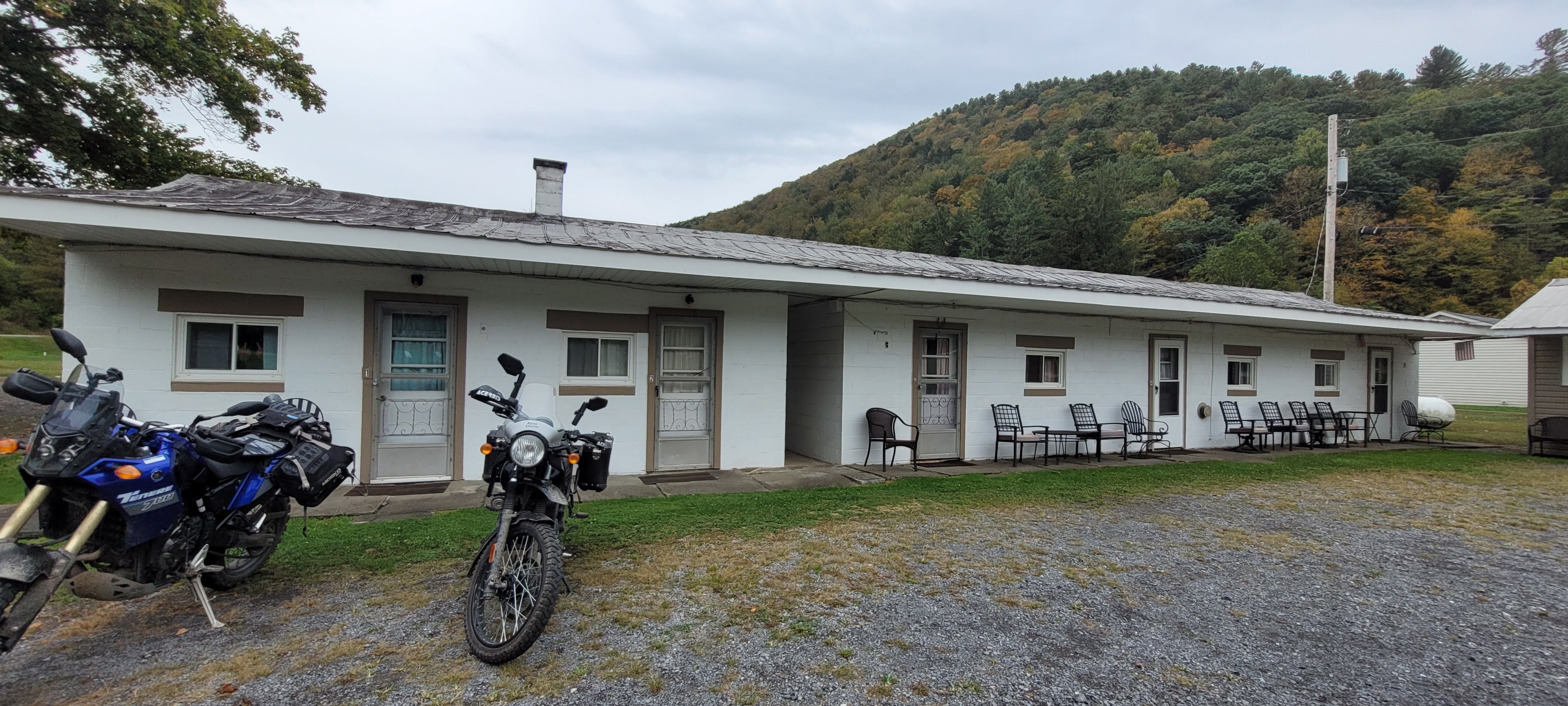
He accepted only cash or checks. Our situation? Cashless. Town facilities? No cash-back options available. Paul’s solution? “Mail it when you can. I won’t leave anyone stranded by my watch.” Not all heroes wear capes.
Rain rolled back in, thunder gathering. Night riding in rain and darkness was a firm no from me, so we accepted Paul’s benevolent loophole hospitality and checked into our retro revival roadside palace.
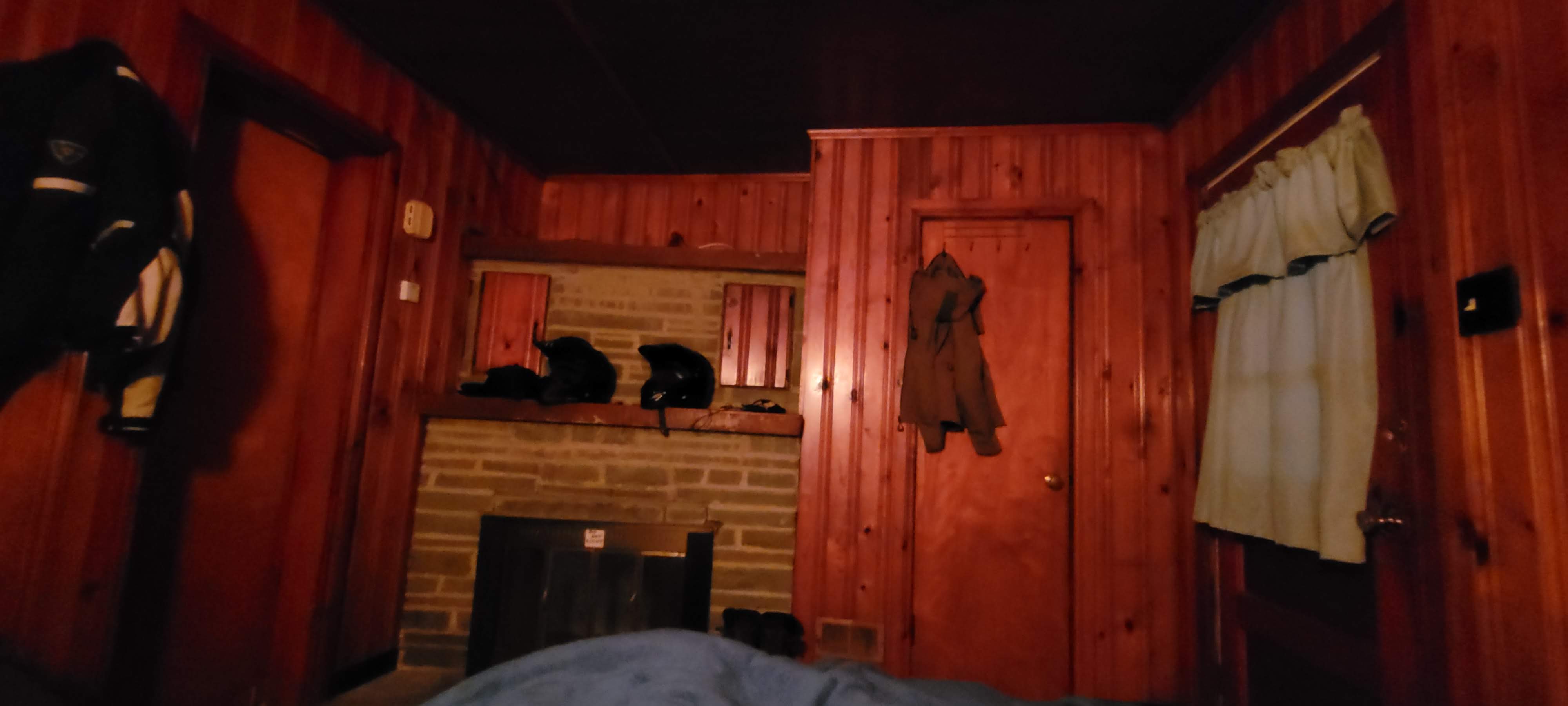
Inside, the décor looked curated by hunters whose color palette peaked in 1973. The beds? Coils enthusiastic enough to trigger mattress PTSD. Yet I loved it. I reveled in the vintage spectacle like an art critic evaluating motel maximalism. Our bikes stood obediently outside our door, sentinels in the dim light. Paul, an absolute legend in his own way, knocks on our door a little while later to offer us towels to dry off our motorcycles before we leave tomorrow morning.
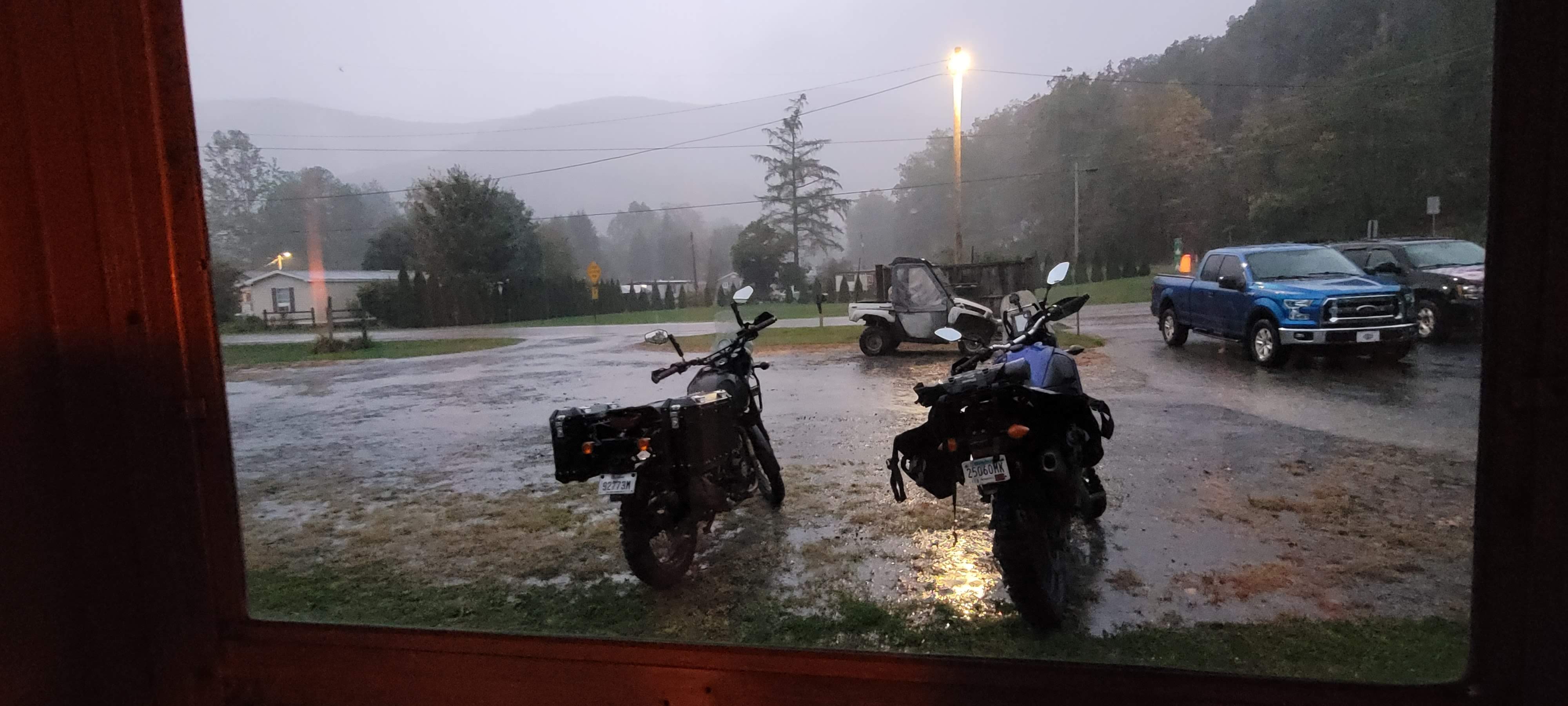
The place flirted with mild Bates Motel vibes—but only as autumn flirts with Halloween: slightly ominous, irresistibly moody. If dark literature had décor, this room would be its perfect embodiment.
Day 4: Crossfork back to Kane (254 miles)
After all that rain, the next morning arrived softened by mist. The roads ahead twisted in endless S-curves. A few puddles waited, glimmering in the pale light, promising small, sparkling splashes as we crossed. The logging zones were particularly treacherous—earth churned and chewed by heavy machinery, softened into a slick glaze we quickly dubbed “greasy.”
It wasn’t mud, exactly. I would classify it more like existential doubt—damp loam mixed with sand, shallow but persuasive enough to whisper, “Go on. Slide a little.” Chris rode through it with unshakable steadiness; I rode it like a woman narrating her own survival tutorial. The terrain didn’t feel chaotic, but it was slippery enough, each wheel-spin felt like a negotiation with gravity itself.
We passed small towns and clusters of farms, roads narrowing and widening, the forest opening in brief glades where mist curled over fields like smoke. Between Cross Fork and Weedville, the route followed winding ridgelines and gentle valleys, punctuated by stream crossings and pine-shrouded hollows.
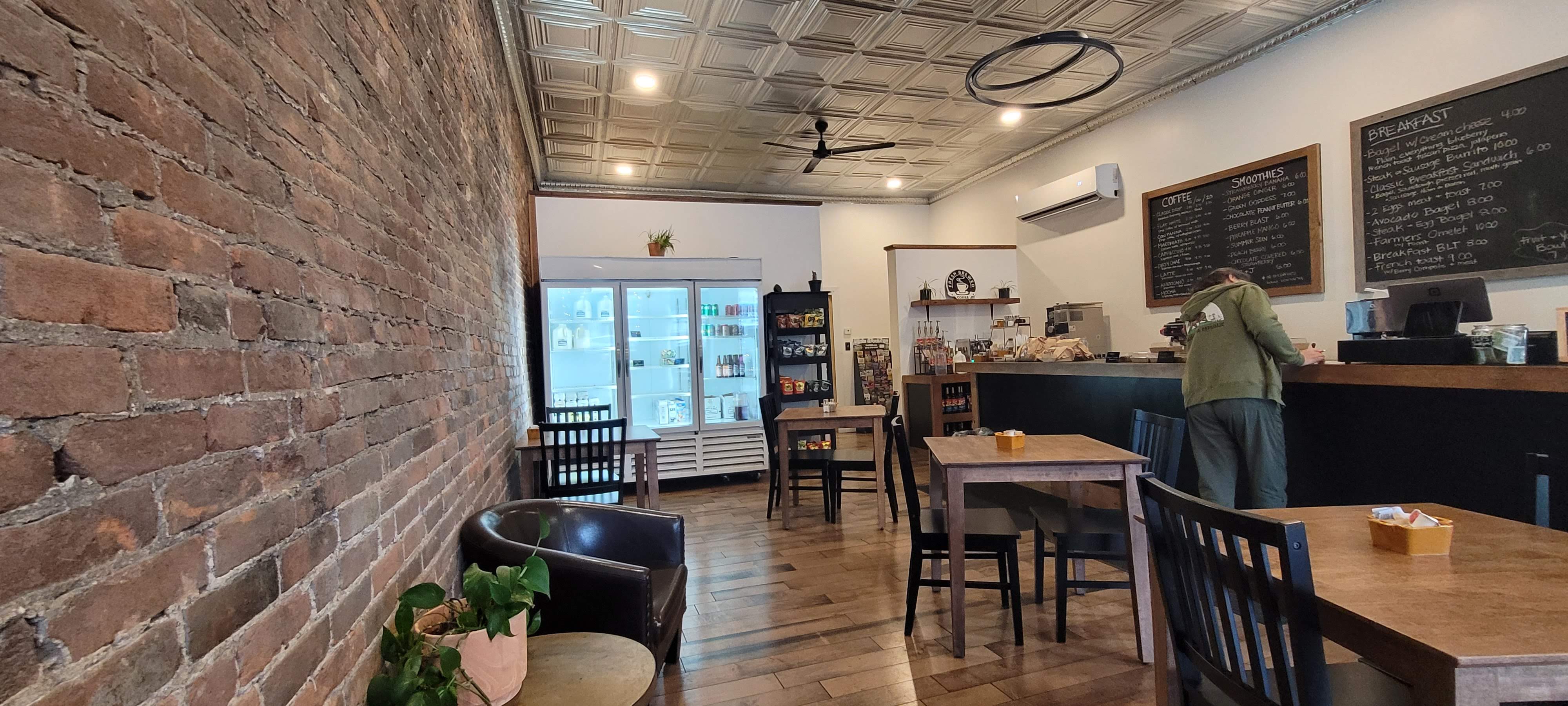
A welcome distraction appeared in the form of a tiny, inviting café in the town of Emporium: Aroma Café & Market. Outside, rain hammered the roof in steady rhythm. Inside, the warmth, the smell of roasted coffee, and the quiet hum of conversation felt like a small, civilized miracle in the midst of the wilderness. We lingered, letting cups of steaming brew thaw our damp spirits.
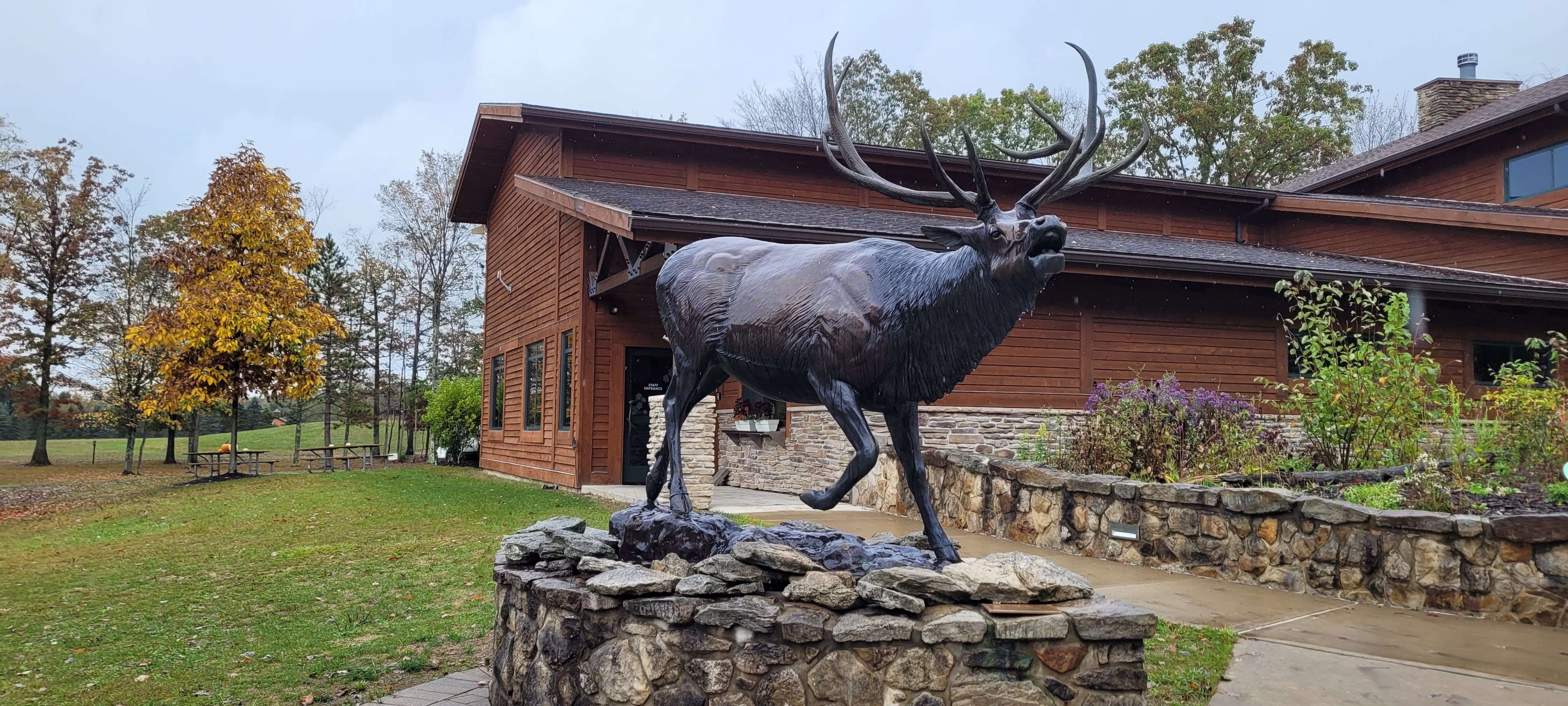
Later, the Elk Museum and Visitor Center drew us in, though we knew the chances of seeing actual elk at this hour were slim. True enough—no majestic antlers wandering past—but the displays offered a silent reminder of the wildlife inhabiting these forests, and a moment to stretch our legs before the final push.
From there, gravel and asphalt wound us back toward Weedville, then northwest toward our campground near Kane, PA. The off-road route was traded for highway in order to get back to home base a little quicker. The rain softened, mist lingering in pockets along the road, reflecting the waning daylight in silver patches. By the time we reached the campground, the RV and the familiar comforts it promised felt like a sanctuary after the loop: tires, bikes, and travelers damp but triumphant, ready to dry off and rest, knowing the forest had given all it had to offer.
 NOMADIC ADV