Tag: motorcycle

  • Already The End Of Our Travels?

    Already The End Of Our Travels?

    We mention our love of coffee quite often in our tales. A good cup to start the day isn’t just a preference, it’s an imperative to a successful day (especially for me). Our method of choice is the humble French press, a small ritual that gives even the most ordinary mornings purpose and intention. When you live full-time on the road, these things matter.

    There are, however, many things Chris and I have learned the hard way in our endeavor as full-time Bus owners. Some lessons come gently. Others arrive with far less grace.

    I say all this because on a seemingly uneventful evening—fresh off our PA Wilds motorcycle adventure—we began the familiar process of packing up and preparing to move on to the next destination. This includes one of the least glamorous parts of RV life: emptying the grey and black water tanks. It’s an absolutely unsexy routine, but one that is necessary.

    As I tidied up the inside of the camper, I could hear Chris outside through the open window. Grunting. Muttering. A few choice expletives carried on the night air. There was some rustling, then sudden silence. A moment later, more noises—but it was dark, and all I could see were shifting shadows moving along the side of the rig and the occasional beam of light from his head lamp flashing through the window.

    Then Chris hollers, “Can you come out here quick! Oh, and bring your phone!”

    Confused and slightly concerned, I slipped on my sandals, hurried down the three steps, and ran around to the other side of the camper. I barely had time to register the scene. Chris was crouched beside the open tank valves, the unattached sewer hose in one hand and a long, thin stick in the other.

    “I think something settled at the bottom of the grey tank and it’s blocked,” he muttered, prodding the entrance with his trusty stick.

    And then all hell broke loose.

    The dam inside the tank gave way without warning. A sudden rush of foul, murky water erupted as Chris scrambled to get the hose properly seated back onto the outlet—just a second too late. Chaos, panic, and a fair amount of shouting followed.

    It didn’t take long to figure out who the culprit was.

    Every morning, while washing dishes, I’d been casually dumping the used coffee grounds from our French press down the sink. Normally, we empty our tanks every couple of days, depending on usage. But this time, we’d been gone on the bikes and we hadn’t emptied our tanks for a full week. Those innocent little grounds had time to sink, settle, and eventually solidify at the bottom of the grey tank—forming a perfect, immovable plug. Lesson learned.

    Is This The End?

    Our travels were briefly disrupted by a deadline: we needed to be back in Minnesota. Not because we were finished with the Bus adventures, but because Chris needed to attend the yearly all-staff in-person company meeting. This gave us the chance to see friends and reclaim a bit of normalcy in our social calendar. Truthfully, full-time travel comes with its own set of challenges. It can feel isolating when your usual support system is scattered across the map.

    There was a part of us that wondered if we could stay and settle for a while. But a stronger part whispered about the next destination, insisting, we’re not done yet. There were still too many places to see. And, practically speaking, Minnesota is not a state you want to spend interminable winter months in a poorly insulated camper—one not built to withstand below-freezing temperatures. Unless it’s winterized and entirely devoid of inhabitants.

    So, from Pennsylvania, we pointed the Bus west and committed to three long days of driving. Up until then, most of our overnights had been spent tucked into truck stops or highway rest areas. Somewhere along the way, we heard about Harvest Hosts: a membership program for RVers that offers free overnight stays at unique locations like wineries and farms. Instead of traditional campgrounds, you park on private property and support the host by purchasing their goods or services. For an annual fee, you gain access to a network of places that feel quieter, more personal, and deeply rooted in local life.

    In my tendency to romanticize life’s simple moments, I was thrilled when we signed up and I got to choose our very first stop. My brain immediately went to “cute” and “fluffy.” Naturally, we headed to a sheep farm.

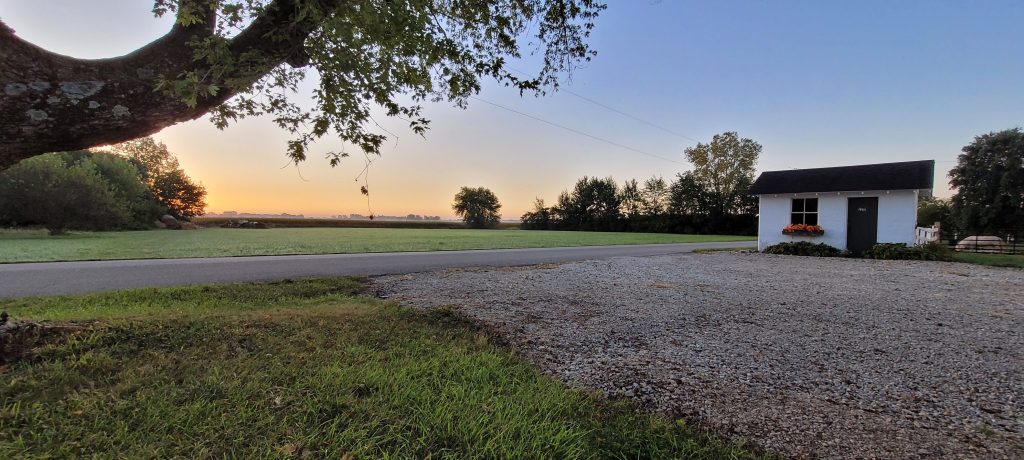
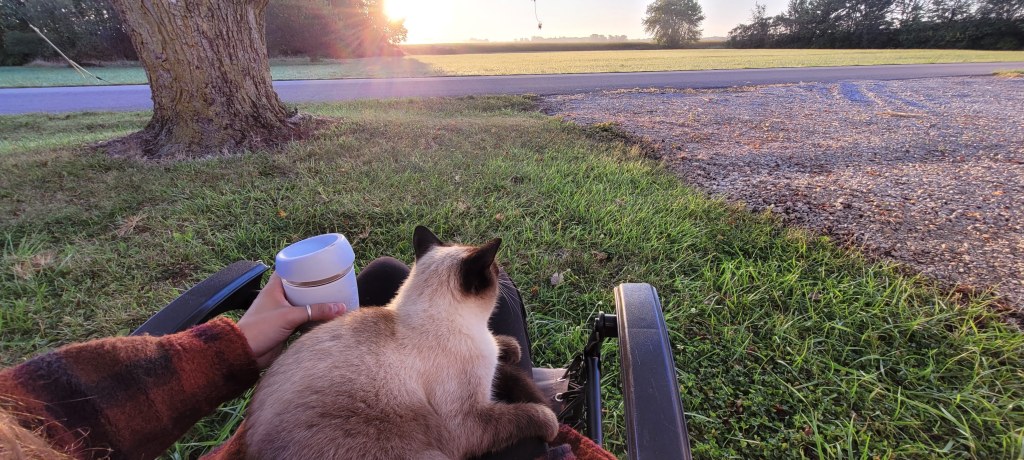
    We settled in for the evening and were lucky enough to receive a small tour of the family’s barn, where we met sheep and goats and learned what it takes to be a competitive show sheep participant in 4H programs. Our parking spot overlooked a wide open field. In the morning, we watched the sun rise as we drank our coffee, and I made the acquaintance of the host family’s cat, aptly named S’mores.

    It was one of those tranquil mornings you know is fleeting. The kind you savor because you’re unlikely to ever be in this exact place again. Yet in that moment, there was nothing but joy and gratitude for being there at all, and for choosing this life that keeps placing us in unexpected pockets of quiet beauty.

    Honey, We’re Home!

    We arrived at Chris’ parents’ homestead in early October and tucked ourselves behind the pole barn, right at the edge of their forested property. We have electricity but no water, which means that any official bathroom or shower situation requires a brisk walk to the house. Or, for those of us who insist on drinking a cup of warm tea right before bed, there’s the less official option: the ever-so-elegant crouch in the dark, under a sky full of stars, hoping a porch light doesn’t turn on at the worst possible moment.

    You could call this the original glamping experience.

     Fall, for many of us, is that perfect in-between season: cool mornings, warmer afternoons, and just enough chill in the air to justify an extra layer. The foliage turns even the shortest drive into something spectacular, and nearly every outdoor activity suddenly becomes more enjoyable. In my opinion, it’s the best time of year, full stop.

    It’s also peak acorn season.

    All night long, acorns rain down onto the steel roof of the barn like nature’s own percussion section. The first night is… not restful. Loud, startling, and deeply confusing. At various moments, it sounds like hail, gunfire, or a very aggressive squirrel with a vendetta. It takes us far too long to realize what’s happening outside, and even longer to accept that our only real solution is to close the bedroom window and hope that most of the acorns will have fallen from the tree that night and the next nights will be better.

    As if nature hadn’t already made her point, we also arrive right in the middle of Minnesota’s prime archery hunting season. Something Chris has been FOMO-ing about all summer. The thought of missing hunting season for the first time in what feels like his entire adult life had cast a noticeable shadow over our travels. Now, with the woods alive and the season open, his mood shifts almost immediately. Despite the acorns, the nightly walks to the bathroom, and the questionable bedtime tea habits, all feels right in his world again.

    For me, being back home also means returning to the barn. Riding and caring for horses has been a constant passion for decades, even back in Canada. There is something deeply cathartic about being around horses, something grounding in a way few other things do. Riding familiar trails, reconnecting with friends, and spending long days outside brings an unmistakable sense of joy to my life.

    Barn friends are a phenomenon all their own. We all range in ages and life stages, yet are bound together by a shared love of horses. Since I started spending time there a little over a year ago, my friend Abbie, who owns the barn, has generously let me borrow one of her horses. Sierra (an opinionated chestnut mare) has become a steady source of happiness and equine therapy since moving to the States and beginning a new chapter of life. She has opinions, she makes them known, and she’s exactly what I didn’t know I needed.

    During one weekend, I’m invited to join a group of gals for a trail ride about an hour north, and it turns into one of those perfect fall days. We ride through forests carpeted in yellow leaves, listening to hooves crunch rhythmically beneath us. Laughter echoes as we splash through a few water crossings, waving to other riding groups as we pass. It’s simple, joyful, and fleeting in the way all the best moments seem to be.

    To Diesel Or Not To Diesel, That Is The Question.

    While we’re in the area, we decide it’s imperative that we start seriously looking for a diesel truck. Because let’s not forget: we very quickly learned the hard way what climbing hills in a gas truck pulling a fifth-wheel feels like.

    As the self-proclaimed Chief Financial Budgeter of this endeavor, I track our expenses by category. Fuel is easily one of our biggest line items, especially when we’re covering long stretches of highway. We feel that cost acutely the moment the terrain gets hilly. With plans to head into the mountains out West next summer, the idea of doing that with our current setup feels daunting—particularly given how much we struggled in comparatively mild hill country.

    Now, let me preface this by saying: I know nothing about trucks. What I do know is that the idea of spending time in a dealership so soon after buying our last truck feels unpleasantly close. We should have done more research. We should have bought the trailer before purchasing the vehicle meant to tow it. We should have… Yes, yes. Hindsight is always 20/20. Like the other lessons on this journey, we learned it in the field.

    Dealerships are also not my natural habitat. I have to actively remind myself to smile, otherwise I look completely unapproachable. “Fix your face,” Chris whispers under his breath as we walk in. Fair enough. I adjust accordingly.

    Before we even walk into the lot, we’ve written down very specific criteria. First and foremost (and this somehow confuses most salespeople) we have a budget. A strict budget. One we are not compromising on. And since we’re already doing this, why not go for the full American experience: a one-ton diesel truck with a ten-speed transmission. Ask me if I knew there were different kinds of transmissions before this process. I absolutely did not.

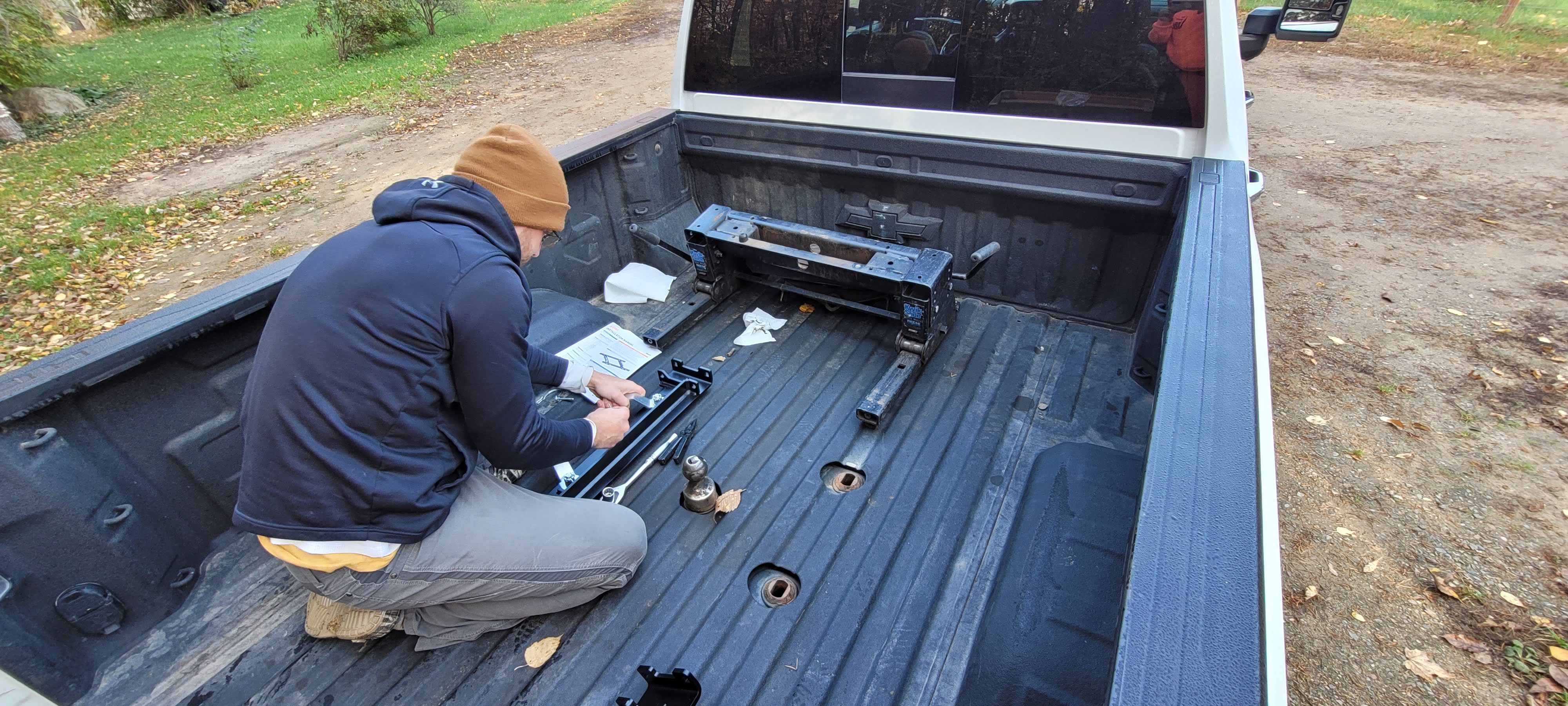
    After a few test drives, a handful of text exchanges, and several near-misses involving trucks with swapped transmissions of questionable origin, we finally settle on a new-to-us diesel that checks the important boxes. The good news: it already has the puck system integrated into the frame for attaching our fifth-wheel hitch. The bad news: it’s a different system than the one on our previous truck, which means we now need a new fifth-wheel adapter from the RV parts store.

    Chris gets his hands dirty installing the new adapter himself, adding yet another skill to the ever-growing roster of RV life competencies. One more lesson learned, one more piece of the puzzle in place—and one step closer to being ready for those western mountains.

    Routine Maintenance and The Case Of A Stubborn Wife

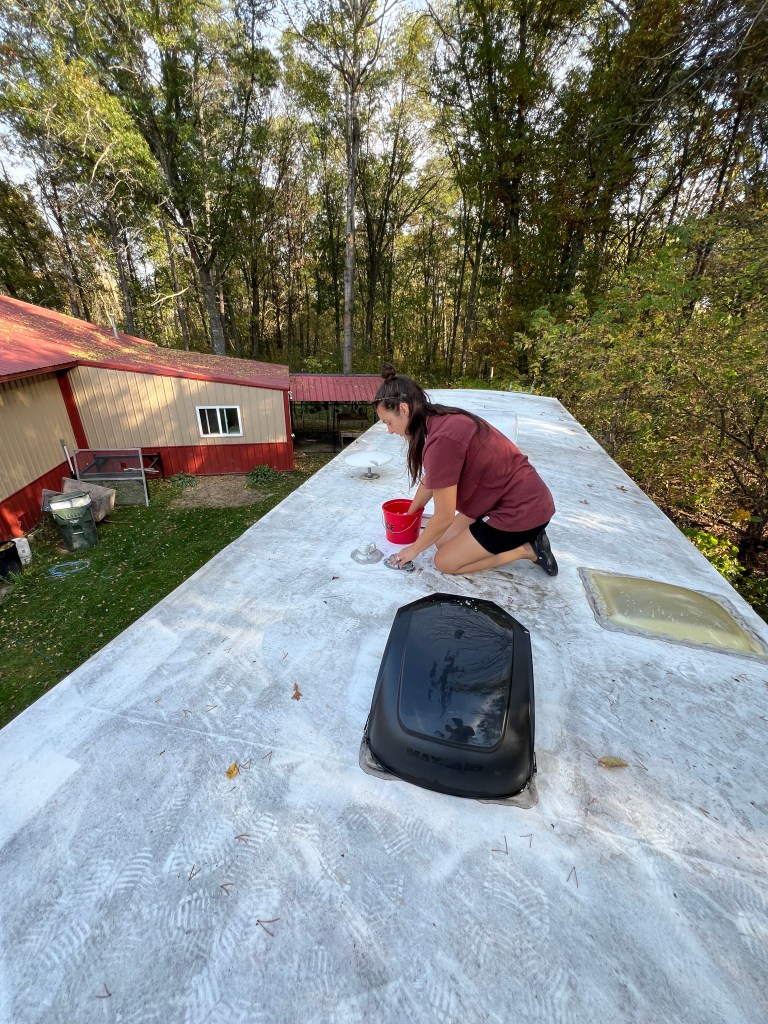
    While still home, we take advantage of the time and space to knock out some routine maintenance on the Bus. The top priority is a UV treatment for the roof. One of those preventative tasks that isn’t very exciting, but goes a long way toward preserving the roof material and, ideally, avoiding leaks or a full replacement down the line.

    After a stop at the local RV shop for supplies, we grab a ladder, we climb up to inspect the roof. And wow. She is filthy. It’s hard to say what exactly accumulated over the last few months, but the surface is coated in a generous layer of grime that clearly didn’t get the memo about being low-maintenance.

    First order of business: a thorough cleaning. We fill a bucket with warm water and diluted dish soap and get to work. Chris tackles the large surface areas with a pressure washer, while I follow closely behind with a sponge, getting into the corners and around the seals—making sure everything is free of gunk before moving on. Once the roof is clean and dry, we apply the RV roof protectant, and Chris finishes up by inspecting all the window seals to see if any touch-ups are needed. By the end, the rig looks noticeably better, and we’re left with that deeply satisfying feeling that comes from crossing something important off the list.

    Being home also gives us the opportunity to address another ongoing issue: Asian beetles.

    For those unfamiliar, Asian beetles (they look like lady bugs) are common in Minnesota—especially after the soybean harvest. Supposedly beneficial in fields, come fall they become aggressive home invaders. They congregate on sunny windows, stain surfaces, occasionally bite, and generally act like they pay rent.

    I retrieve our vacuum from the storage unit and make it a ritual to vacuum them up at least once a day. They tend to emerge when the sun is out, clustering along windows and ceilings. It’s also a sobering reminder of just how… porous RV construction can be. Bugs find their way in through windows, vents, seams—places you didn’t even know existed.

    But I digress. The goal is simple: reduce their numbers.

    Spoiler alert: not all of them were vacuumed. To this day, months later, beetles still emerge from mysterious hiding places we cannot identify. Where they come from remains unknown. What is known is that they have fully committed to RV life whether we like it or not.

    Another important task on our ever-growing Bus upkeep list is flushing and treating the water tanks. It’s one of those preventative chores meant to keep sensors uncovered, lines clear, and unpleasant surprises to a minimum.

    We start with the black water tank and everything goes according to plan. There’s a clearly marked flush port, clear instructions, and one very important rule: the black tank valve must be open while flushing. Easy enough. The tank flushes cleanly and successfully. We’re feeling confident.

    Maybe too confident.

    With the black tank done, my mind immediately jumps to the grey water tank. After all, if we’re flushing tanks, shouldn’t we flush all the tanks? Especially considering the recent coffee-grounds incident. I am determined to get every last particle out of that system.

    At this point, the black tank valve is closed. Chris, sensing danger, warns me not to reconnect the water. I don’t fully understand why, so I move closer to inspect. He repeats himself. More firmly this time.

    I remain fixated.

    I reconnect the water anyway.

    It takes approximately four seconds for things to go very wrong.

    Water begins leaking onto the ground—definitely not part of the plan. We scramble. The hose is shut off, we rush inside the trailer, and that’s when we realize what happened: with the black tank valve closed, water pressure had nowhere to go. The pressure built up and blew out the water pressure regulator valve.

    Luckily, the damage is limited. The regulator is easily accessible behind the toilet, which is both convenient and humbling. I head back to the RV parts store, purchase the replacement part, and we get everything repaired without further incident.

    Another lesson learned.
    Another reminder that confidence in RV maintenance should always be paired with listening.
    And maybe—just occasionally—pausing before reconnecting the hose.

    How to Register Your Motorcycle: The Saga Continues

    At this point, I’m convinced that the saga of importing and registering my motorcycle has taken nearly as long and has required as many steps as obtaining my permanent resident status. Possibly more. There’s certainly irony here.

    According to my research, once your motorcycle is imported, getting a state license plate should be fairly straightforward. The internet, as usual, made it sound almost charming.

    Step 1: Clear U.S. Customs & ensure compliance.
    CHECK.

    Step 2: Gather Minnesota DMV documents (proof of sale, insurance, etc.).
    CHECK.

    Step 3: Visit a Minnesota License Center.
    Here I am. CHECK.

    Step 4: Submit documents, pay fees, receive plates and registration stickers immediately.
    Absolutely no CHECK.

    Reality arrives swiftly. Because I’m from a French-speaking province in Canada, some of my documents contain French words. This alone is enough to bring the front desk to a complete halt. I’m informed that before anything can proceed, I must have these documents translated by an approved translator.

    Additionally, I’m told I need the original registration paper associated with my Quebec license plate.

    I try to explain—calmly, politely—that Quebec’s system is now digital. There is no original paper. We don’t have a vehicle “title” in the way the U.S. does; it’s called a registration, and it exists as a digital document. I have printed it. This is the thing.

    Nope. Nothing they can do. Figure it out.

    I leave the building frustrated and defeated, genuinely surprised. I had assumed that border patrol and the actual importation of the motorcycle would be the hardest part of this process. Instead, here I am—so close to the finish line, yet once again stuck running endlessly on the hamster wheel of bureaucracy.

    When I share this story with a few people, I’m told this experience is… not uncommon. Apparently, this particular DMV has a reputation. The suggestion is simple: try the license center in the next town over. They’re supposedly nicer. More adaptable. Possibly human.

    Still, assuming I’ll need that translation regardless, I send my French-language insurance document to one of the approved translation companies on the provided list. The total? $95. FOR SIX WORDS.

    Fine.

    Meanwhile, I embark on a side quest to contact the Quebec Road Safety Authority  to see if there’s any way to have a physical registration card mailed to my parents’ address, who could then forward it to me in the States. Every instruction loops me back to the website, where I can download and print the same PDF I already have.

    Yes. I know.
    But the DMV wants something tangible.

    Oh and Canada Post is on strike at this time. So even if this magical paper existed, who knows when it would arrive. Joy.

    After about a week of attempting to rationalize with the idea that government systems surely know what they’re doing, I lose patience. I gather my documents and drive to the next town’s DMV, fully prepared for another round of disappointment.

    I walk in.
    The bell dings.
    And I’m greeted with… a wave? A smile?

    Could it be?

    I step up to the counter and explain my situation. What I want to do. Where I’m coming from. And then I hear the words I never thought I would:

    “Absolutely, no problem.”

    She even comments on how ridiculous it was that I’d been asked to translate six words when the document’s purpose is painfully obvious. Digital-only registrations? Completely normal in other states and countries. My printed PDF? Perfectly acceptable.

    Well, I’ll be.

    Within minutes, my paperwork is processed. And then—just like that—I’m handed a license plate on the spot.

    And with that, we can officially close the extended case file entitled: “How to Import and Register a Canadian-Bought Motorcycle in the United States.” 

    Thanks for tagging along.

    The Delicate Art of Motorcycle Maintenance

    I’ve said this before, but I’ll say it again: I am not particularly skilled at diagnosing mechanical issues based on sound. If my vehicle begins making an unfamiliar noise, my instinct is not investigation, it’s volume adjustment. If the noise becomes harder to hear, then clearly the problem has been addressed.

    This philosophy has worked just fine for me until now.

    One weekend, my brother-in-law takes my bike out for a short ride. He returns and immediately informs me that my chain is making an odd noise. I acknowledge this information in the only way I know how: politely, and without action.

    A closer inspection—this time by Chris, while he’s tightening the chain on his own bike—reveals the truth. My chain isn’t just noisy; it’s well past its service life. The wear is obvious. Stretch, uneven tension, and teeth on the sprockets that have seen better days. This is not preventative. This is overdue maintenance.

    So the list grows: new chain and new sprockets.

    While we’re already elbow-deep in motorcycle upkeep, we decide to revisit another unresolved issue: the persistent squeak coming from my rear brake. Previously, we had replaced the brake pads, which had changed nothing except our optimism. This time, we escalate. The rear disc rotor gets swapped out, because surely this is the logical conclusion to the problem-solving process.

    It is not.

    Despite fresh pads, a new rotor, and perfectly functional braking performance, the bike continues to squeak every time I apply the rear brake. Consistently. Reliably. Almost reassuringly.

    The bike stops. The braking force is solid. The noise remains.

    At this point, we’ve decided to interpret the squeak not as a defect, but as feedback: a reminder that maintenance has occurred. And most importantly—when I press the brake, the motorcycle slows down. Which, from a technical standpoint, is the primary objective.

    Hit the road, Jack

    It’s been a full and meaningful four weeks parked back in Minnesota. The days passed quickly, filled with good food, conversations, and the kind of family time that settles you in a way the road doesn’t always allow. We tackled the practical things and quietly squared away the technical loose ends that make the next leg of travel feel possible rather than stressful.

    As the month went on, the temperatures began their steady descent. Nights dipped to freezing, and our sleep setup evolved accordingly: extra blankets layered on, an oil heater borrowed and strategically placed, and the growing awareness that our camper, charming as it is, was not designed for prolonged Midwestern winters.

    Still, we lingered. We savored the meals shared around familiar tables, the easy laughter, the comfort of being near people who know us well. There’s something soothing about pausing long enough to feel rooted again, even if just temporarily.

    But the road has a way of calling, and this time it’s calling us south. Toward warmer air and mornings that don’t require negotiating with frozen hoses or multiple layers of fleece. We leave Minnesota grateful for the time, the memories and ready, once again, to point the Bus toward the next horizon.

    Warmer ground awaits.

  • Kickstand Chronicles, Vol. 3: Rugged East Coast Americana

    Kickstand Chronicles, Vol. 3: Rugged East Coast Americana

    From YouTube Content to Reality

    The Backcountry Discovery Routes—BDRs for short— had become a regular feature on our YouTube feed as we planned the places we wanted to see during our full-time travels. Watching other riders tackle long stretches of dirt, gravel, and forest roads gave us a sense of what was possible. BDRs are a network of long-distance, mostly off-pavement motorcycle routes that run through different regions of the U.S. Each one highlights public lands, small towns, and remote backcountry areas, offering riders a safe, legal way to experience wilderness travel without guesswork.

    Now we were finally moving from screen to real life. Rolling out of Maine, we followed the last hints of summer southward. The first signs of fall greeted us along the way: cooler air, shifting light, a sense that the season was turning. As we crossed state lines into Pennsylvania, the landscape widened. Farmland opened on both sides of the road, hills rose and fell in long, steady waves, and the rhythm of riding felt effortless.

    Ahead of us was the PA Wilds BDR, the next route on our list. This particular stretch winds through one of the largest undeveloped forests in the eastern United States, connecting state forests, fire roads, small communities, rivers, and overlooks. Riders talk about its mix of terrain—graded gravel, forest lanes, rocky sections—and the way it feels both accessible and remote at the same time. For us, it marked the beginning of a new chapter: more dirt, slower days, and the chance to settle into the kind of travel we’d been preparing for.

    To really slow down and savor all 500 miles of the route, Chris took a full week off from work. We were riding the BDR on its terms: no rushing, no clock-watching, just letting the trail set the pace and allowing ourselves the unhurried joy of stopping whenever something caught our attention.

    Up to this point, the weather had been almost suspiciously cooperative. Warm days, cool nights, clear skies stretching ahead. Which, of course, should’ve been our first warning. A quick forecast check revealed a wall of rain perfectly timed for our start. Classic. Gear would get damp, roads slick, and we would laugh at the universe’s impeccable timing. Bad luck? Maybe. But it had become part of our rhythm. A trademark, if you will. Nearly every story we tell later, over campfires or coffee, begins with clouds gathering behind us.

    So we ride—rain or shine. Because these are the conditions that turn ordinary days into legends.

    Day 1: Weedville to Milroy (164 miles)

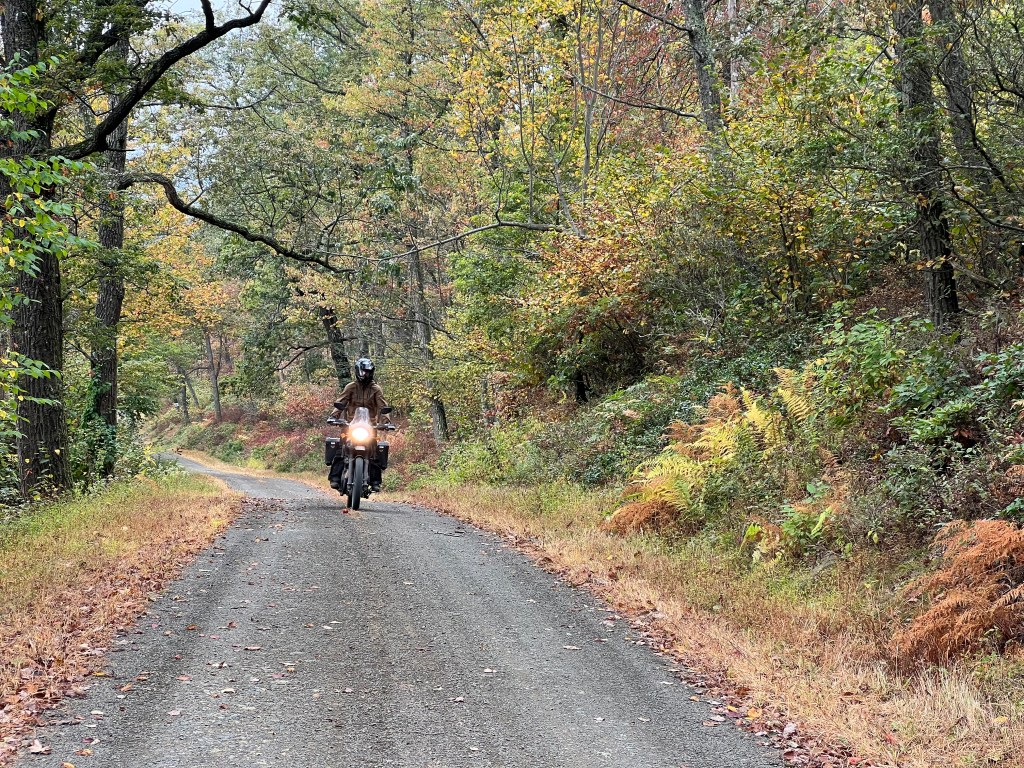
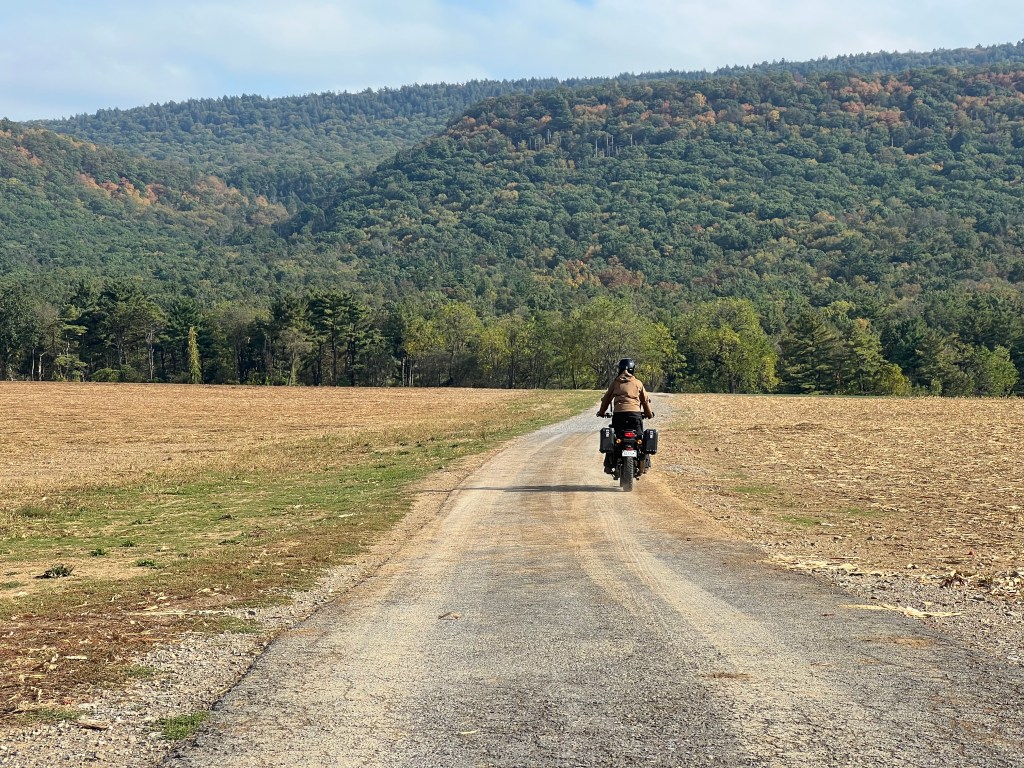
    On the first morning of our Pennsylvania adventure, we rolled out fresh and eager. The sun climbed over forested ridges, casting a warm glow across the valley. Today, we start with Section 3 of the PA Wilds BDR: 164 miles of gravel, forest roads, and hidden valleys. Fall was in full swing; maples and oaks flickered reds and golds in the sunlight. Rolling hills and distant ridges appeared and disappeared as the road folded back on itself in a hypnotic rhythm.

    The ride started smoothly, tires skimming over loose stones and nicely maintained gravel roads. Then, just as the rhythm sets in, a road sign appears: “Road Closed – 5 miles ahead.” Classic foreshadowing. Closure, as we know, is rarely absolute. “Road closed?” Chris says. “How closed can it be?”

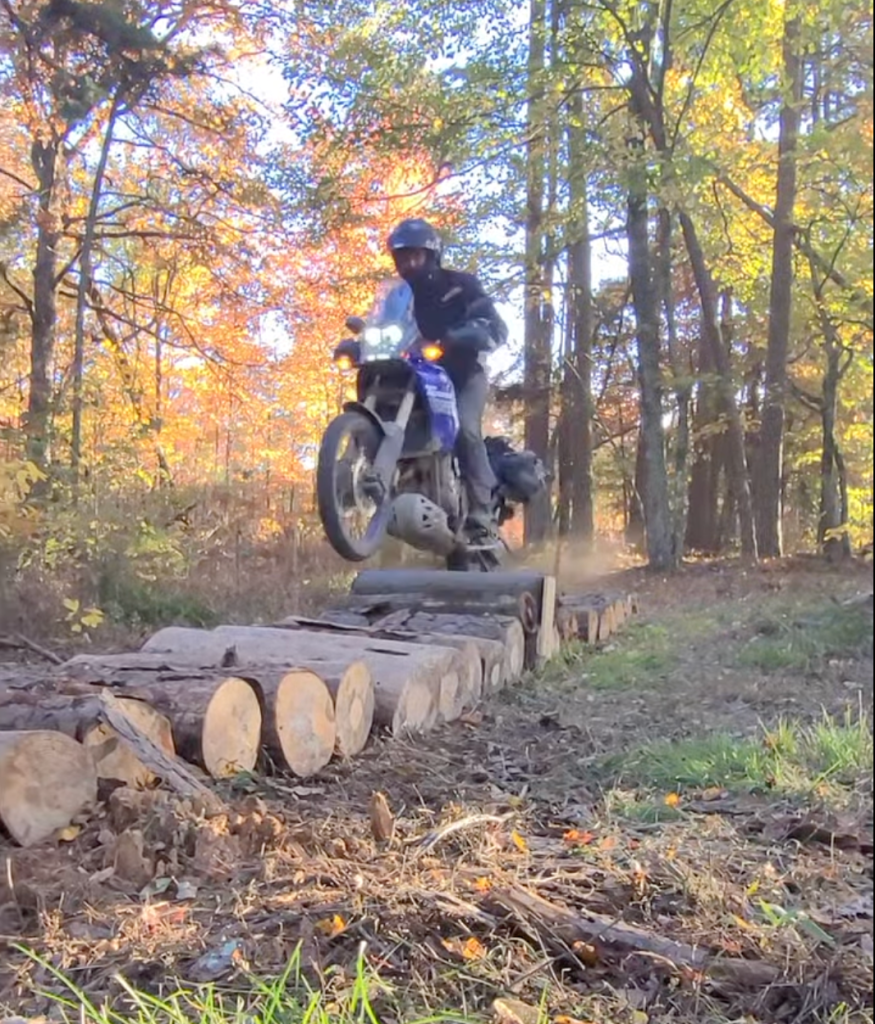
    Not long after, the answer reveals itself. Bridge construction sprawls across the path: Cement barricades litter the road like abandoned chess pieces, rebar juts skyward like skeletal fingers, and a dormant crane crouches in the distance, prehistoric, Jurassic Park–ready. Loose gravel skitters under our boots. Chris becomes pure momentum, sending the bike over rogue construction panels like a hero in a DIY montage. My bike’s turn comes—commitment unwavering as he runs back, jumps right on and does an encore performance. Boots tap, tires slide, adrenaline hums. Meanwhile, I narrate silently from the sidelines, prestige-documentary style, until the inevitable: the walk of shame as I traverse the scene on foot.

    The forest gravel road stretches onward, and that’s when I notice it: a square opening in the remnants of an old stone foundation. Out of the corner of my eye, it looks like nothing. Then suddenly, my imagination kicks in: hobbits, rituals, haunted mini-homes.

    Chris hears my exclamation over the helmet intercom:
    “Oh wow, I wonder where that goes!”

    I quickly park on the side of the road, hop off and jog towards the hobbit hole. Torchlight engaged—phone flashlight trembling like a nervous Android candle—I peer inside. It’s dark, damp, unhelpful. Shadows crawl across jagged stones, soil hints at abandonment, a perfect set for a low-budget horror flick. Chris encourages:
    “Go on inside.”
    “Looks like one of those haunted spaces you see in the movies.”

    I promptly sprint back to the bike. Zero out of ten for comfort, ten out of ten for story potential. Miniature hobbit hole of horrors: highly recommended.

    The afternoon sun is slowly starting to come down. The landscape opens up quickly, and before long the road runs straight through a set of cornfields. It’s flat, smooth riding—just a simple farm road with rows of cut corn stocks on both sides. It’s a brief section, but it stands out because it feels so open compared to the rest of the forested route.

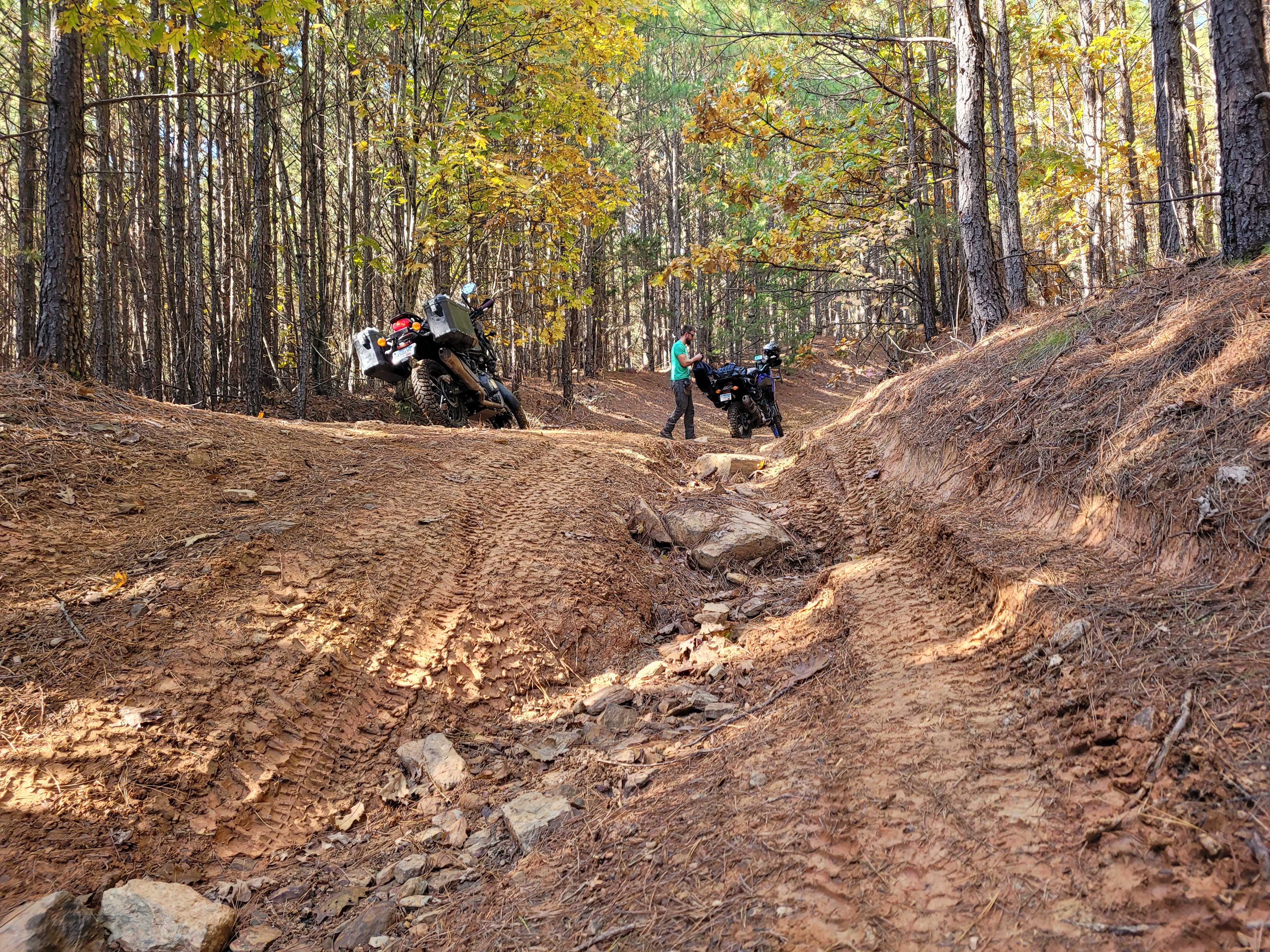
    Once you reach the end of the fields, the terrain changes almost immediately. The road narrows, the gravel gets rougher, and the first rocks start appearing. Within a few minutes, the route becomes a steady uphill section with a mix of loose rock and embedded stone. The climb continues through the trees, with a few spots where the surface gets chunkier and you feel the rear tire slip slightly before catching. A consistent, rocky uphill that keeps you focused until you reach the top.

    After the climb levels out, the road becomes easier again. I stop the bike to catch my breath and take a moment to celebrate the accomplishment of having conquered this section. To the average rider, this isn’t overly difficult, but it does require a bit of line-picking and keeping steady momentum. Being able to see my skills improving is encouraging and gives me some much needed confidence for what the next few days could throw at us.

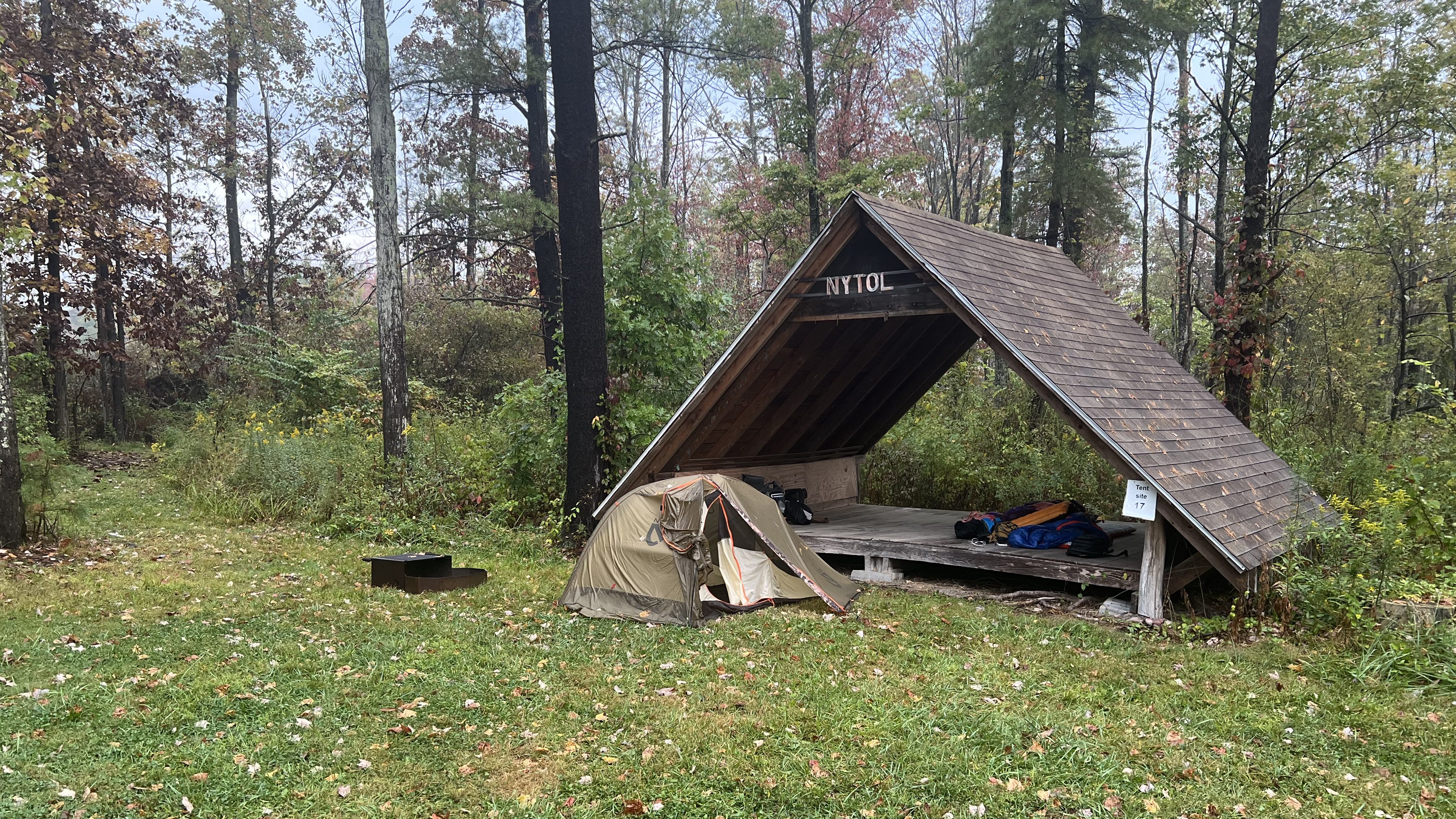
    By late afternoon, the miles have carried us past forested ridges and narrow valleys, rolling farmland opening the view as we approach Milroy. First order of business: find a place to stay the night. The website promised mini cabins, hot tub included, for $89. However, when we contact the campground management, it turns out that there is an additional $50 cleaning surcharge. Our dream is crushed, in order to respect our budget. Instead we decide to go for a classic tent site for $47.

    Hunger propels us into town. It’s Monday; not much is open. Across from a trailer‑park‑vibe stretch, we spot a bar. Perfect. We clomp inside in full ADV regalia—dusty jackets and boots, helmets under arms. While Chris walks to the bathroom, I head towards the bar area to ask if we can sit on the outside patio.  A man sitting on the nearest stool turns towards me and with a sweeping up/down glance asks:
    “What kind of horse did you ride on into here?”

    His accent catches me completely off guard: Since when does Pennsylvania cosplay the Deep South? My brain responds on autopilot:
    “A really dusty one.”

    My response is promptly rejected with a shoulder turn. He resumes his original position and continues drinking his beer. Okay then. 

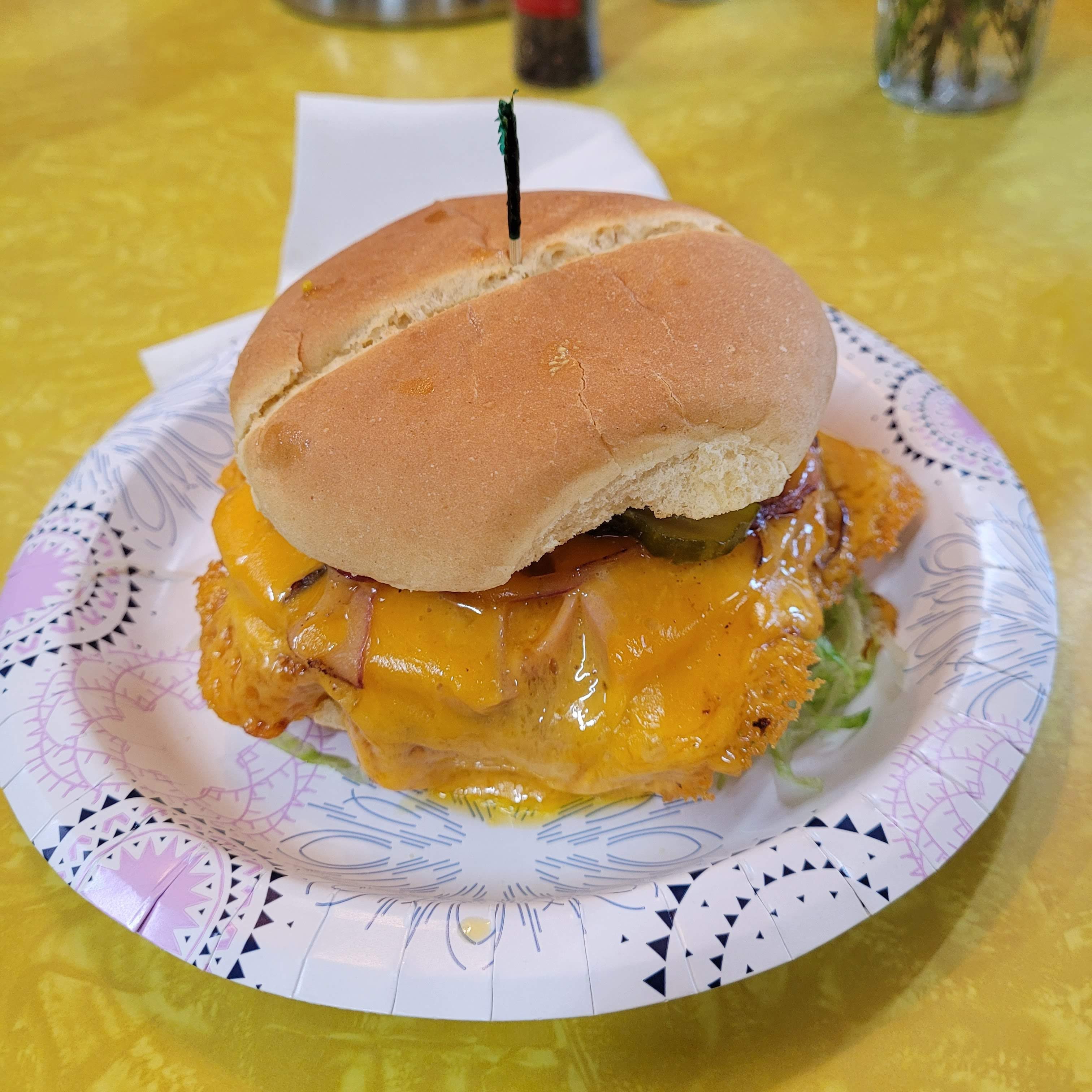
    We step onto the patio, order our meals and get to witness a corn hole tournament in full swing. It’s live, loud, and fueled by enough beer to make the rules optional. It’s glorious in a National-Geographic-meets-drunk-backyard way. Our burgers devoured, beers gulped down, we hear thunder rolling in like a cinematic audio cue. If we don’t get back to our campsite soon, the rain will get the better of us.

    By the time we retreat to the tent, the sky is darkening and occasional raindrops are pattering on the canvas. Dirt under finger nails, dust in every seam, adrenaline fading into tired contentment. Day one of the PA Wilds BDR: complete. 

    Our next morning’s verdict is… Sore. Unrested. Questioning life choices. We ride past the tiny hot‑tub cabins and wave politely, mourning silently. If there is one regret we will have during our adventure, it’s not having taken advantage of a hot tub after a long day on the motorcycles. This is the price to pay when living on a budget.

    Day Two: Milroy to Waterville (126 miles)

    The second day greeted us, not with a sunrise, but with fog so thick it seemed to blur ambition and destination alike. We packed our gear and made a beeline for the nearest breakfast spot, desperate for caffeine to stir our minds. A hearty morning meal at The Honey Creek Inn did more than fuel us—it sharpened our focus and gave the day ahead a sense of purpose.

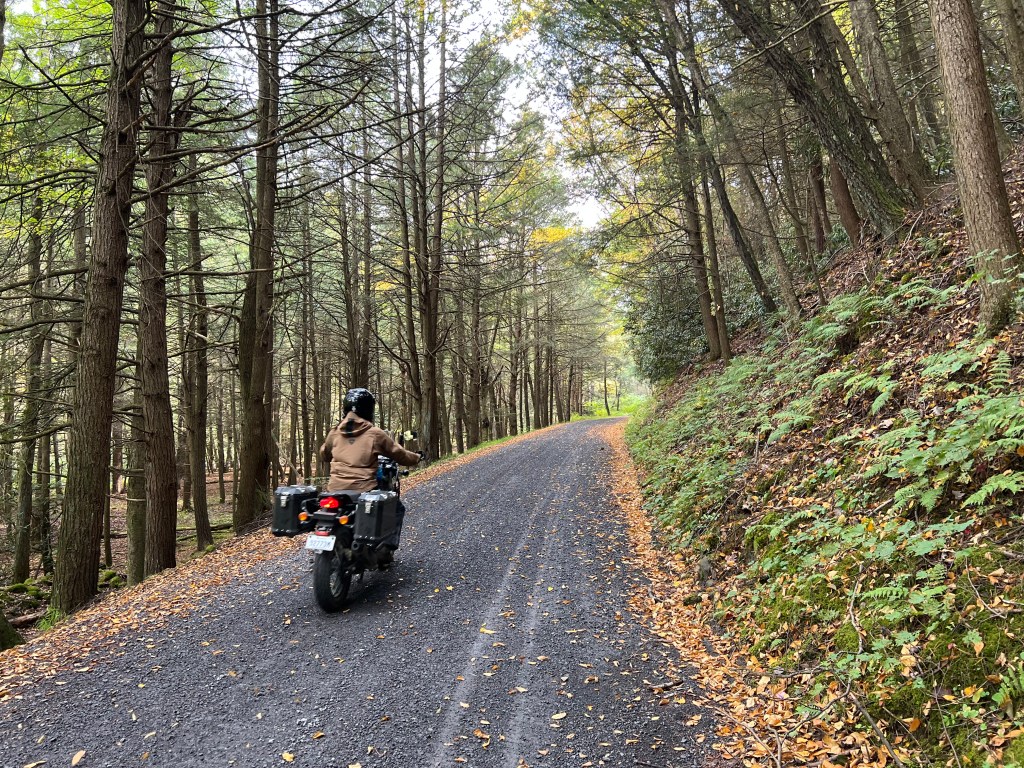
    From there, we plunged into the desolate expanse of Bald Eagle State Forest. The gravel twisted and climbed, rising and falling across mountain gaps like the undulating back of some ancient creature. Here, the roads flow with a gentle, forgiving rhythm—perfect for those seeking adventure without the aggression of technical trails.

    Mist clung to us like a living presence as I eased to a stop on the dirt road to take it all in. The forest around held its breath. Every leaf shimmered with the remnants of rain, trembling under water still undecided whether to fall or hold on. The air was thick with the unmistakable scent of damp earth, pine, and something primal I couldn’t name. It filtered through my helmet like a whisper from a dream, both familiar and strange.

    Above, the trees arched in sweeping vaults, their limbs intertwined like the ceiling of a forgotten cathedral. Shadows lingered in their upper reaches, while the forest floor glowed faintly, a diffused light reflecting off the mist. The peace was absolute, yet edged with something sharp, a quiet that felt as if the woods were watching. Beauty here demanded stillness—it pulled you inward, slowed your pulse, and forced reverence.

    For a moment, I stayed there, suspended between calm and unease, breathing in the wet air, letting the hush after the rain sink in. When the engine beneath me rumbled, a low hymn in this sylvan sanctuary. I dropped into gear, twisted the throttle, and let the towering trees swallow me as the trail carried me deeper into the PA Wilds Backcountry Discovery Route.

    The winding gravel roads alternated between ascents, ridge lines, and descents, each offering glimpses of the Pine Ridge Creek valley before climbing back toward the ridges. By early afternoon, the rain had turned relentless. We were approaching Waterville, eyes scanning the GPX map for the Waterville Inn.

    At first, hope faltered: the inn was closed on Tuesdays and Wednesdays. A glance at the other local inn brought no relief—it sat permanently shuttered. We returned to the Waterville Inn, soaked but undeterred, huddling under the porch and pleading with the mist, “Anything but canvas.” We couldn’t handle another sleepless night on the hard ground.

    Then a grey pickup rolled in. A man stepped out, keys in hand, moving toward the locked entrance with the air of someone who belonged. “Who ARE you, rain-key-hobbit-sir?” I muttered under my breath. Minutes later, he returned and looked towards us. “You waiting on a key?”

    We stared. Did he even work here? Not quite. He was a restaurant supplier, and better yet, a friend of the owners. He personally guided us to the country store next door, helping us get in contact with the Inn owner. Within minutes, we secured the last available room. Ritchie, patron saint of last-minute budget redeemers, had saved the day.

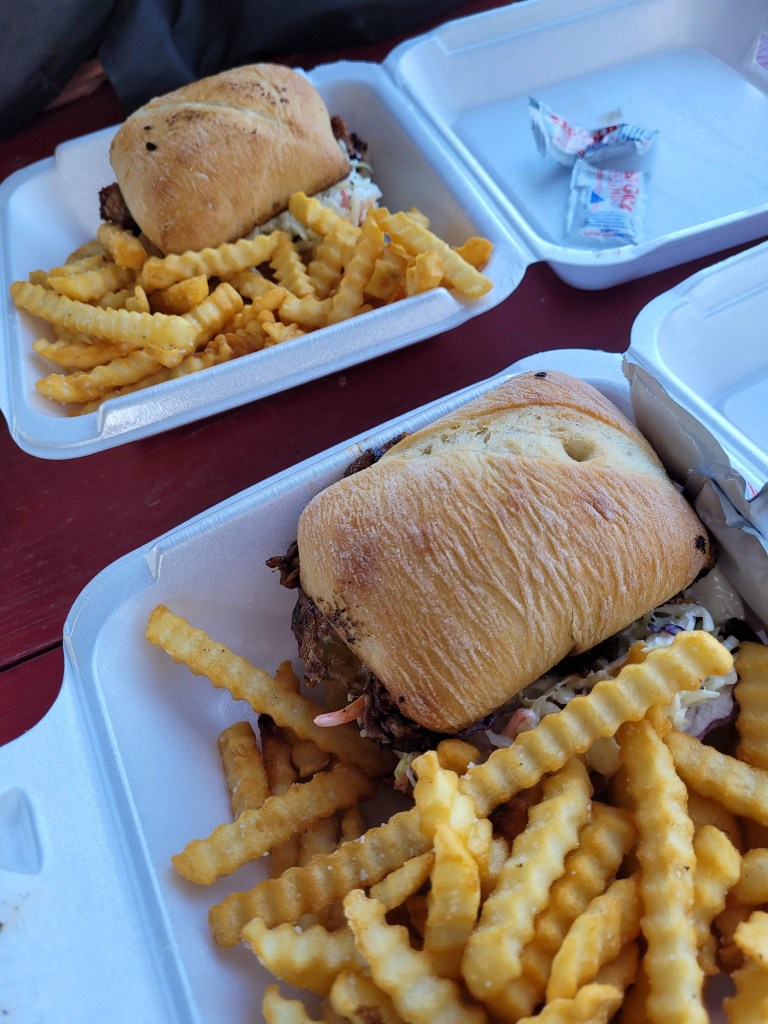
    Supper followed, courtesy of Ritchie’s recommendation: homemade deli subs from the Country Store “so good that the Amish boys love them.” Cultural endorsement accepted. While we waited for our subs to be assembled, we wandered the country store aisles—a survivalist candy land of fishing gear, camping necessities, hunting paraphernalia, and taxidermied squirrels in mid-victory poses. A tiny boxing raccoon grinned up at me. Roadside Americana at its finest.

    Soon, the inn owner appeared. We paid for the room and were led upstairs to a space that Pinterest would classify as “Rustic Luxe Meets Log-Cabin Aesthetic.” Gear and baggage were piled near the warmth, a small comfort against the forecasted rain.

    Then came the moment I had imagined all day: collapsing onto the mattress.

    It… boinged.

    Betrayal. Too springy. Too firm. This was supposed to be my night of restorative glory. Chris, meanwhile, was already asleep—lights out, no commentary, a mystery of manly endurance that science may never solve. I lay there instead, listening to the rain drum a steady rhythm on the roof, the forest’s hush now translated into a lullaby of droplets and distant wind.

    Day 3: Waterville to Crossfork (140 miles)

    We leave Waterville behind and dive back into the forest roads. Pine, oak, and hemlock scent the air, a damp, earthy perfume mingling with the faint tang of moss and fallen leaves. Each twist of the road reveals another ridge or hollow, rolling topography that makes your body follow the bike instinctively—lean, lift, a fleeting moment of perfect flow.

    The gravel alternates between smooth stretches and loose patches that keep you honest. Small streams gurgle through rocks, their edges lined with ferns glistening like tiny emerald carpets. Mist clings low in the valleys, wrapping the hillsides in a secretive veil.

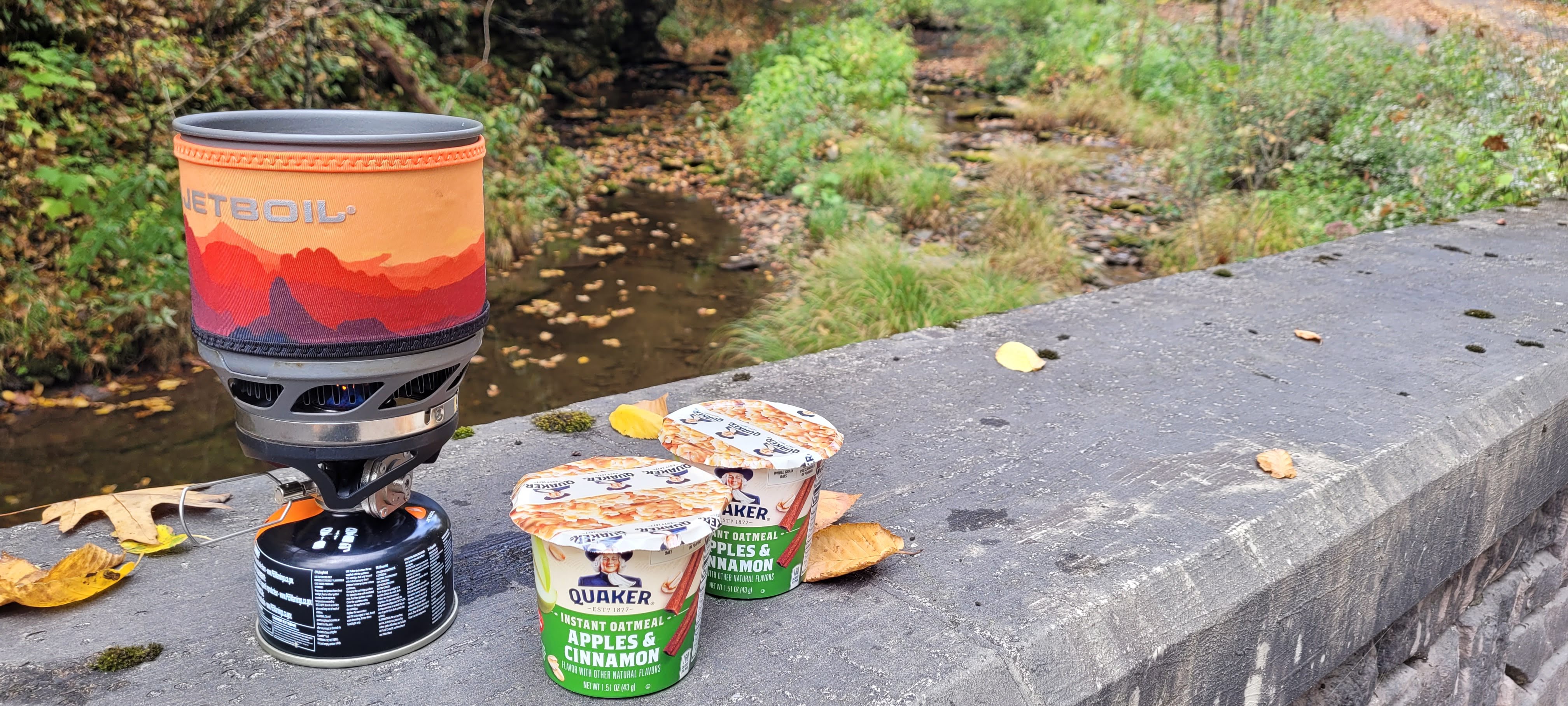
    By midday, a bridge became our impromptu rest stop. We unpacked oats and stirred a pot of oatmeal on our Jetboil stove beneath misty trees. Birds trilled overhead. For a few brief moments, the calm made me consider abandoning civilization entirely, embracing the life of a nature columnist, utterly absorbed in the quiet babble of the brook below.

    As we wrap up our break and head back on the road, we see wildlife flit in and out of sight. A flash of copper marks a red fox; further down, a white-tailed deer freezes at the roadside, weighing our presence before vanishing back into the trees. Bird songs echo faintly, a soundtrack to the solitude. Towns are rare: Duncan is little more than a quiet cluster of homes and a general store—a brief human punctuation before the forest reclaims the road.

    Every mile here is a study in contrasts: steep climbs that test endurance, followed by descents that demand attention and reward riders with glimpses of hidden valleys. The road’s twists mirror the hills’ undulations, a natural choreography that makes you feel less like a visitor and more like a participant in the landscape.

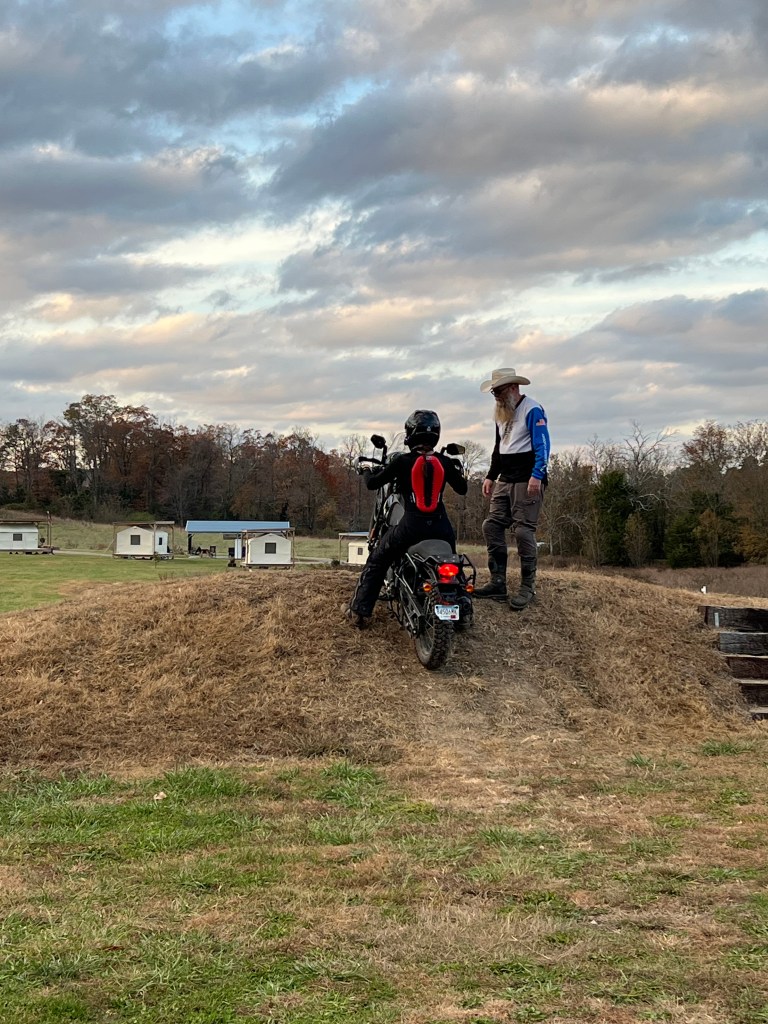
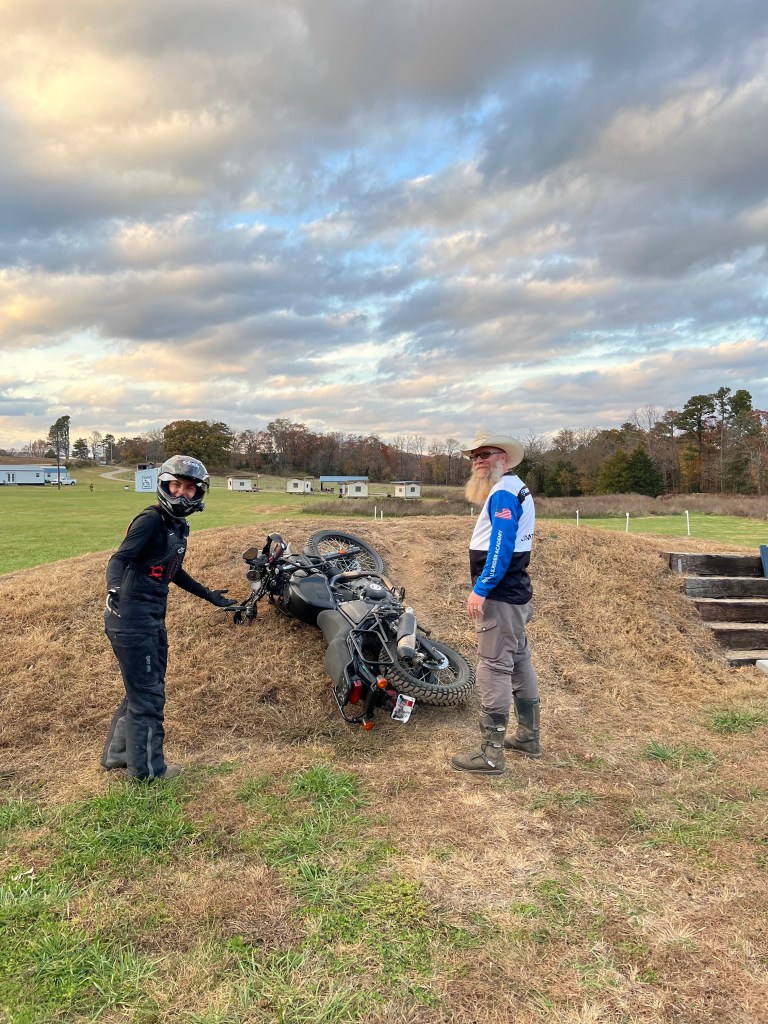
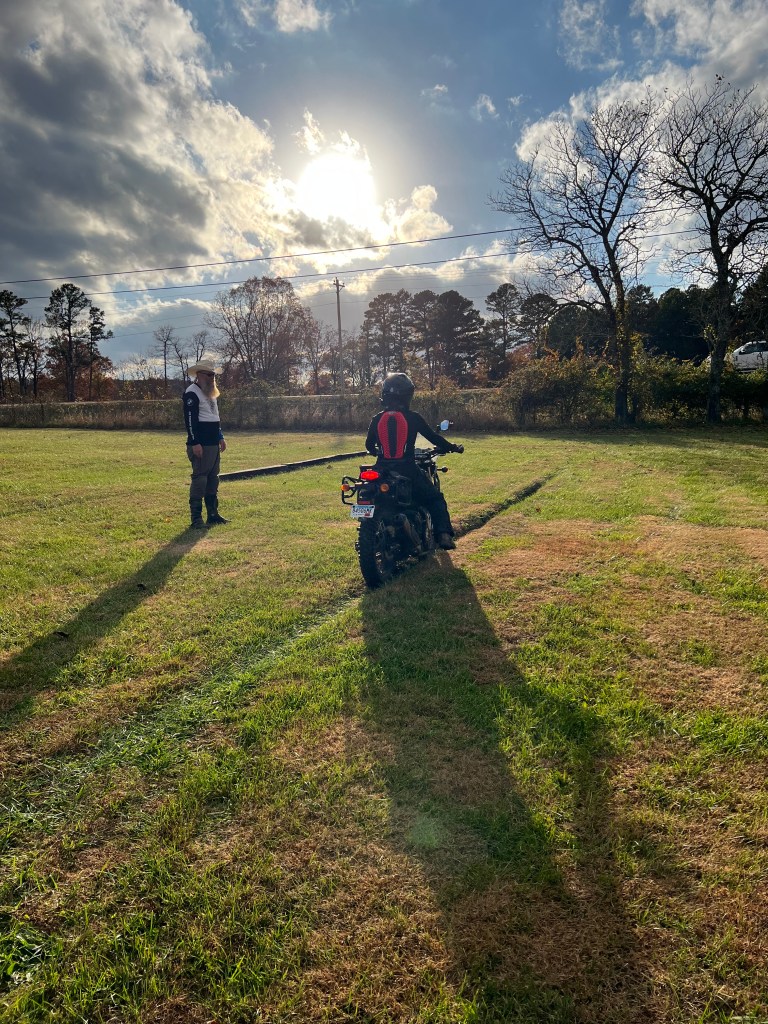
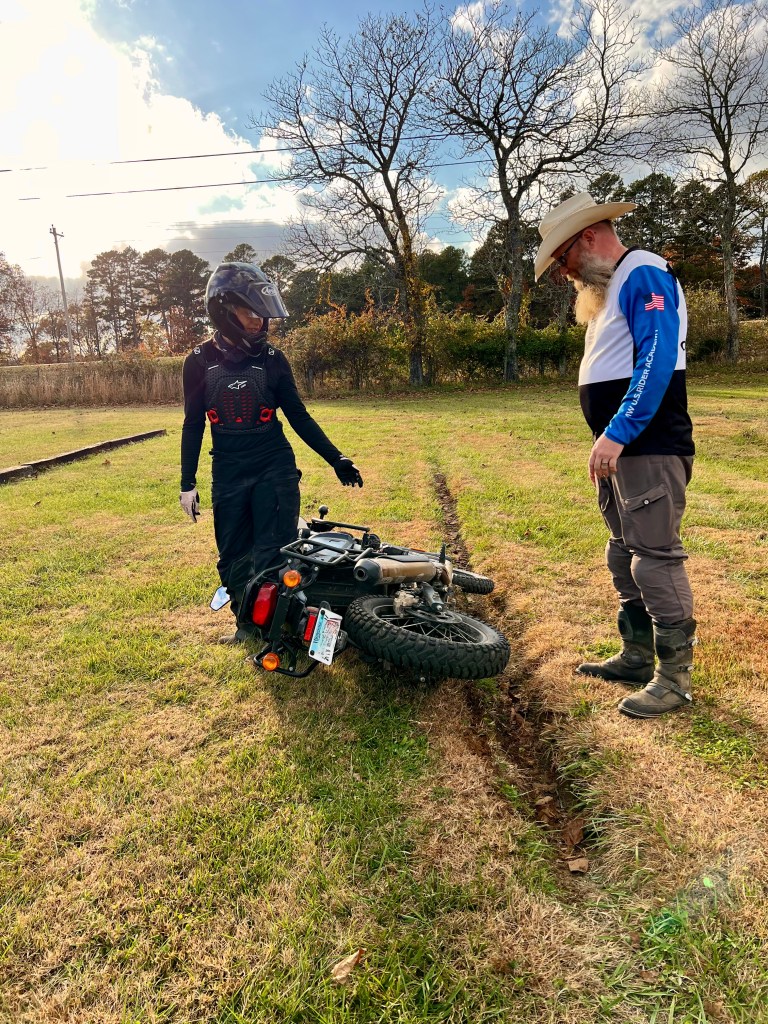
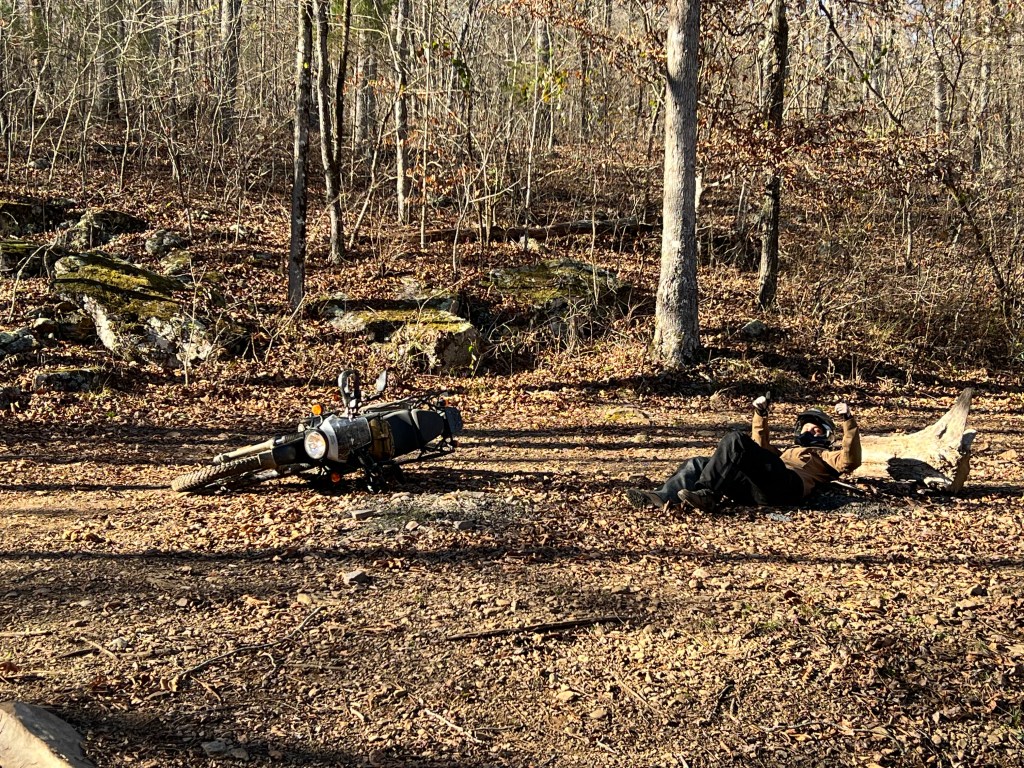
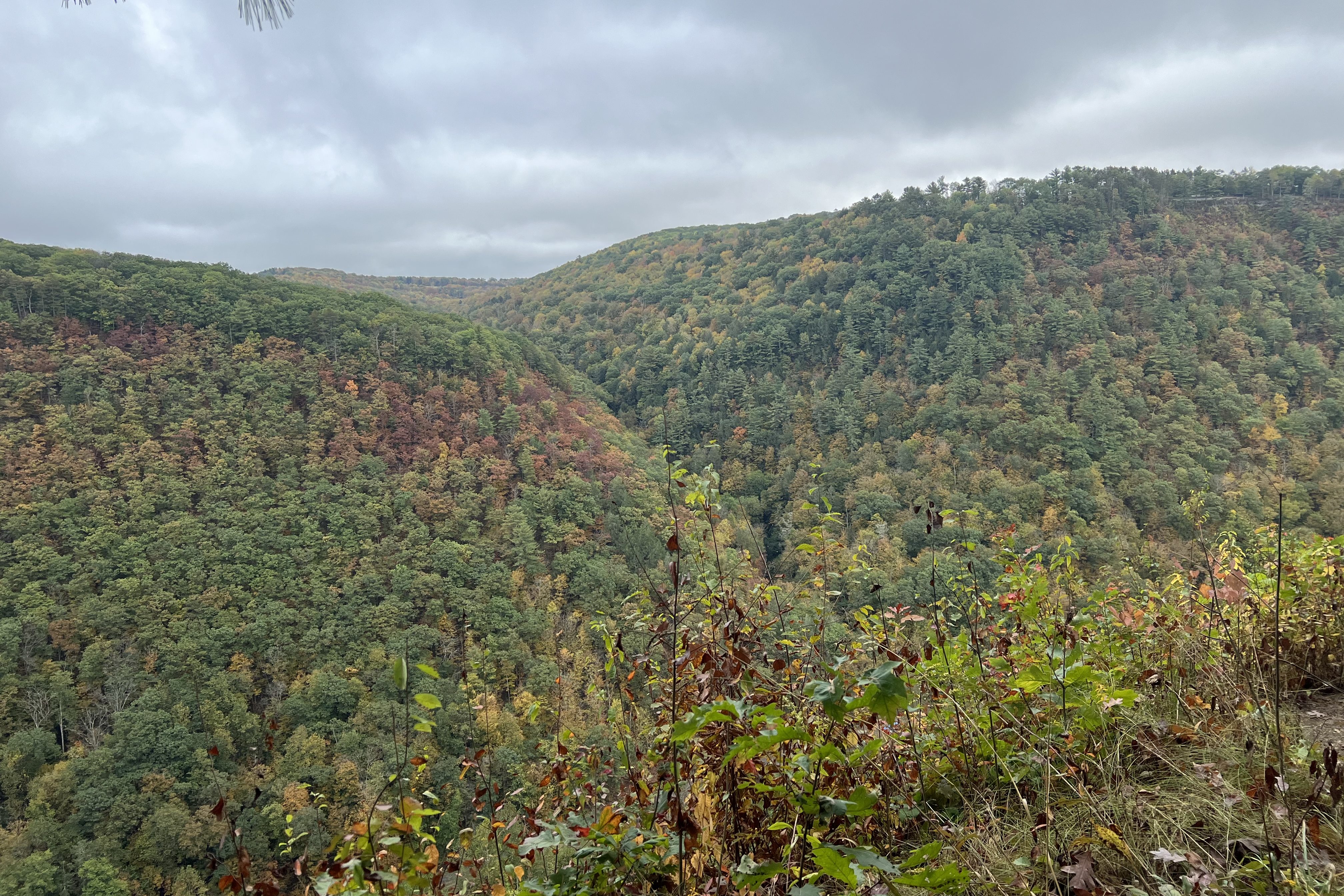
    There’s a small detour to the Colton Point State Park overlook. Before all this, I’m blissfully unaware of what’s about to unfold. Our comm systems are still on, and Chris barely has time to park before he notices me trying to back up like an ungraceful duck attempting to waddle backwards with all 400 pounds of my motorcycle. He sees the disaster forming before I do. Through the headset I faintly hear, “…you’re falling!” which I find ridiculous, because my left foot is already pushing down the kickstand. But then I feel it—that slow, undeniable gravitational pull. Before I can make sense of anything, the bike tips right, taking me with it, and I end up sprawled across the parking lot. How is this happening again? All I can think to say, staring up through my rectangular visor at the tops of the trees, is: “How did you know I was falling!?” The parking lot is barely off-camber—maybe a couple of degrees—but just like on the Cabot Trail, it’s apparently my nemesis.

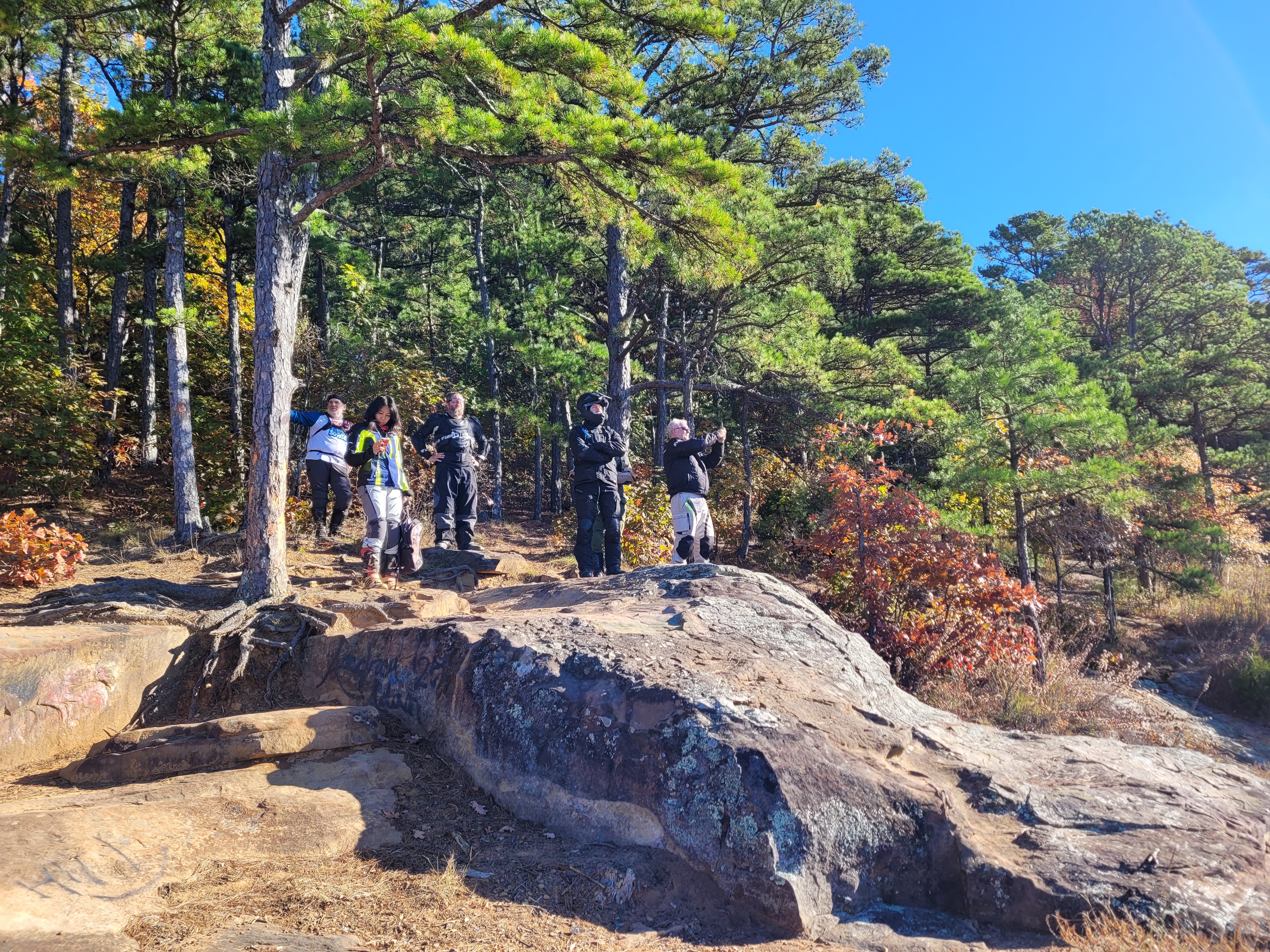
    We walk to the overlook afterward. It’s beautiful: Pine Creek winding far below between two mountain ridges, families scattered along the railing, everyone taking in the view. I try to keep up a strong front, as if I didn’t just tip over in a perfectly normal parking lot, silently hoping no one noticed (at least no one rushed over like during the Cabot Trail episode). To this day, I barely remember the overlook itself—just the flood of adrenaline and the photo that proves I was actually there.

    By the time Cross Fork appears, the forest thins just enough to reveal glimpses of sky and distant ridges. Solitude lingers like a shadow, even as signs of settlement whisper that civilization has not entirely abandoned this stretch.

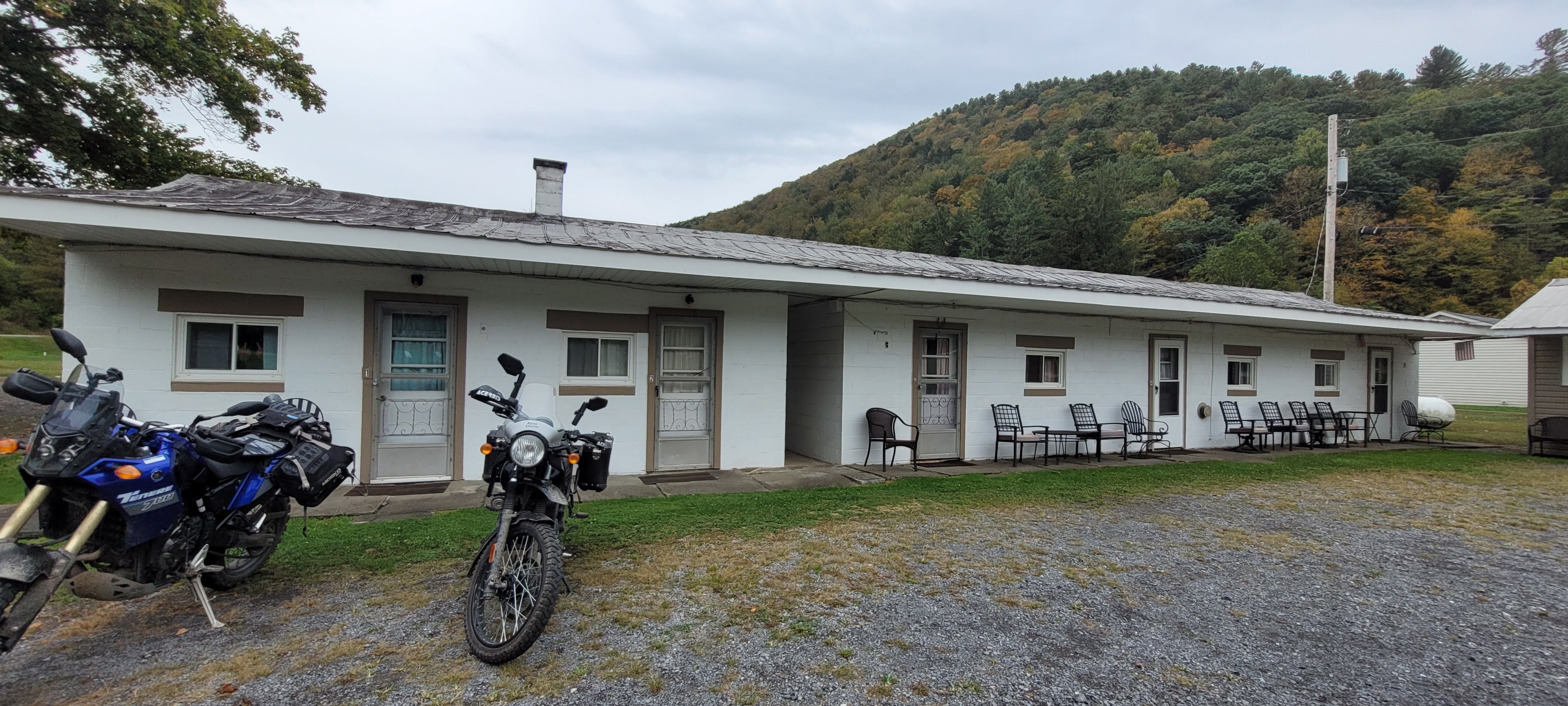
    Outside the bar, we met a man enveloped in a cloud of cigarette smoke. Paul, owner of the modest motel we had passed—its mid-century façade a relic that could belong in a roadside anthropological archive labeled Hunting Grandpa Chic—offered more than a room that day. He offered a rescue arc.

    He accepted only cash or checks. Our situation? Cashless. Town facilities? No cash-back options available. Paul’s solution? “Mail it when you can. I won’t leave anyone stranded by my watch.” Not all heroes wear capes.

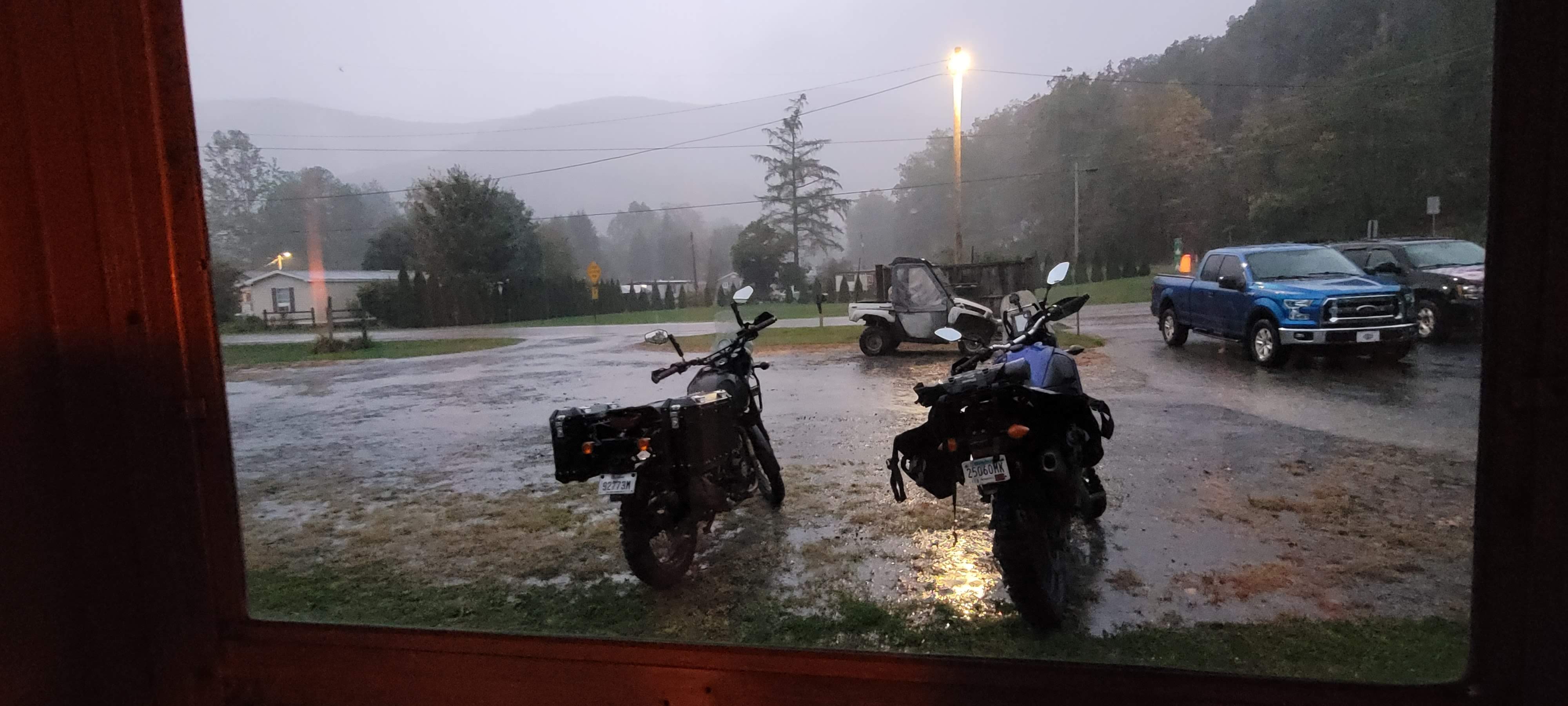
    Rain rolled back in, thunder gathering. Night riding in rain and darkness was a firm no from me, so we accepted Paul’s benevolent loophole hospitality and checked into our retro revival roadside palace.

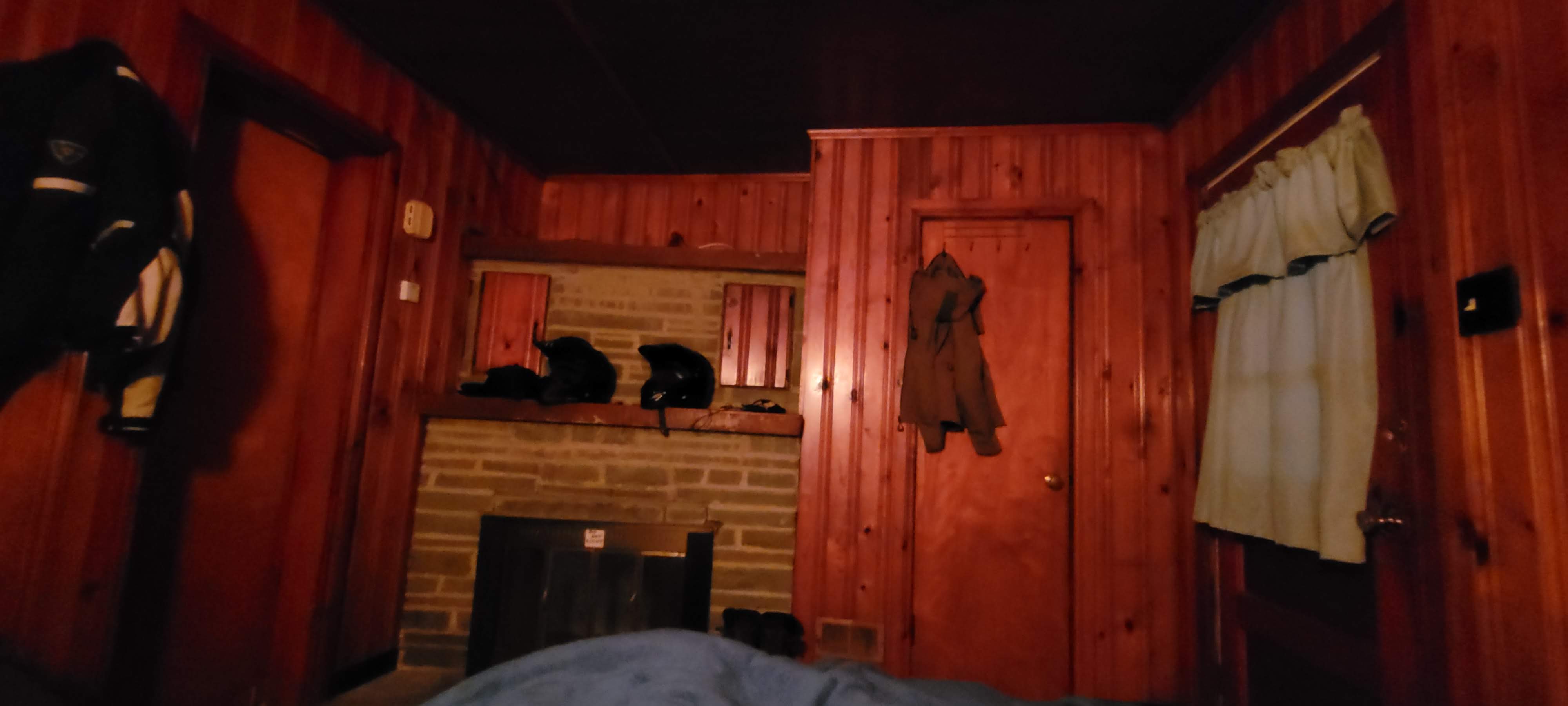
    Inside, the décor looked curated by hunters whose color palette peaked in 1973. The beds? Coils enthusiastic enough to trigger mattress PTSD. Yet I loved it. I reveled in the vintage spectacle like an art critic evaluating motel maximalism. Our bikes stood obediently outside our door, sentinels in the dim light. Paul, an absolute legend in his own way, knocks on our door a little while later to offer us towels to dry off our motorcycles before we leave tomorrow morning.

    The place flirted with mild Bates Motel vibes—but only as autumn flirts with Halloween: slightly ominous, irresistibly moody. If dark literature had décor, this room would be its perfect embodiment.

    Day 4: Crossfork back to Kane (254 miles)

    After all that rain, the next morning arrived softened by mist. The roads ahead twisted in endless S-curves. A few puddles waited, glimmering in the pale light, promising small, sparkling splashes as we crossed. The logging zones were particularly treacherous—earth churned and chewed by heavy machinery, softened into a slick glaze we quickly dubbed “greasy.”

    It wasn’t mud, exactly. I would classify it more like existential doubt—damp loam mixed with sand, shallow but persuasive enough to whisper, “Go on. Slide a little.” Chris rode through it with unshakable steadiness; I rode it like a woman narrating her own survival tutorial. The terrain didn’t feel chaotic, but it was slippery enough, each wheel-spin felt like a negotiation with gravity itself.

    We passed small towns and clusters of farms, roads narrowing and widening, the forest opening in brief glades where mist curled over fields like smoke. Between Cross Fork and Weedville, the route followed winding ridgelines and gentle valleys, punctuated by stream crossings and pine-shrouded hollows. 

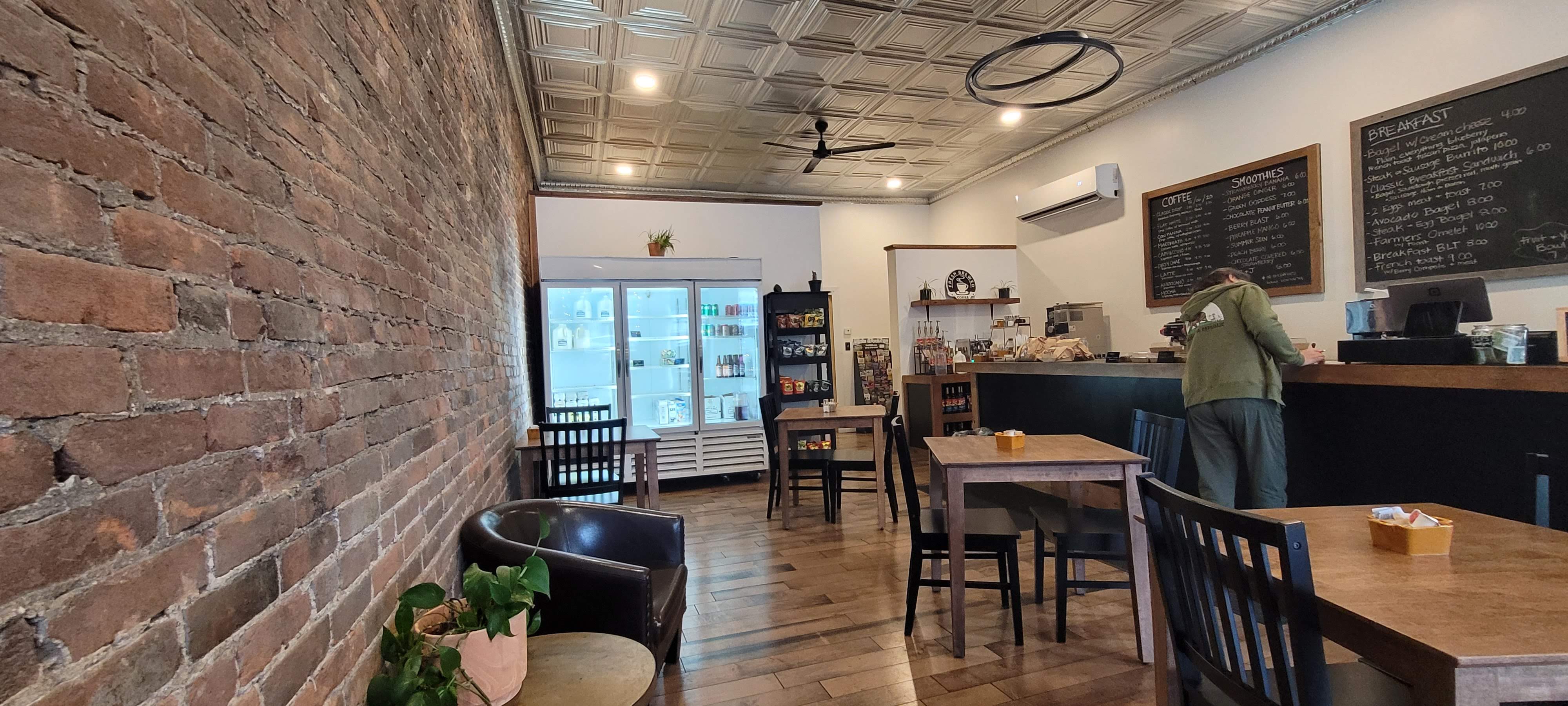
    A welcome distraction appeared in the form of a tiny, inviting café in the town of Emporium: Aroma Café & Market. Outside, rain hammered the roof in steady rhythm. Inside, the warmth, the smell of roasted coffee, and the quiet hum of conversation felt like a small, civilized miracle in the midst of the wilderness. We lingered, letting cups of steaming brew thaw our damp spirits.

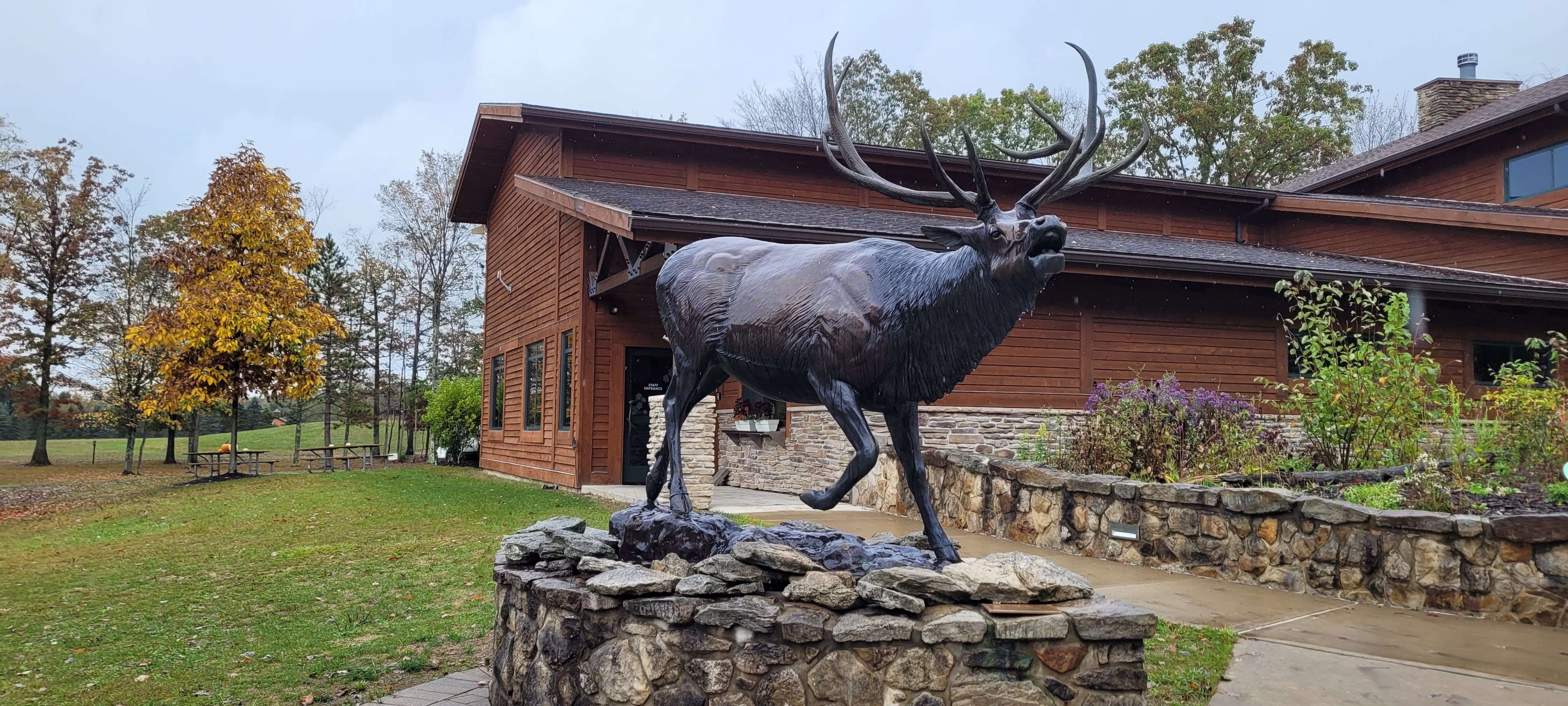
    Later, the Elk Museum and Visitor Center drew us in, though we knew the chances of seeing actual elk at this hour were slim. True enough—no majestic antlers wandering past—but the displays offered a silent reminder of the wildlife inhabiting these forests, and a moment to stretch our legs before the final push.

    From there, gravel and asphalt wound us back toward Weedville, then northwest toward our campground near Kane, PA. The off-road route was traded for highway in order to get back to home base a little quicker. The rain softened, mist lingering in pockets along the road, reflecting the waning daylight in silver patches. By the time we reached the campground, the RV and the familiar comforts it promised felt like a sanctuary after the loop: tires, bikes, and travelers damp but triumphant, ready to dry off and rest, knowing the forest had given all it had to offer.

  • Marathon Hikes & Surprise Seafood Feast

    Marathon Hikes & Surprise Seafood Feast

    Maine and Nova Scotia. It’s surprising how two coastal regions along the same Atlantic stretch can be so different. The very air tells two stories. 

    In Maine, the salt in the breeze is clean, briny, and threaded with the faint scent of seaweed sunning on the shore. It’s the kind of classic “ocean smell” people picture when they dream of the coast. The contrast is small but unmistakable. Maine’s air feels gentler, mellowed.

    Driving along, the coast reveals another set of differences. Maine’s houses have that iconic New England charm with weathered cedar shake siding, dark shutters, and an understated color palette shaped by storms, salt, and tradition. Many homes feature radiant “sun face” wall ornaments—technically called sunburst wall plaques—watching over wide porches. According to Wikipedia, they symbolize warmth, energy, happiness, and positivity, often inspired by ancient solar deities and cultural beliefs in good luck and abundance. It’s a look that feels old-school, nostalgic even, especially as the road winds toward each mountain peak.

    Long Live The Daily Hike

    When one gets in the habit of hiking, it brings you into an almost addictive headspace. Where the streak must be continued. Every day feels incomplete without at least a few miles on a trail. Your cardio gets better, your balance improves, and even the hiking sticks start to feel like extensions of your own rhythm.

    With time, you begin to understand the personality of different trails—how “moderate” can mean anything from a pleasant forest walk to a full quad workout; how elevation gain written on a map never truly reflects how steep a climb feels when your breathing quickens. There were a few hikes I had planned that ended up taking much longer than expected. Some even pushed us past sunset, turning into careful nighttime descents lit only by headlamps.

    Those after-dark hikes were a first for me. The forest shifts at night—the temperature drops, the birds quiet, and every rustle feels amplified. My knees, already a bit weak and jumbled from hours of stepping over roots and rocks, protested with every uneven stretch. The already difficult task of placing each foot over obstacles rather than into them became even more challenging as the sun slipped behind the tree line.

    But there was something strangely calming about it too. With our headlamps cutting narrow beams through the darkness, the world shrank into a tunnel of light. Step, plant, breathe. Step, plant, breathe. Mile after mile, we made our way back to the truck—slowly, steadily, and somehow feeling more alive than we had at the start. Especially when the unmistakable howl of coyotes echoed in the distance.

    Saturdays Are For Long Hikes

    Then came the Saturday that will forever be known as THE LONG HIKE.

    I had planned what I thought would be a challenging but reasonable nine-mile route. Nine miles didn’t sound like much, mostly because my brain still insists on converting everything into kilometers and convincing me it’s shorter. 

    The logic was simple: We had a full weekend to rack up miles and conquer peaks. And for some reason, it had evolved into this unspoken competition with ourselves—pack in as much as possible, squeeze every ounce out of daylight. So much for nature’s calming influence.

    As we approached the trailhead I’d pinned on our map, two crucial factors had been conveniently ignored: the time and the day. We left for the trail at 10 a.m. on a beautifully sunny Saturday in Acadia National Park. Peak weather, peak season, peak foolishness. Naturally, the parking lot I aimed for was completely full.

    Time for Plan B.

    We kept driving up the winding road along the base of the mountains, searching for any sliver of available space. The next lot was also full—but there were cars neatly lined along the shoulder of the road. Perfect. We joined the single-file pilgrimage, creeping forward until we hit a stark sign that read: “NO PARKING BEYOND THIS POINT.” Because we are eternal optimists, we tried our best to wiggle our big truck behind the sign, but also dangerously close to the front bumper of the car behind us.The front cab and hood of the truck were definitely flirting with illegal territory, while the bed of the truck was defiantly sticking out. If you squinted, we were good. Technically. Kind of. 

    As it turns out, nine miles was actually fourteen miles once the full route revealed itself—twenty-two kilometers. That mathematical betrayal hit us only after the fact.

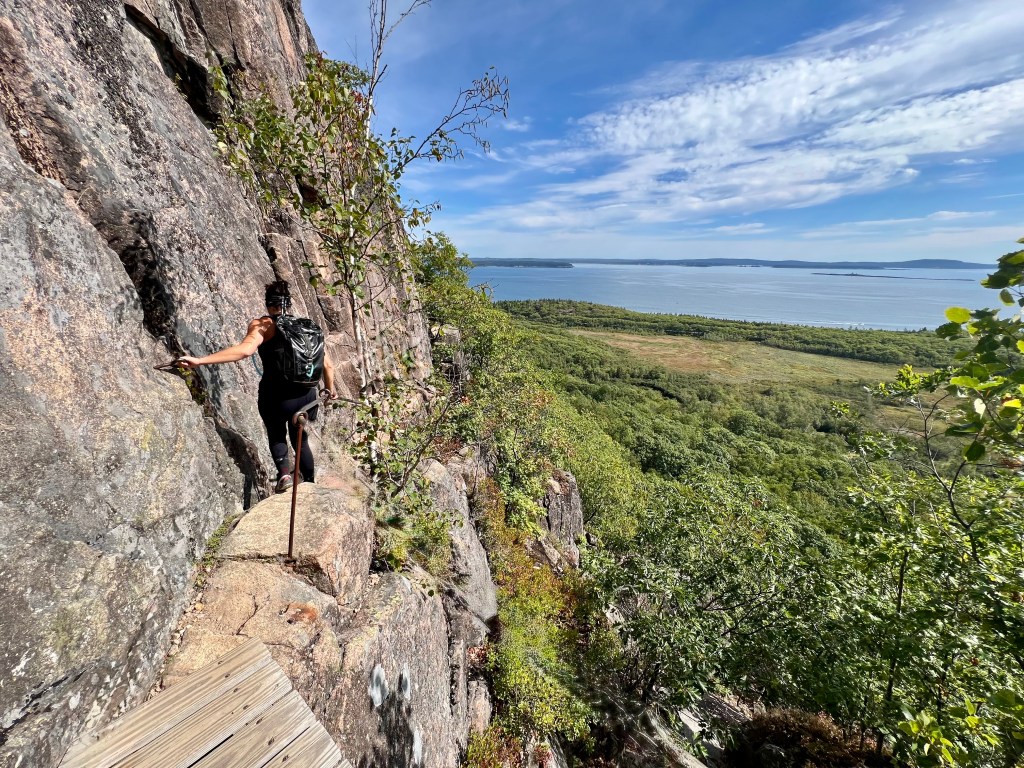
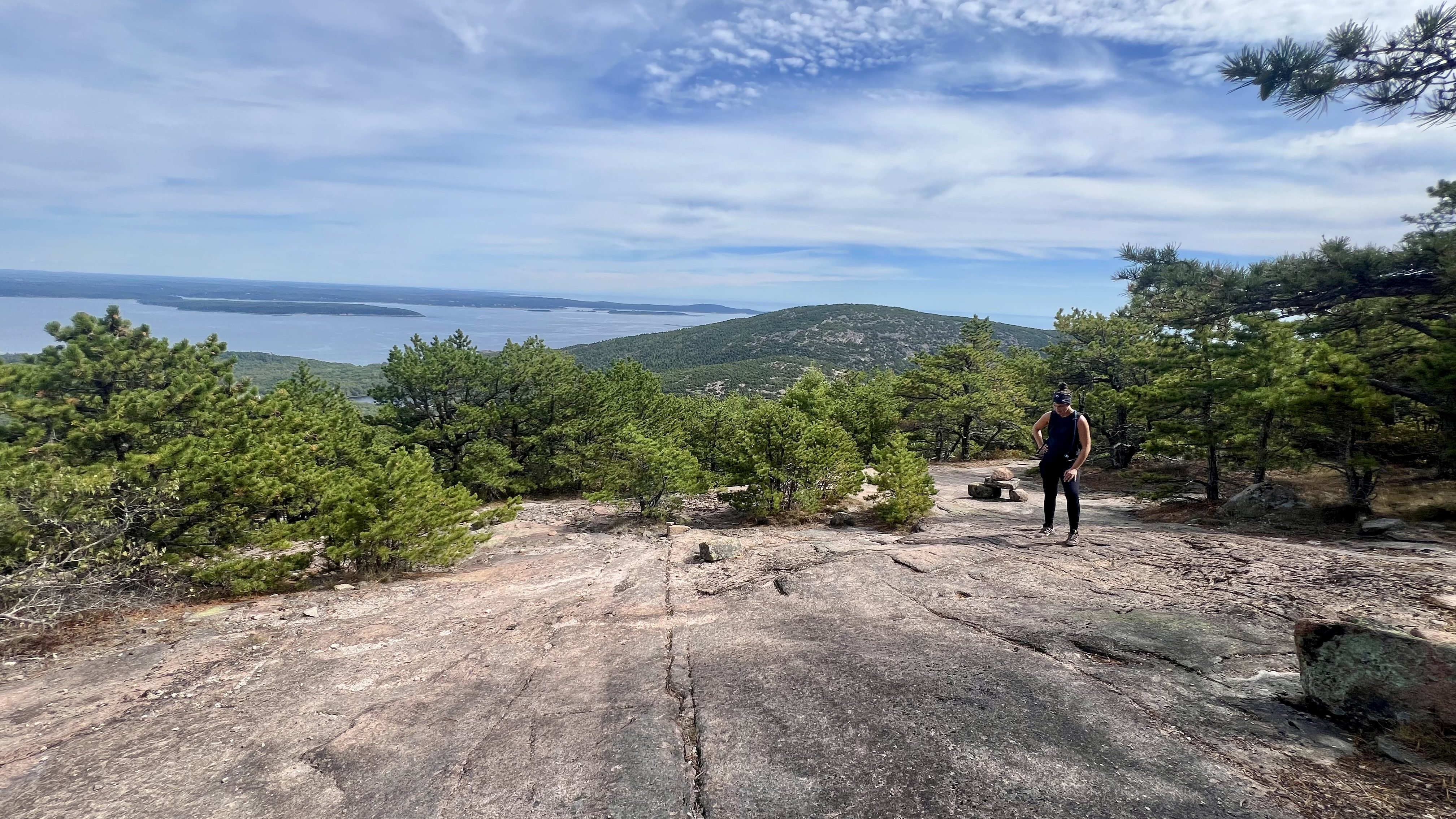
    We began with the famous Precipice Trail, which turned out to be exactly what the name promises, with absolutely no false advertising. The route climbs almost straight up, rising over iron rungs bolted into the cliff face, threading narrow ledges that press your spine against granite and dare you to look down. The views are spectacular. Every downward glance delivered a pleasant surge of vertigo and the reminder that gravity is a very real concept.

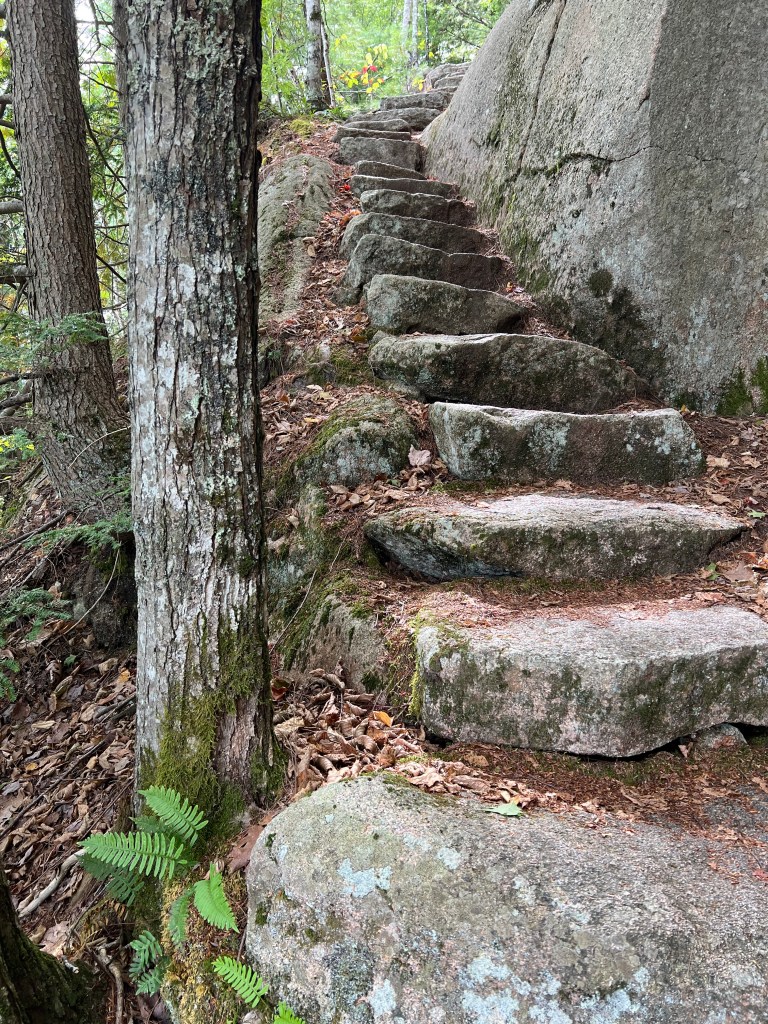
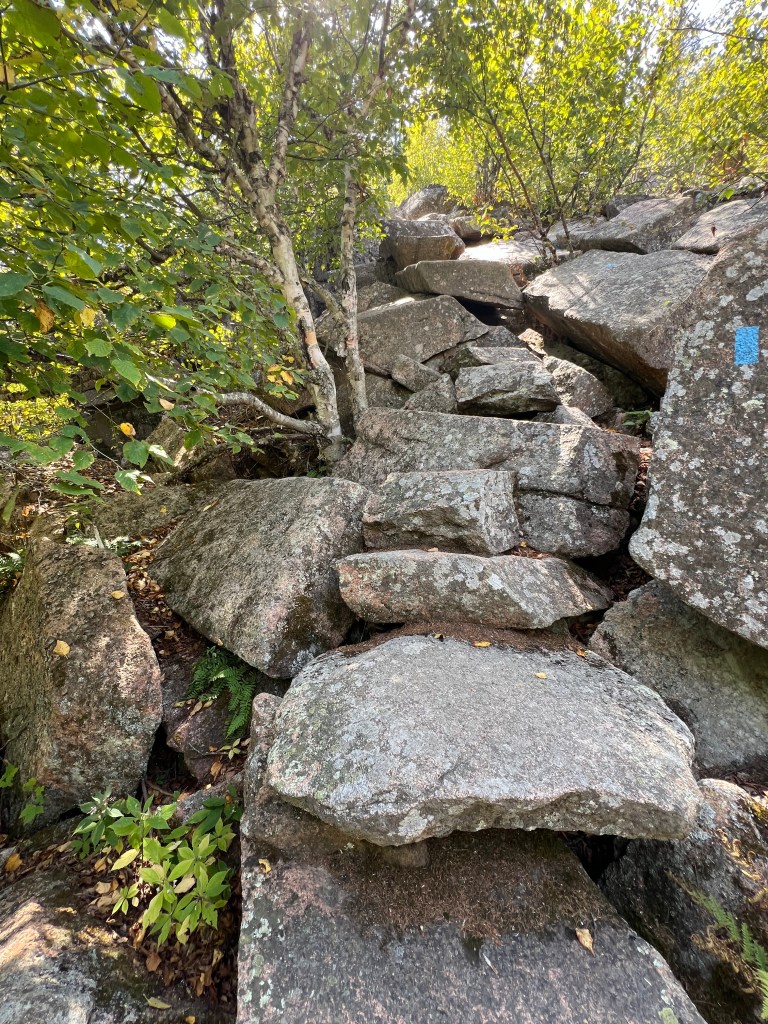
    As we continued our quest for spectacular views atop mountain peaks, we had the privilege of hiking up various types of terrain. Among them, the rock staircases varied wildly—some neatly arranged like nature’s version of a gym circuit, others complete free-for-all scrambles. We followed the painted blazes, trusting that they knew where the trail was supposed to go even when our legs questioned why we were going there. Each step was a fresh reminder that glutes and calves are both heroic and dramatically petty when pushed too far.

    The trail stretched on far longer than expected. Every section seemed to open into yet another—another ridge, another scramble, another false sense of nearing the end. Hours passed. Eight of them, in fact. By the time we emerged from the last segment, every muscle in my body was trembling. But the vistas were indescribable, the kind that make you stop mid-sentence. The fellow hikers we met along the way were wonderfully kind with little bursts of camaraderie. Quick smiles, encouraging words, that unspoken “we’re all in this together” energy that happens when strangers become temporary teammates.

    One man, cheerful and sweat-soaked like the rest of us, recommended a brewery near our campground. “Great pizza. Great beer,” he said. “If you’re into that kind of thing.”
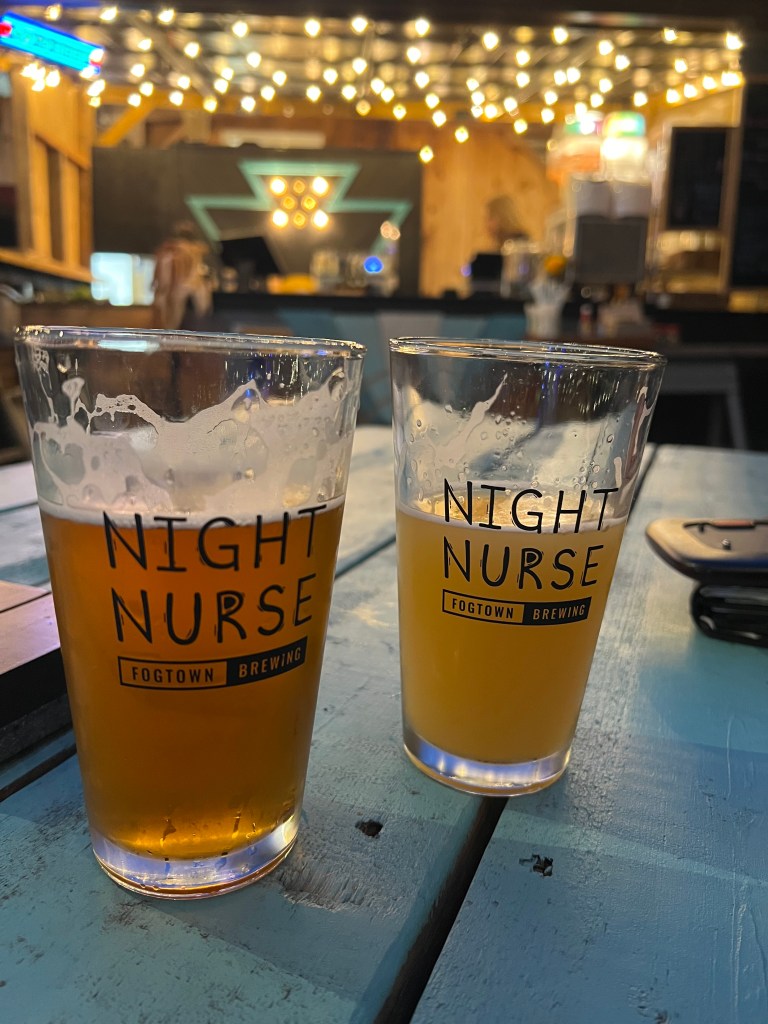
    Well. He spoke directly to our souls.

    The scenery almost erased the discomfort (almost) until we climbed back into the truck and my legs staged a mutiny. The photos taken that day capture the entire emotional arc: hopeful excitement, mild concern, worsening concern, full existential questioning, then the hollow-eyed perseverance of someone who just wants a sandwich and a soft surface.

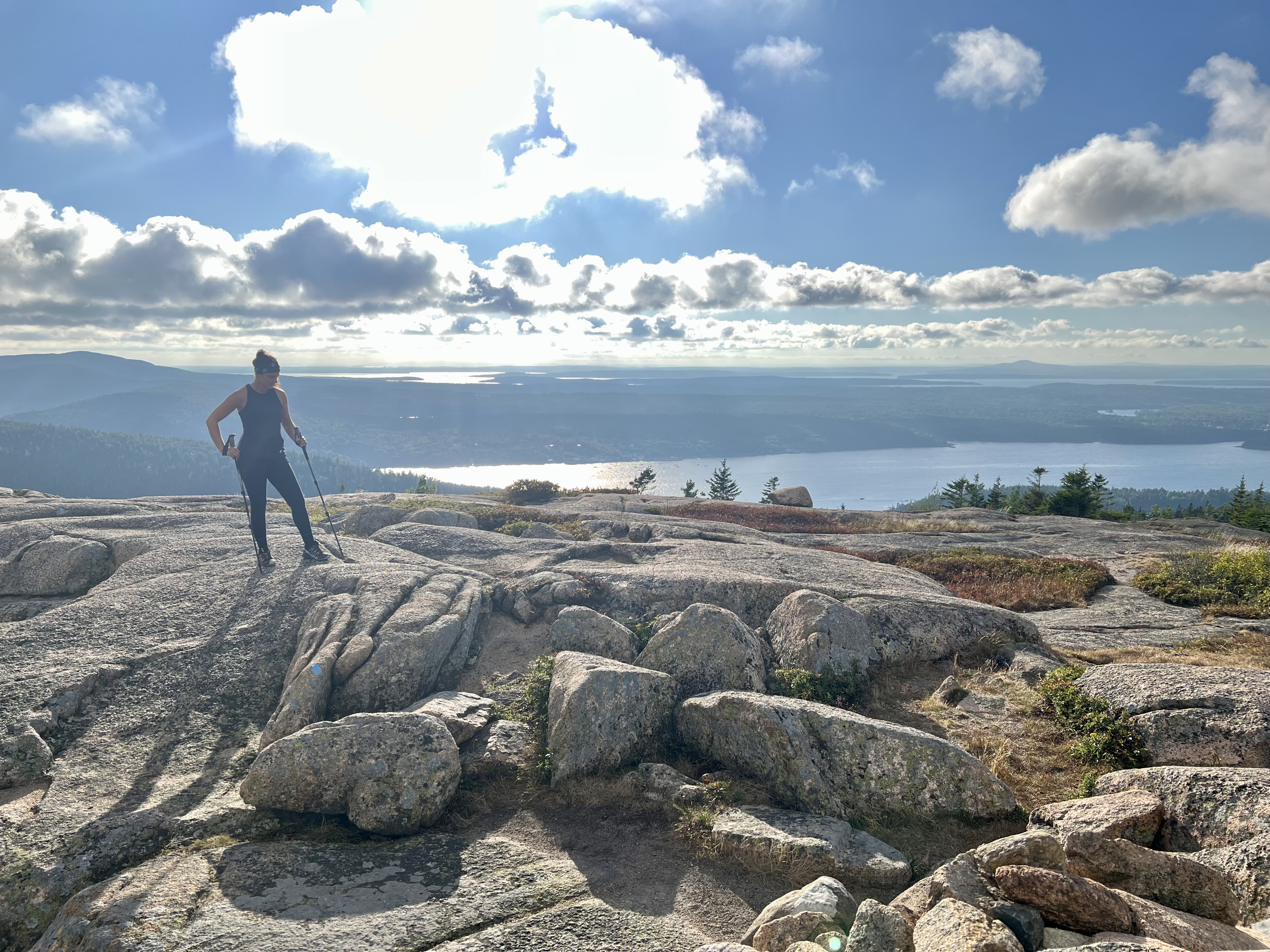
    And while we’re on the subject of photos—how do influencers look effortlessly radiant at the summit? I look like I’m molting. The moment the incline begins, I turn into a sweaty, frizzy, tomato-tinted creature that no filter can save. Any action shot of me requires distance. Dramatic distance.

    That’s me. Clearly in the “questioning my life choices” phase of the hike.

    The final leg of the journey wasn’t even on the trail—it was the long walk along the pavement back to the truck, since to Precipice was a one-way climb. Every passing car was a temptation. A tiny part of my brain whispered, “Flag them down. Hitch a ride. No one will judge.” But then the stubborn part kicked in, and we marched on, fueled by the promise of beer and something carb-loaded. My internal mantra became a chant: pizza and beer, pizza and beer, pizza and beer. Sometimes survival looks like determination; sometimes it looks like food-based affirmations.
    By the time we finally spotted our truck in the thinning row of cars, we remembered our questionable parking job. A group of hikers ahead of us noticed too—they paused, laughed, tried to take a picture. Chris, being the embodiment of Minnesota Nice, shouted a joking “Hey! That’s ours!” They burst into laughter, relieved to find the renegade parking belonged to someone whose day had clearly been as long as theirs.
    Like us, they were coming to the end of a long day, some of them barefoot now because their shoes had surrendered earlier. Before I could blink, Chris offered them a ride to their campground. Five of them piled into the truck bed like a scene straight out of a feel-good movie. I could hear their laughter trailing behind us, wind tossing their voices around. When we reached their stop, one of them gave two taps on the roof (classic signal) before hopping out with heartfelt gratitude. In moments like that, the world feels small in a good way.

    And then, finally, the reward: Fogtown Brewery. Live music drifting through warm air, tiny pixie lights hanging above the patio like glowing fireflies, the smell of pizza that could revive the dead. We devoured slices, sipped cold drinks, and let the day settle into memory.

    That meal tasted like victory. Like exhaustion. Like pure contentment.
    It tasted exactly like THE LONG HIKE deserved.

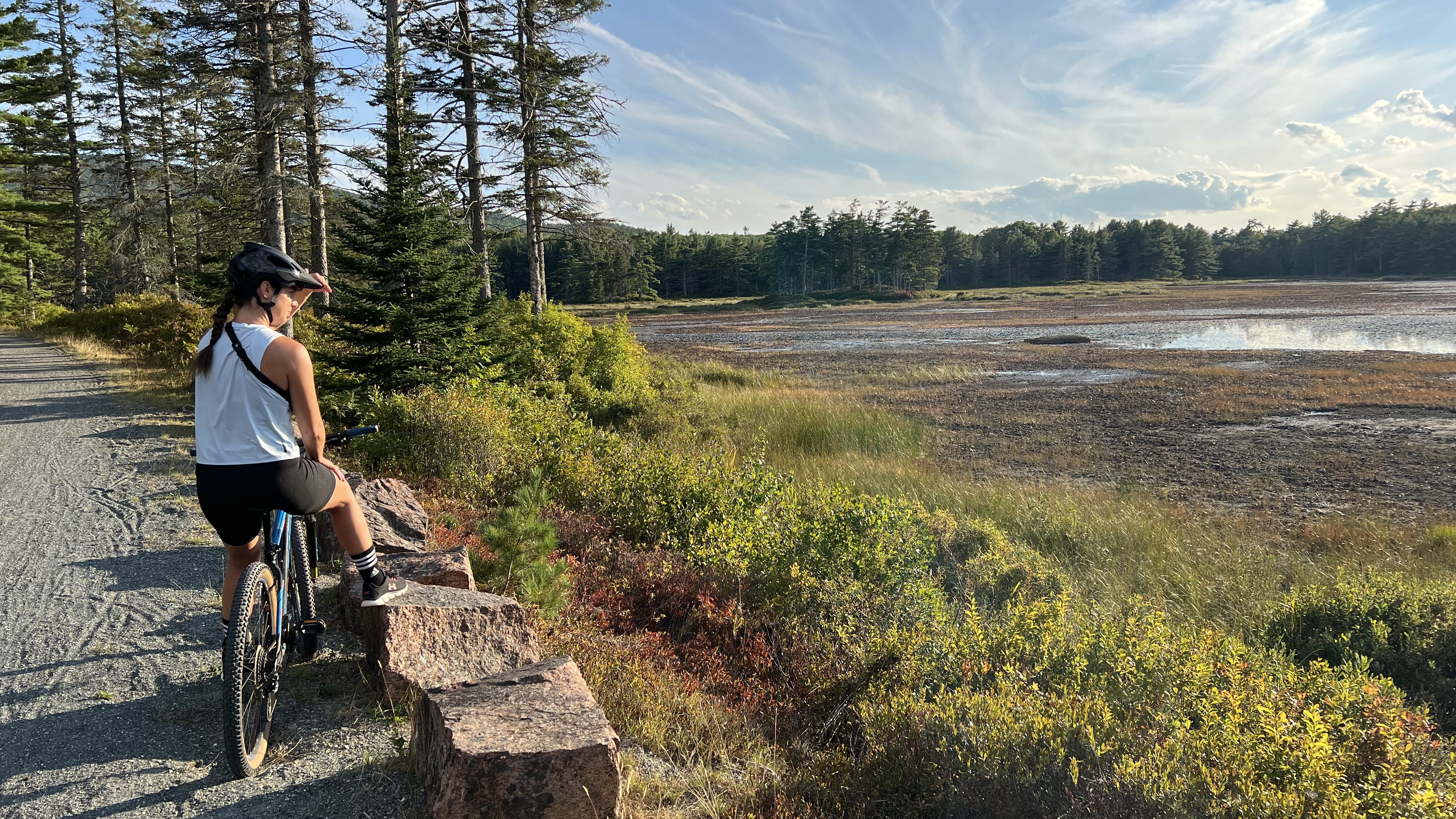
    The next day’s planned hike was quickly forgotten and instead we decided to take a very leisurely bicycle ride on carriage road, where we gave our bodies some well deserved rest, but also kept ourselves moving to keep the streak going.

    The Particularity of Our Campground

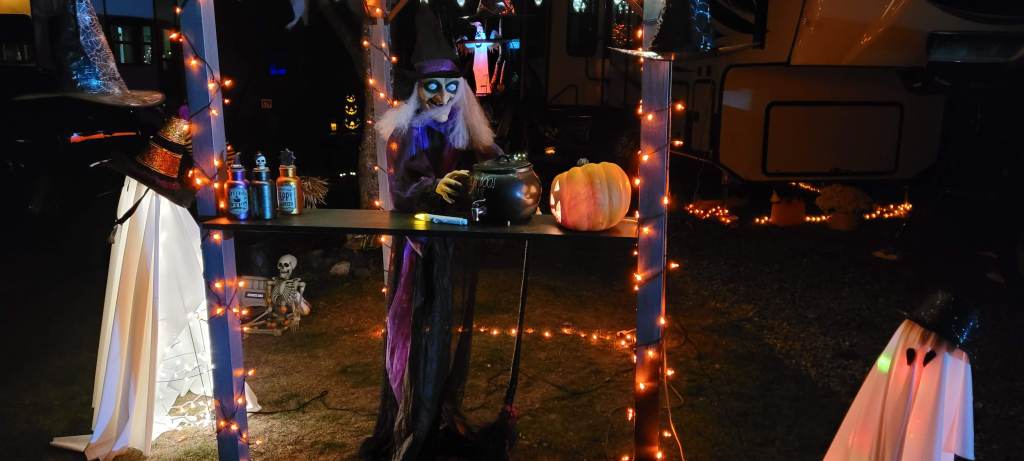
    One thing we quickly learned about campgrounds in Maine is that the calendar runs a little differently—especially when it comes to Halloween. Apparently, Halloween happens in September. Not officially, of course, but in practice. And honestly? As a super-fan of anything spooky, eerie, pumpkin-themed, or glow-in-the-dark, it felt like a cosmic gift.

    The first clue was subtle: a few pumpkin lights strung around a camper, a witch’s hat perched suspiciously on a picnic table. At first, I thought people were simply getting an early start. But then the decorations ramped up—fast. Campsites transformed into full-blown Halloween displays overnight. Motion-activated skeletons jerked to life as we walked past, their red eyes glowing like something out of a low-budget horror film. Ghosts swayed in the trees. A fog machine hissed to life in the evenings, rolling smoky tendrils across the gravel like a scene from a haunted carnival.

    By the second night, it became clear this wasn’t just enthusiastic decorating—it was a tradition. Entire families returned each year specifically for “Campground Halloween,” a weekend of spooky lights, potlucks, costume parades, and friendly attempts to outdo each other. And honestly? It was magical. Something about being surrounded by twinkling lights, cackling animatronics, and grown adults who take their skeleton displays very seriously made the whole place feel like a cozy, festive micro-universe.

    Maine Hospitality Comes in a Bowl of Mussels

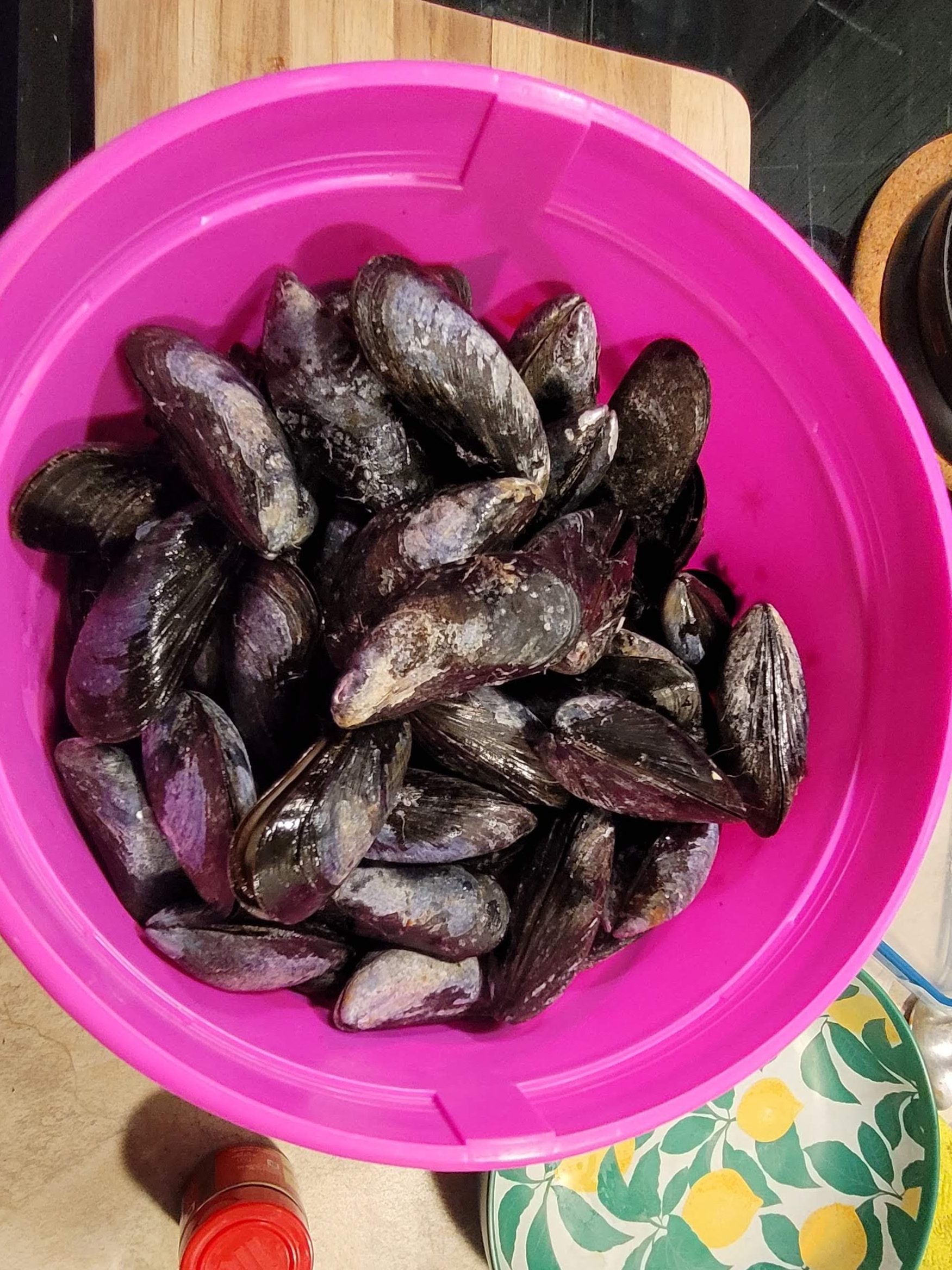
    On our final evening, the universe handed us yet another surprise—this time in the form of food. One of our neighbors, who had been out fishing the day before, knocked on our door holding a bucket the size of a kid’s Halloween candy pail. Inside: mussels. A lot of mussels. Apparently, he had caught far more than he and his family could eat and figured we might be up for a fresh seafood feast.

    Cue me speed-scrolling through Pinterest for a recipe while trying to remember what pots we actually had with us. Remember a few chapters back when I mentioned that we packed minimally? Well, that included bringing only three out of our four pots and pans. Thankfully, one of them happened to be the biggest pot we owned, and it just—just—fit enough mussels for two people.

    The cooking process turned out to be wonderfully simple: clean, steam, and serve. I melted an embarrassing amount of butter, added garlic (for culinary confidence), and crossed my fingers. In minutes, the shells opened, releasing that salty, ocean-fresh aroma that instantly makes you feel like you’re doing something right.

    We sat outside at our little campsite table, surrounded by the glow of Halloween lights and the faint echo of a distant fog machine, digging into a bowl of mussels that tasted like pure East Coast charm. Chris slowly acquired the taste—hesitant at first, then increasingly enthusiastic as he realized dipping anything into butter and garlic is practically cheating.

    By the end, we were full, happy, and deeply grateful. Not just for the food, but for the generosity of strangers and the small, unexpected moments that make travel feel less like being on the road and more like being part of a community.

    Little Motorcycle Rides in Maine

    During our three-week stay, we didn’t end up venturing onto any off-road trails with the bikes—something we usually chase whenever we’re in a new region. But honestly, the paved routes around Acadia National Park, the Schoodic Peninsula, and even Deer Island had their own kind of magic. Sometimes a calm ride is exactly what the moment calls for.

    Riding through Acadia National Park feels like gliding through a moving postcard. The Park Loop Road twists along rugged cliffs and dips into stretches of dense forest where the scent of pine becomes almost heady. Every few miles the trees open up to reveal glittering blue ocean, granite ledges, and distant islands that look like they’re floating. Even at lower speeds, the road’s gentle curves give that satisfying lean that makes a motorcycle feel like the perfect way to experience the landscape. There’s a peaceful rhythm to it—uphill, coastal view, downhill, forest shade, repeat.

    The Schoodic Peninsula was a completely different vibe—quieter, moodier, and more remote. The roads here are wide and smooth, with long stretches where you hardly see another vehicle. It’s the part of Acadia that most people skip, which makes the ride feel like a secret you’ve stumbled upon. Black volcanic-looking rock lines the shoreline, waves constantly crashing against it. We stopped to enjoy the scenery and were greeted by grey seals in the distance. Just a small part of their heads were sticking out of the water. Their eyes followed our movements as we found a comfortable rock to sit on and quietly take in our surroundings. Riding with the sound of the waves in the background, and the salty mist occasionally brushing your face shield, made the whole loop feel cinematic. It’s a place where your mind slows down and your shoulders drop a little without you even noticing.

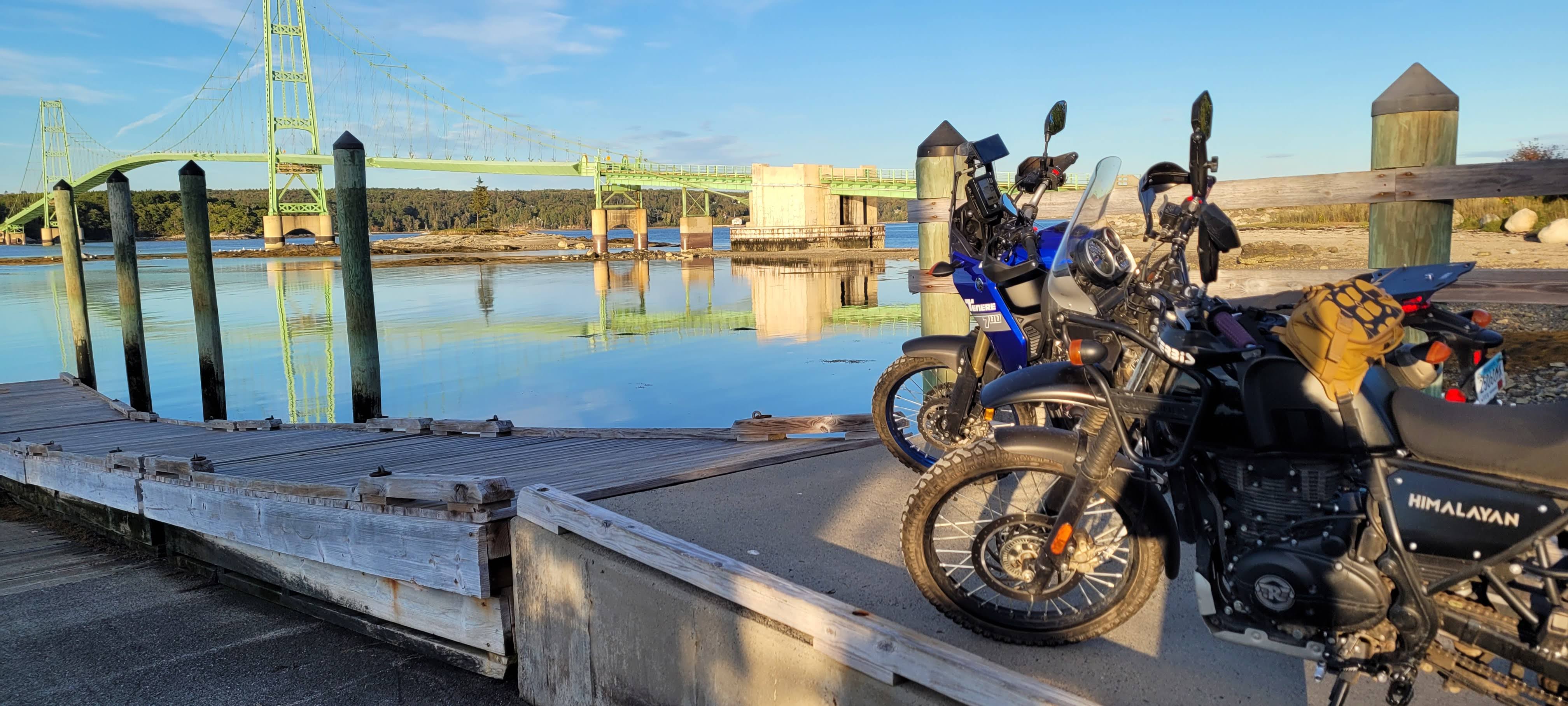
    Our favorite unexpected ride was Deer Island. The route takes you through small fishing towns, over bridges that hover above quiet inlets, and past clusters of weathered boats anchored close to shore. It’s the kind of ride where you follow the road simply because it’s beautiful, not because there’s a particular destination waiting at the end. The island itself has a slower heartbeat—calm roads, gentle hills, and scenery that feels untouched. No rush. No noise. Just the hum of the engine and the soft roll of the Atlantic in the background.

    Even without the thrill of off-roading, those weeks of riding were memorable for their easy pace. Each route offered something a little different—ocean views, coastal cliffs, fishing villages, forests—but all of them shared the same quiet, grounding charm. Sometimes the best rides aren’t the most technical ones; they’re the ones that simply let you breathe, look around, and enjoy the place you’re in.

    And just like that, our stay in Maine came to an end. Between marathon hikes, coastal motorcycle rides, and unexpected seafood feasts, it’s safe to say the state kept us well-entertained. Tired… but entertained.

    But the road doesn’t slow down for long. With the Bus hitched and the bikes strapped in, we’re pointing our compass toward Pennsylvania next—ready to trade ocean views for forest trails and ride the Backcountry Discovery Route loop we’ve been eyeing for months.

    New terrain. New stories. Same two wandering souls.

  • Kickstand Chronicles, Vol. 2: The Island Ride

    Kickstand Chronicles, Vol. 2: The Island Ride

    The morning air carries a hint of salt and goodbye as we load the bikes for one last Maritime ride. The camping gear is packed, coffee cups emptied, and there’s that familiar buzz that always hums before the road unfolds. Our time out east is almost over, but before we turn the page, we have one more chapter to write.

    Leaving early from Pictou, we follow quiet backroads lined with fall-tipped trees, the kind of roads that make you slow down just to take them in. The pavement unwinds through open farmland and sleepy towns, each turn framed by bursts of golden light as the sun climbs higher. As the coast gets closer, the air thickens with salt, and the horizon opens up wide, a reminder that the ocean is never far away in the Maritimes.

    As we near the Confederation Bridge, an overlook offers the first glimpse of it: A ribbon of concrete stretching impossibly across the ocean. From a distance, it doesn’t even look real, just a delicate line connecting two worlds. It’s wild to think that in a few minutes, we’ll be riding into another province on one of the longest bridges in the world.

    Crossing the bridge is something else entirely. Heading toward Prince Edward Island, the view feels endless, water and sky melting together in every direction. We stand on the pegs to catch it all, the horizon rising on both sides, the wind tugging at our jackets, the steady rhythm of the bikes echoing between the rails. Going this way, it feels lighter, freer, like the start of something new rather than the end of a journey.

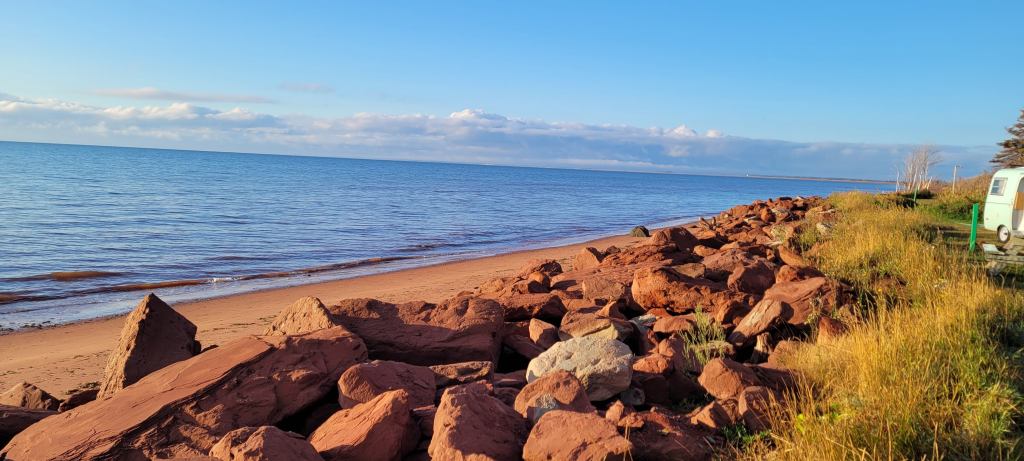
    The moment our tires touch down on the island, the landscape changes. The soil here is unmistakable, a deep, rusty red that stains our boots and glows under the afternoon sun. It owes its color to iron oxide in the sandstone, a natural pigment that seeps into everything, from the roots of the potato plants to the rhythm of island life itself. Red earth, blue skies and green fields is a palette worthy of the greatest artists. 

    We roll in from the southwest corner of Prince Edward Island, aiming to trace the island’s edges like a ribbon and follow the road wherever it leads. The ride takes us through wide expanses of farmland, rows of potato plants stretching endlessly in neat, earthy rows. Tractors rumble in the distance, and a few farmstands sit unmanned, jars for coins left on wooden counters.

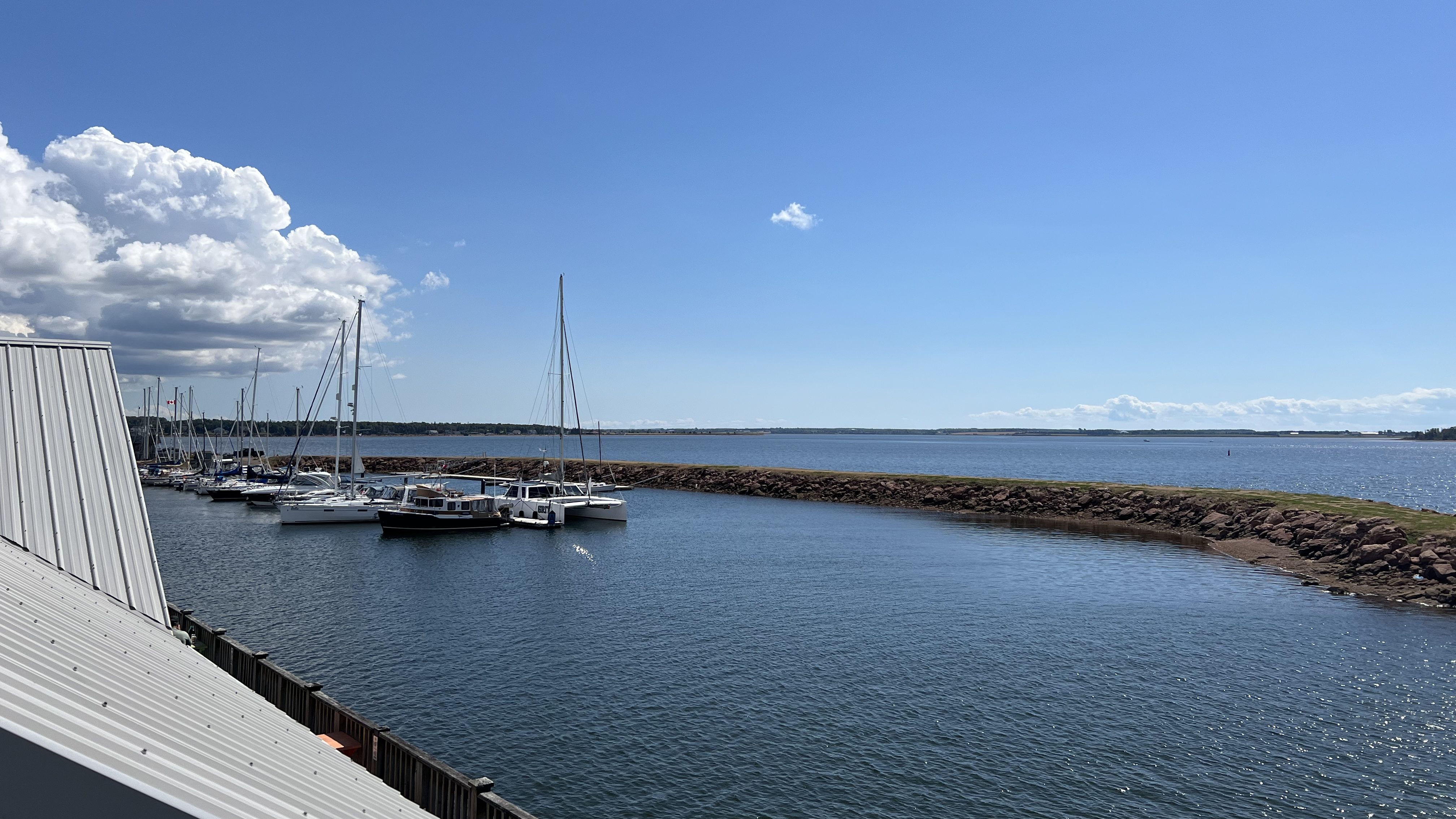
    Our first stop is in Summerside, where the Deckhouse Pub & Eatery makes for a perfect mid-day break. We park the bikes at Spinnakers Landing, a colorful boardwalk market built on the water. The area is lined with boutiques, ice cream stands, and hand-painted signs swaying in the breeze. The harbor is calm, the sunlight soft. A cold cider and a plate of nachos never taste as good as they do after a long morning in the saddle. From the patio, we watch the sailboats rock gently in the marina, that easy kind of movement that makes time stretch a little longer.

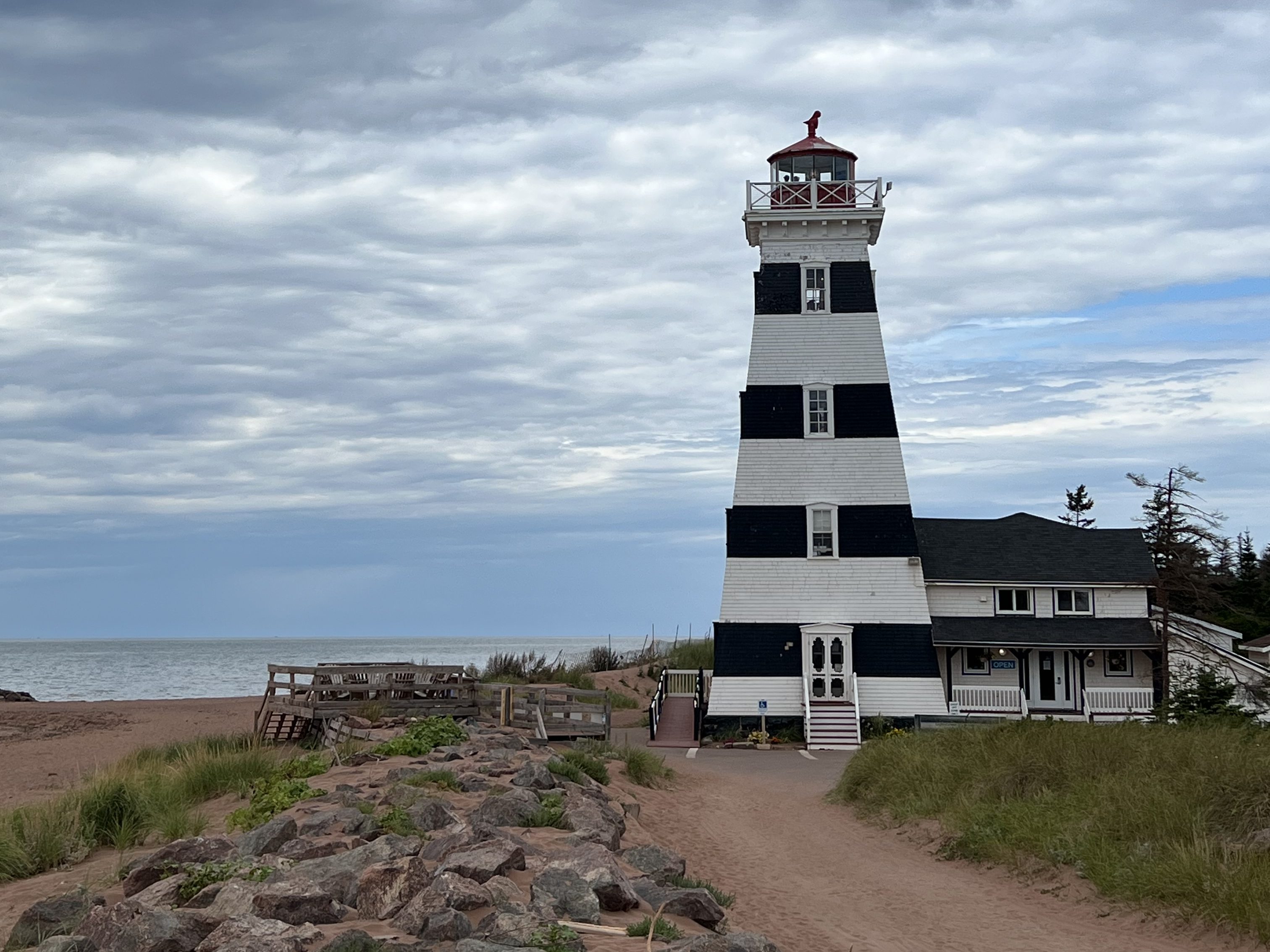
    From there, we push west toward the tip of the island until the road narrows and brings us to Cedar Dunes Provincial Park, home of the iconic black-and-white West Point Lighthouse. It rises from the dunes like a painted sentinel, overlooking miles of empty beach. The air smells faintly of salt and pine, and the sand here carries the same red hue that defines the island, soft underfoot and glowing against the dark bands of the lighthouse tower.

    We turn north, winding our way toward the island’s uppermost coast. The roads here are quieter and narrower, sometimes paved, sometimes not. At one point, we turn onto a red dirt road that cuts sharply toward the water. The front tire slides slightly where compact soil gives way to looser ground. A tight right-hand turn reveals a wide and sudden view: tall grass swaying in the wind, the ocean just beyond, and a line of weathered coastal homes standing proud against the horizon.

    The rhythm of Prince Edward Island’s rural charm feels both familiar and distinct. The houses echo the Maritime spirit, with their wooden siding silvered by salt air; and yet they have their own unique character. Blue and red roofs brighten the muted landscape while wide porches face the sea.

    The road narrows farther north, curling along the coast where fishing boats rest on shore and the landscape grows wilder, quieter too, as if the island itself is tapering off into the sea. A sudden rise in the horizon reveals the unmistakable silhouette of a windmill turning slow and steady against the sky. One becomes two, then a line of them, their blades cutting through the coastal wind in perfect sync.

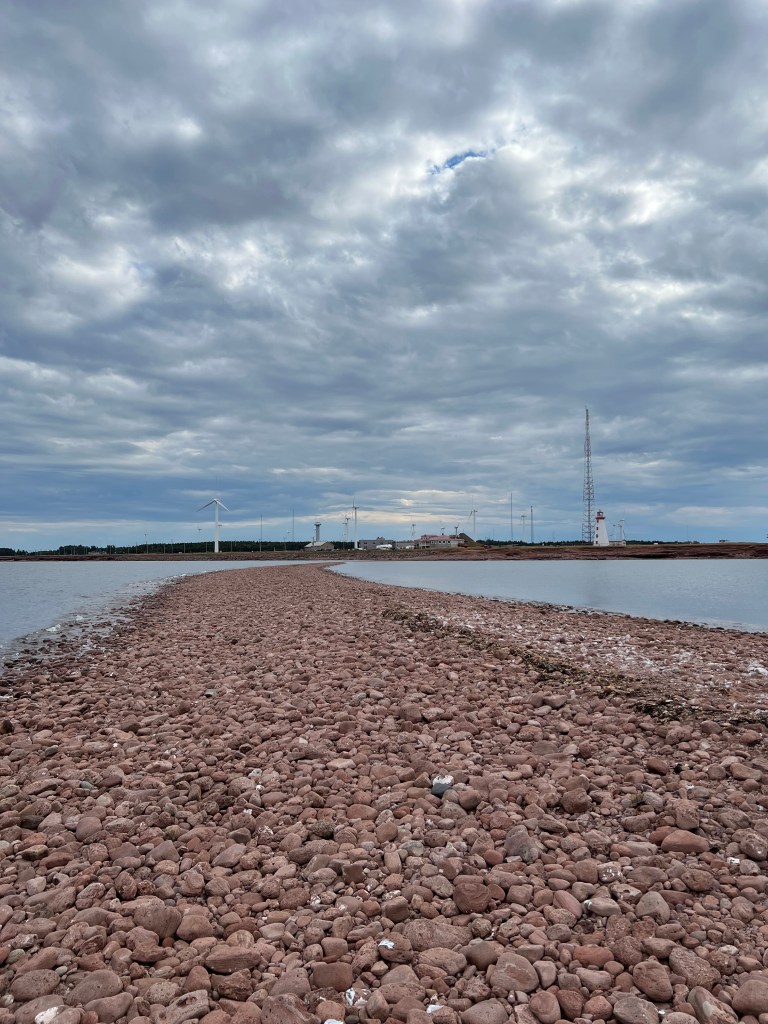
    Route 12 carries us all the way to North Cape, the northwestern tip of Prince Edward Island, where the Gulf of St. Lawrence presses in from one side and the Northumberland Strait from the other. Their waters meet in a restless dance that never truly ends. The cliffs are carved deep and red, layered like the pages of time. From the edge, we can see the reef stretch far into the distance, a long spine of rock disappearing two kilometers into the sea. When the tide is low, you can walk along it, seeing a few grey seals in the distance. 

    The lighthouse at North Cape stands quietly among it all, weathered by years of salt spray and shifting seasons. Its white walls catch the last light of day, glowing against the copper earth. Waves curl and crash along the reef while gulls wheel overhead. Every sound feels amplified — the wind, the surf, the creak of metal on the turbines turning behind us. If you time it right, you can see the moment the two bodies of water meet, their currents twisting in a pattern that looks alive.

    Fuel for Thought: When to Turn Back

    After leaving North Cape, the afternoon light fades faster than expected. The air feels heavier, the colors flatter. What was once a bright stretch of coastal road is now  a shade of gray that signals change. The clouds over the Gulf darken, and we both know what’s coming.

    We push on, hoping to find a place to stay farther down the coast. Jacques Cartier Provincial Park flashes by on our left but we keep going, convinced something better lies ahead. The towns grow smaller, the houses more scattered. Gas stations and motels become rare, and it becomes clear that “ahead” may not hold much at all.

    The first bed and breakfast we find has no vacancy. The next town doesn’t have accommodations at all. The dark gray clouds roll in low and fast, and a few raindrops tap our visors as we pull over, helmets off, weighing our options.

    If we keep going, we’ll ride straight into the storm. We’ll end up wet, with nowhere to dry our gear, and no guarantee of shelter. It is the tug-of-war every motorcycle rider faces: Wanting to keep moving forward while knowing it is time to turn back.

    We pause and realize the answer is obvious. Turning back feels like defeat, but logic wins out. We retrace our path to Jacques Cartier Provincial Park, watching the sky change from gray to slate as we ride.

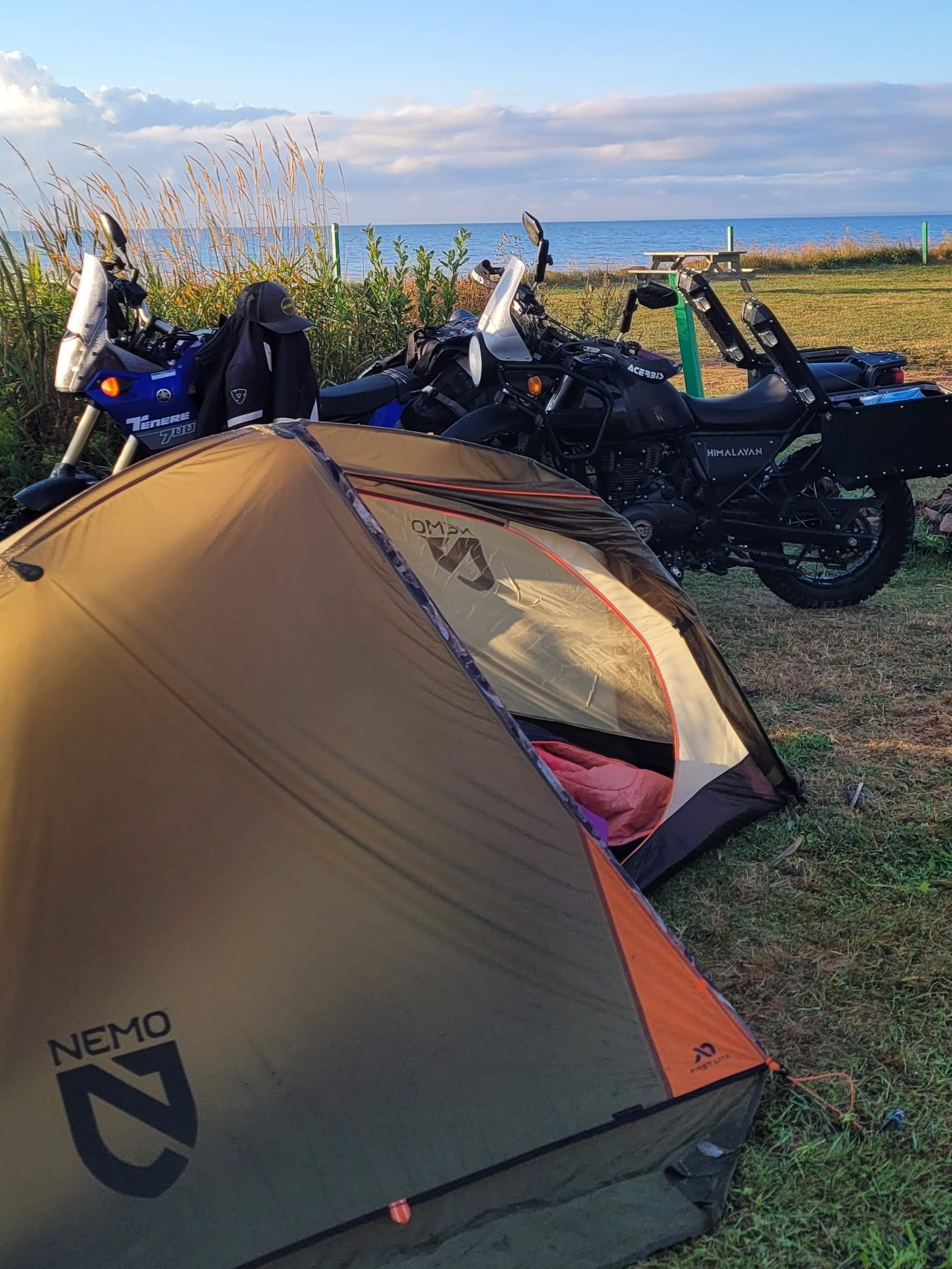
    Happily, luck is on our side: A tent site is still available, right by the ocean. We smile at the irony. Another night beside the waves — round two after our sleepless Cabot Trail storm. Hopefully, this one treats us better.

    The clouds are almost on top of us now, dark and heavy, moving fast. We waste no time. The tent goes up in record speed (under five minutes flat) poles snapping into place, gear tossed inside, rainfly clipped down just as the first drops begin to fall. Within moments, the patter of rain becomes a full symphony against the fabric roof. We climb inside, damp around the edges, but dry where it counts.

    It rains most of the night. The sound of wind and water blends into a rhythm that eventually lulls us to sleep. By morning, the world feels washed clean. The sun breaks through, the ocean sparkles, and the smell of wet earth hangs in the air. Our gear is dry, spirits lighter, and the road around the island waits once again.

    Day Two: Cavendish to Pictou

    We wake to clear skies and the promise of a full day on the island. After yesterday’s storm and a long night of rain, we know we won’t be able to circle the entire island. Instead, we head for Cavendish Park, one of the most celebrated corners of Prince Edward Island.

    The landscape opens up in soft, rolling hills of emerald green, dotted with white fences and small farmhouses. Cavendish Park is a study in contrasts: rugged red cliffs plunging into the Northumberland Strait, waves crashing at their base, juxtaposed with wide stretches of sandy beaches that curve toward the horizon. Hiking trails weave through the dunes, tall grasses swaying in the breeze, and the air carries a faint mix of salt, pine, and the subtle sweetness of late-season flowers. We pause often to take it all in — the cliffs, the beaches, and the expansive dunes that feel almost endless under the bright sky.

    Eventually, we push on, passing through Morell as we make our way south toward the ferry. Our plan is simple: grab tickets at the gate, maybe eat in town depending on timing, and catch the next ferry of the day. Easy enough, we think.

    It is not easy.

    At the ticket booth, chaos awaits. The clock reads 1:27 p.m., and the boat departs at 1:30. There is no time to second-guess. Motorcycles are easier to load than cars, apparently, so we’re hustled to the ferry. The lady at the booth radios ahead to confirm we can go, and suddenly it’s a race. The horn blares, the motors roar, and the massive door begins to close just as we roll forward. The ferry leaves the shore before we’ve been able to turn off the bikes.

    Down on the lower deck, the cacophony of engines, metal, and shouted instructions is deafening. A crew member calls out that we need to strap down our bikes. I freeze. How exactly do you strap down a motorcycle? Chris, calm as ever, grabs the hanging straps and quickly secures his bike. Then he straps mine. Done. Smooth. Efficient. I marvel at his composure.

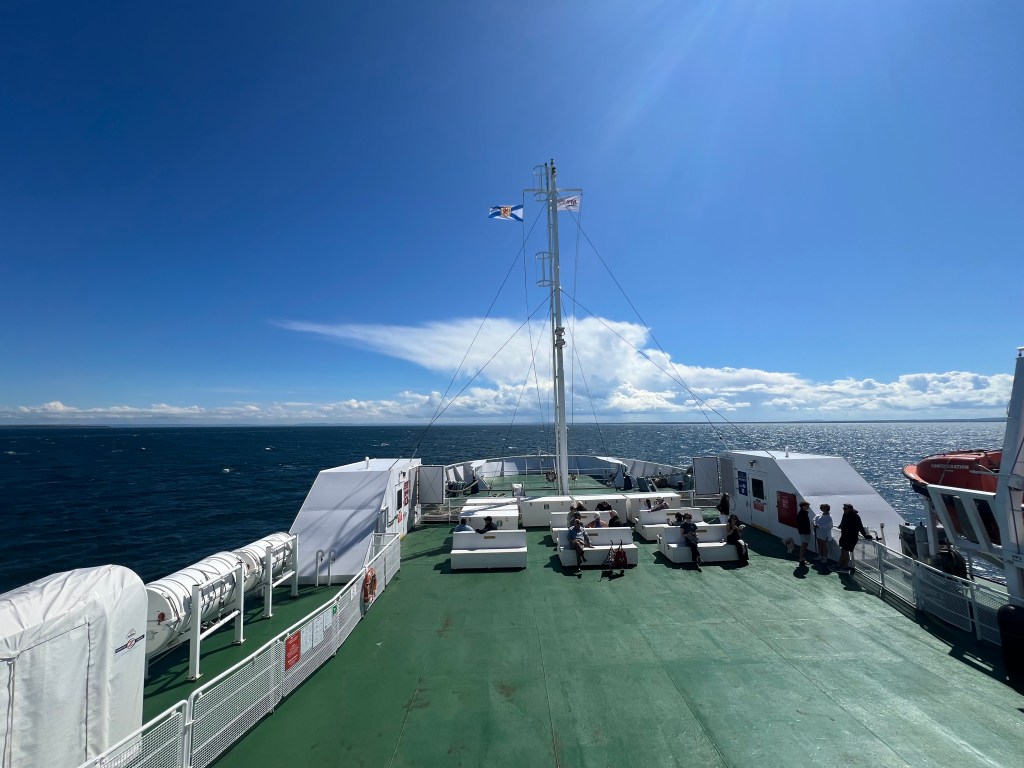
    Once the bikes are secure, we make our way to the top deck. Wind hits us, saltwater spray in the air, and the island falls away behind us. Waves churn alongside the hull, the ship slicing through the channel with a power that is impossible to ignore. We settle into the moment, watching the coastline fade.

    Eventually, the horn sounds again — time to return to the vehicles. Pictou comes into view. The crew instructs us to go to the front of the ferry and exit first. My stomach tightens. The deck looks slick, and the slightest misstep could send a bike and rider sprawling. Chris remains calm, while a crew member offers to help.

    “Easy does it,” the man says, pushing my bike backward slowly. I tiptoe alongside him, holding just enough to balance.

    “Thank you, sir,” I say. “I really didn’t want to end up on the floor as things get busy.”

    “Ah, don’t worry,” he replies. “You wouldn’t be the first or the last to drop your bike here.”

    “Good to know,” I murmur, trying to steady my nerves. “But still, I don’t want to become part of those stats.”

    The bike touches asphalt, the ferry door swings open, and just like that, we are back on solid ground. Adrenaline still humming, we roll away, grinning at the equal measure of chaos and relief we experienced. 

    As the day winds down, we make our way to the campground, the last stop before we pack up for our departure from the Maritimes and prepare for the next leg of our journey. The Maritimes have given us cliffs and beaches, windmills and reefs, storms and sun, and enough small adventures to fill volumes. As we ride these quiet final stretches, it’s impossible not to feel grateful for the roads we’ve traveled, the moments we’ve shared, and the lessons we’ve learned along the way.

    This chapter closes, but the road, as always, is waiting.

  • Kickstand Chronicles, Vol. 1: The Cabot Trail

    Kickstand Chronicles, Vol. 1: The Cabot Trail

    The hum of our engines cuts through the morning fog as the first light spills over our campsite in Pictou. The world is quiet except for the low rumble of anticipation and caffeine kicking in. We’re gearing up for our first multi-day motorcycle trip, the beginning of The Kickstand Chronicles, a collection of rides, reflections, and fleeting moments that remind us of why we chase horizons on two wheels. 

    Our destination is the legendary Cabot Trail. One hundred and eighty-five miles of winding asphalt carved through cliffs, forests, and sea spray. It’s the worst-kept “hidden gem” among motorcyclists, a bucket-list ride we’ve dreamed about for years. Today, it’s finally happening. 

    But before a wheel even turns, the age-old debate arises: Clockwise or counterclockwise? Ask any local, and you’ll hear passionate arguments for both. After hours of forum scrolling, campground chats, and a fair bit of indecision, we settle on counterclockwise. That route hugs the coastline, keeping the ocean to your right, the edge so close you can taste the salt in the air. Some say it can trigger vertigo. I call that a front-row seat to the Atlantic. Besides, I tend to romanticize everything, remember? 

    Panniers packed, GPS loaded, comms charged, we roll toward Cape Breton Island. The drive takes just over an hour, and we avoid the highway whenever possible. When we finally cross the causeway, signs boast about the world-famous Cabot Trail. Unsure how far apart gas stations might be, we fill up and set off. 

    The plan is clear. Counterclockwise it is. 

    Except, within twenty minutes, it isn’t. 

    Something feels off. “This doesn’t look right,” I mention through the comms. 
    “This is definitely the way,” Chris replies, his voice full of confidence. 

    Given my less-than-stellar navigation record, I let it go—until a few miles later, I hear a faint “Crap” through my helmet. 

    “What is it?” I ask. Silence. His blinker flashes, and he pulls to the shoulder. 
    “What is it?” I repeat, louder this time. 
    A pause, then a half-laugh, half-sigh. “You were right.” 

    Did I hear that correctly? I was right? 
    Too stunned to celebrate, I ask, “Wait, what do you mean I’m right?” 

    Turns out we had turned too soon and were heading clockwise the whole time. My carefully plotted route and dream coastal views vanished with one wrong turn. 

    We consider doubling back but quickly dismiss it. The road ahead is open, the day young, and retracing steps has never been our style. This is how we always travel: Part plan, part instinct, and a generous dose of improvisation. 

    How many miles we cover in a day depends on the weather, temperature, and how often I stop to admire the view (which is often). The only real rule is to keep moving forward, wherever the road decides to take us. 

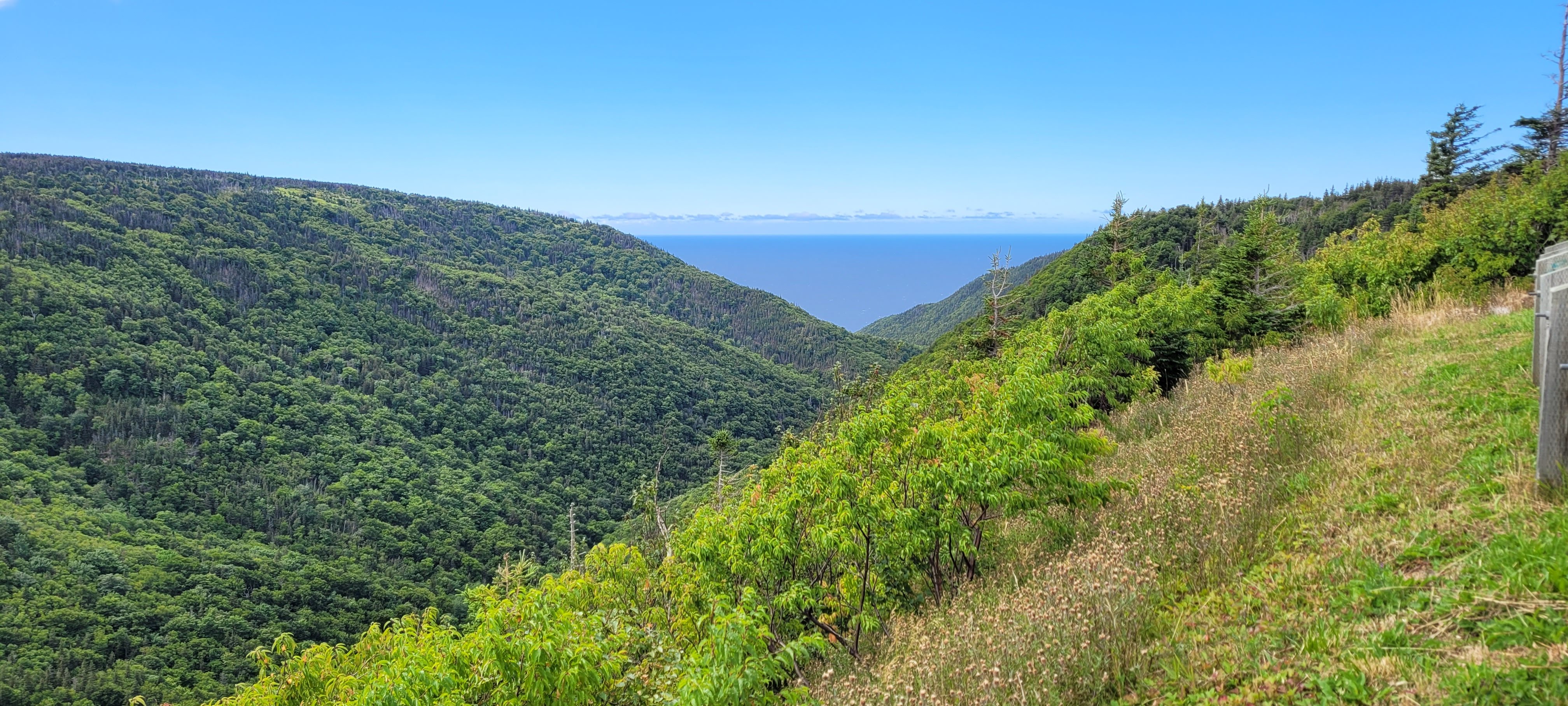
    At the entrance to Cape Breton Highlands National Park, a ranger waves us down to share tips on the best lookouts. This year, there’s no park fee, and thanks to a fire ban, campsites are easier to find. The gate lifts, and we shift into first gear, winding upward through curves that reveal spectacular ocean vistas. Steep cliffs drop vertically into blue depths. Just when we think we’ve seen the best view, the next corner proves us wrong. Choosing which lookout to stop at becomes a battle with FOMO. 

    As everything feels perfect—the bikes humming, the sun warm on our shoulders, the road unfurling ahead—we pull over at a scenic curve along MacKenzie Mountain. From here, the coastline stretches endlessly into the Atlantic, rugged cliffs stand proud beneath a sky too blue to be real. Tourists gather at the viewpoint, laughter and camera shutters carried by the wind. 

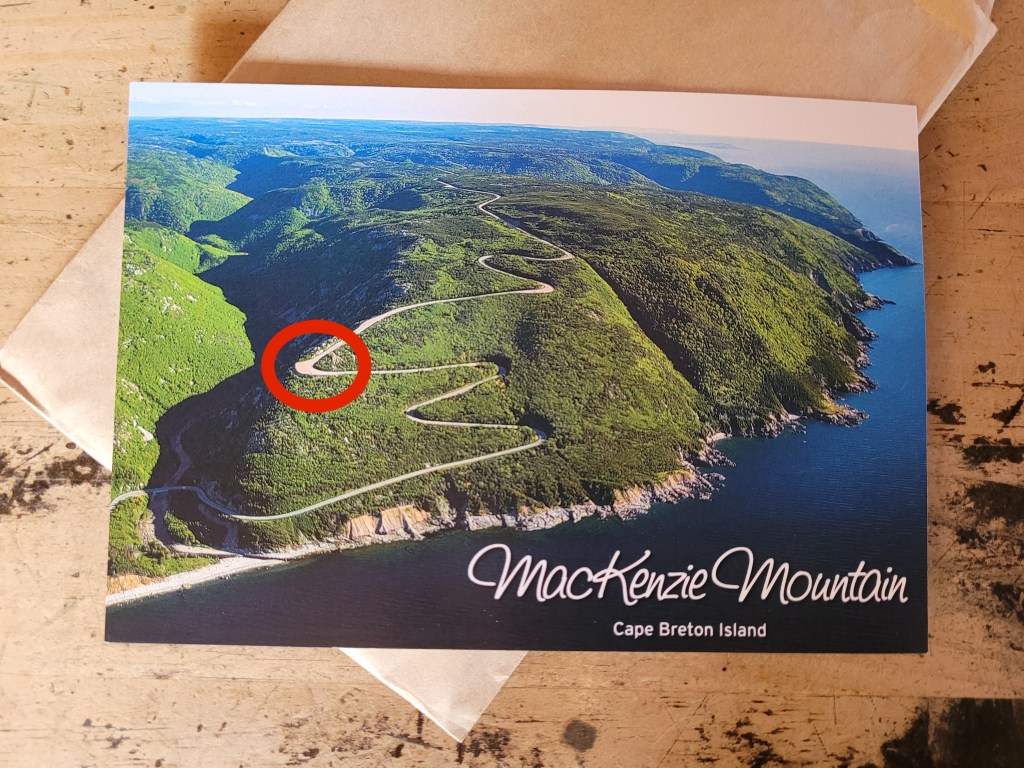
    MacKenzie’s turns sweep down the mountain in wide arcs, but the parking lot sits on a noticeable slant. Not much, just enough. 

    When it’s time to leave, I swing my leg over the seat and feel it: that slow, sinking shift. “No, no, no…” I whisper, but gravity has already decided. In slow motion, the bike leans, wobbles, and with a loud splat hits the asphalt. 

    Unfortunately, I go down too. My body flings sideways like a ragdoll in a bad stunt reel, landing flat on my back, arms sprawled out as I stare up at the sky in disbelief through the rectangle of the helmet visor. 

    In my ear, Chris’ sigh comes through, one part patience, one part prophecy. He had already noticed the slope and parked me in a safer spot. And here I am, proving him right again. 

    Tourists rush to help, their concern comically disproportionate to my bruised ego. Together, we heave the bike upright, her shiny new handguard scuffed, my pride thoroughly demolished. 
    “You good?” Chris asks, his tone halfway between concern and amusement. 
    “Yep,” I answer. “Now please help me lift this thing so I can die of embarrassment somewhere else.” 

    The “I fell here” memento I made from a postcard bought in a nearby shop.

    And just like that, the perfect ride has its first mishap, the kind that becomes a favorite story later. Or a cautionary tale. Whichever one calls to you best. 

    We continue through the valleys of Cape Breton Highlands, the scenery still surreal. Cliffs plunge into the sea, winding roads weave through dense trees, and every curve reveals another picture-perfect moment. As the sun dips low, we start scanning for a campsite. 

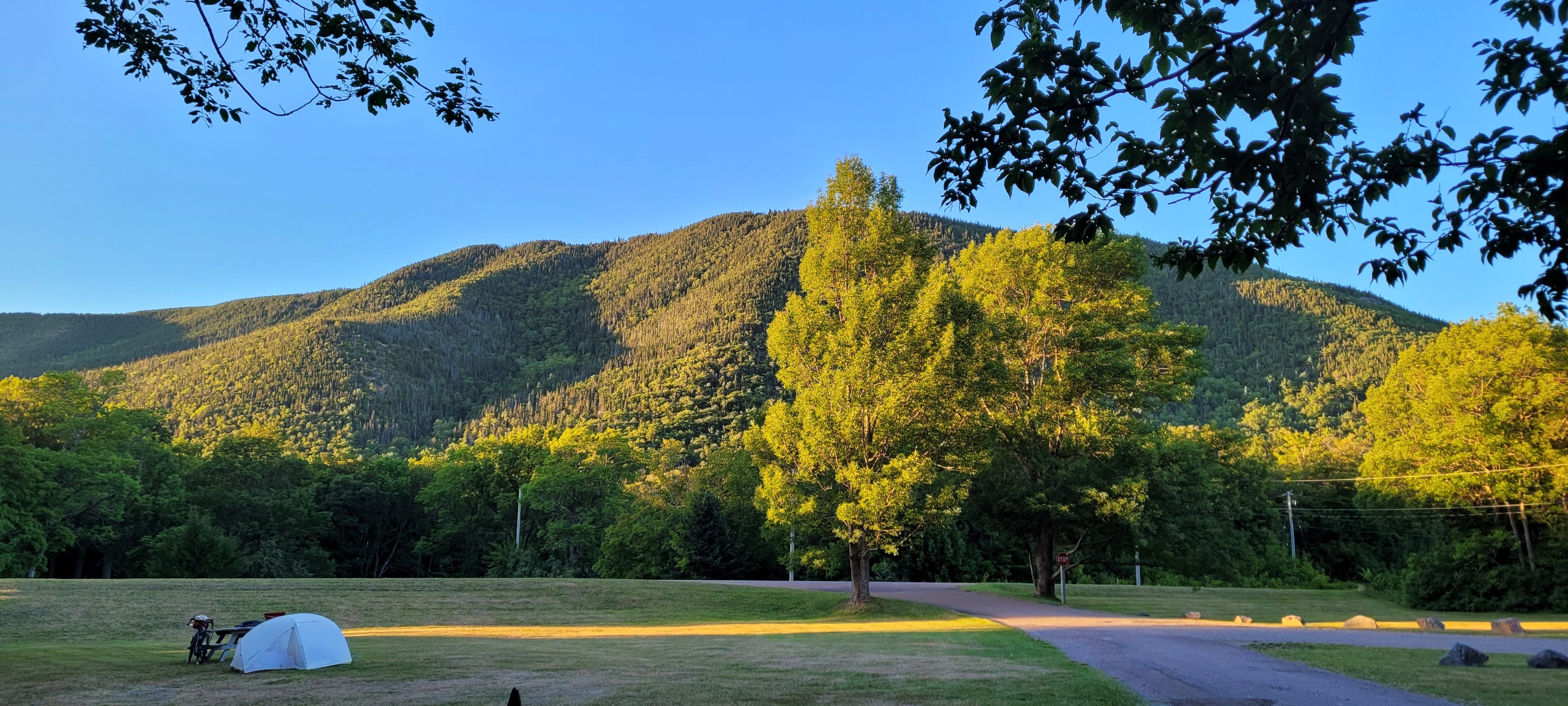
    We find a quiet spot near the mountains, nothing but rustling leaves and a babbling brook nearby. Our only neighbor is a small tent with a lone bicycle parked beside it. We had seen the same bike earlier, the rider grinding up a steep incline while we cruised past, impressed and a little guilty. 

    Curiosity wins, and we wander over. That’s how we meet Johan from Lyon, France, who is cycling across Canada, from Vancouver to Newfoundland. By now, he has pedaled nearly five thousand miles, averaging 70 a day and surviving on Knorr meal packs. Genius, really. We have spent far too much on dehydrated camping meals, and here he is proving the cheaper ones taste just as good. 

    As we walk back to our tent, I sigh dreamily. 
    “Wow,” I say. “I want to try that kind of travel someday.” 
    Without missing a beat, Chris replies, “You couldn’t ride from here to the road without getting winded.” 
    Touché. 

    The next morning greets us with stiff backs but another golden sunrise over the mountains. Sleep wasn’t great, but the view makes up for it. We pack our gear, stretch our sore muscles, and head to Pleasant Bay for a long-anticipated whale-watching excursion. 

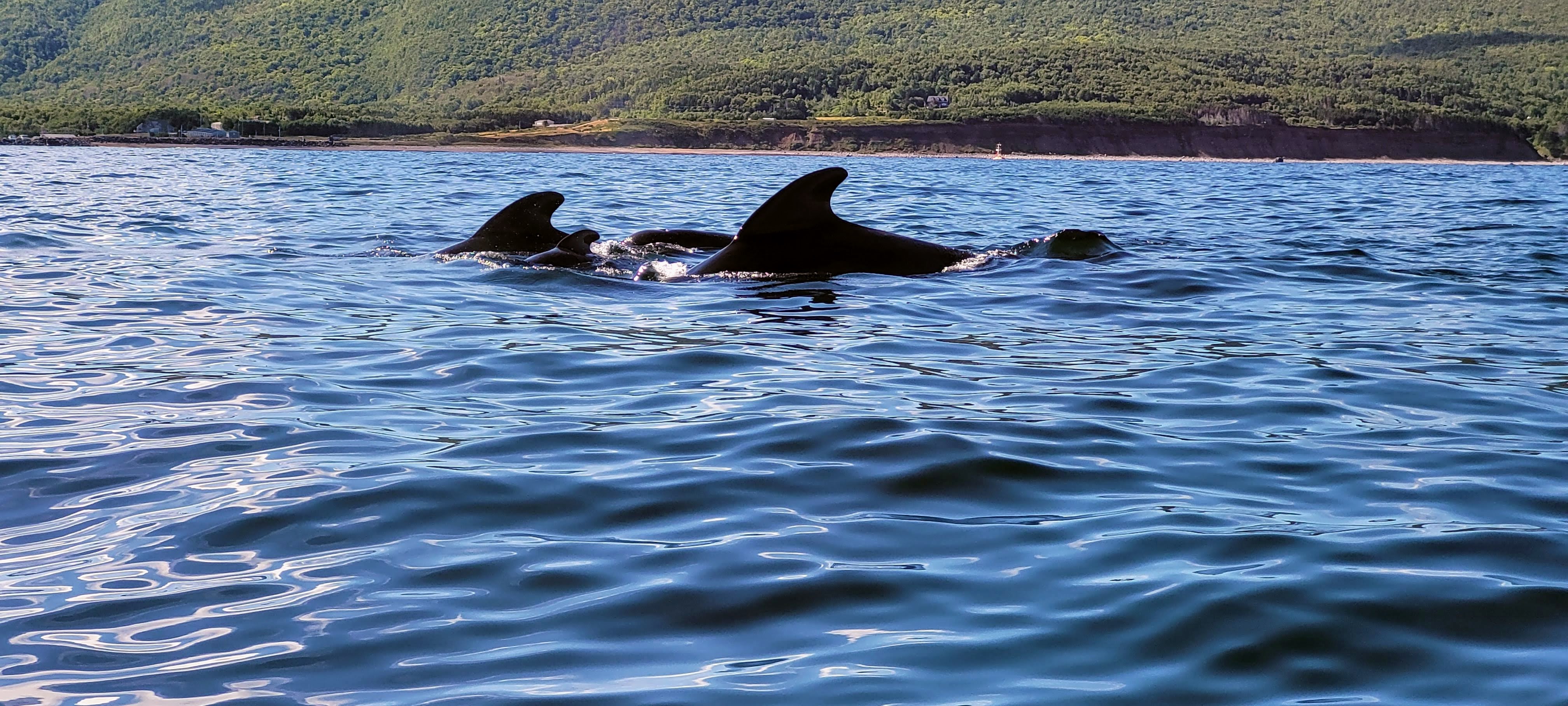
    At the dock, Captain Mark welcomes us aboard a small zodiac. His energy is contagious, his stories blending fact and folklore with effortless charm. As we head out, the sea greets us with gentle swells and salt spray. Before long, a pod of pilot whales surfaces nearby, sleek and curious. Mothers and calves glide between the waves, unbothered by our presence. 

    Above us, Northern Gannets dive like arrows into the sea. Closer to shore, cliffs rise in jagged layers, their edges carved by time. Captain Mark points out “The Old Man,” a rock face shaped by nature into a profile both haunting and human. Grey seals pop their heads above the water, watching us with curious eyes before slipping beneath the waves again. 

    After two hours on the water, we return to shore, salt-streaked and grinning. It’s the kind of experience that lingers long after you’re back on land. 

    Side note: our GoPro didn’t survive the adventure. In a burst of enthusiasm, Chris dunked it underwater for the perfect whale shot. Minutes later, it blinked, sputtered, and died. Saltwater, as it turns out, isn’t forgiving. Another casualty of curiosity. 

    Later that day, we follow a small dirt path toward a Buddhist temple we spot on a roadside sign. The trail twists through trees and opens to a clearing where a white and gold stupa gleams under the sunlight, prayer flags fluttering in the breeze. The air feels still and sacred. Carved messages speak of peace and presence, a quiet reminder to slow down. 

    Captain Mark had mentioned that each year, monks here buy a local lobster catch, bless the lobsters, and release them back into the sea. It’s their way of giving life another chance, just in case one of their brothers has returned in shellfish form. The story lingers with us as we ride away, engines blending with the hum of the forest. 

    From Pleasant Bay onward, the Cabot Trail feels like it opens up at every turn. The road clings to the mountainside, the Atlantic stretching endlessly below. Each curve offers something new: a burst of wildflowers, a sliver of beach far below, a rush of wind that smells like pine and salt. The trail demands our focus but rewards us with awe. 

    Before leaving Pictou, our campground neighbor Dwayne had warned us with a grin, “Watch out for the hill people up north. You’ll know when you get there.” What we find instead is Meat Cove, a windswept, cliffside campsite where ocean and sky meet in spectacular fashion. It’s less remote wilderness and more adventurer’s resort, full of tents, camper vans, and laughter drifting through the salt air. We can’t help but laugh at the irony. 

    As the sun dips into the horizon and the waves crash below, the beauty of it all leaves us silent. 

    We rarely plan campgrounds ahead, so our options often depend on timing and our sore backsides. Balancing the choice between riding longer or settling for what’s available has led us to some of our best surprises. Sometimes the gamble lands us somewhere extraordinary, like a stretch of beach framed by forest and ocean. 

    That’s how we find our next stop: A literal beachside campground. I imagine a magical night by the sea, the kind of place you see in travel magazines. For the first hour, it’s just as whimsical as I’d imagined. The sky turns from gold to deep indigo, the waves hum softly, and the tent glows warm from lantern light. Then the wind shifts. 

    What starts as a breeze becomes a gale. The tent walls whip and snap, and sleep becomes a distant dream. Then comes the rain. We scramble to zip the fly shut, sealing ourselves in a humid cocoon that feels half sauna, half shelter. By morning, we’re bleary-eyed and delirious, the night officially filed under “memorable disasters.” 

    Coffee is non-negotiable, so we roll onto a small cable ferry and ride straight across without dismounting in Englishtown. Breakfast follows, along with the inevitable conversation about why we do this to ourselves, hauling gear, chasing weather, and sleeping on noisy, slippery fabric. 

    Refueled and restless, we continue east to circle the island completely. The wind roars against our helmets as we ride through stretches of empty coastline, windswept trees bending inland. On this side, there are fewer tourists, more “for sale” signs, and a quiet stillness that feels both freeing and slightly eerie. 

    Lighthouses dot the shoreline, white and red against the blue horizon. Even after a dozen of them, their silhouettes never lose their magic. They are symbols of endurance, quiet keepers of the Maritimes. 

    Further south, we reach Isle Madame and the village of Petit-de-Grat, a serene fishing community shaped by the sea. The road meanders along the coast, where pastel homes rest close to the water and boats sway gently at their docks. The air smells faintly of salt and seaweed, touched with the clean smell of linens hanging on clotheslines. 

    The pace here is unhurried. Every bend reveals another cove, another weathered shed, another moment worth remembering. Locals wave as we pass, their gestures warm and familiar. Isle Madame feels humble, proud, and deeply rooted—a place where the sea is both companion and teacher. Riding here isn’t about distance; it’s about simply being present. 

    We end our loop at a small pub, toasting the ride with a local specialty: the donair fried roll. Crispy, rich, and exactly what tired riders need. Once again, the sun dips below the horizon, and though a few hours still stand between us and the Bus, the pull of our soft bed wins out. 

    Helmet hair, rosy cheeks, and road dust—signs of an adventure well lived. The Cabot Trail has earned its place in the Chronicles. 

  • Welcome to Lac Belanger

    Welcome to Lac Belanger

    The road has paused for a while. Two unhurried weeks stretch ahead of us. The cabin is stocked with a mountain of food and the promise of loud and happy conversations. The first night sets the tone: Glasses clinking, voices rising, and the cabin already echoing with the kind of overlapping chatter only my family can produce. As the sun dips toward the tree line before supper, Chris wanders out to the dock with his fly rod, savoring the quiet rippling of the water. His patience pays off with a modest triumph: A bass so small it barely bends the line, yet it’s enough to make him grin like he’s landed a trophy. 

    Much needed family time

    Being with my parents is never quiet; the air itself seems to hum with their forty-four years of lively sparring. They’re less like graceful dance partners and more like a bickering comedy duo—one part kitchen chaos, one part standup comedians. The night of the “pineapple incident” was peak performance.

    Dad, intent on mixing his legendary piña coladas, clanged through cupboards with theatrical urgency. Mom, already exasperated, barked from across the kitchen: “Check the top shelf!” Within seconds they were arguing over the mysterious whereabouts of a can of pineapple chunks.

    Chris and I were out on the deck, windows open, quietly listening as the volume climbed. Then the truth surfaced: the pineapple wasn’t even for the blender, just for the garnish. Mom’s voice sliced through the evening air, sharp enough to rattle the ice: “Is it just for decoration, Robert?!

    Later, Dad confessed half grin, half shrug that he’d left that little detail out on purpose. “If I’d said it was just for garnish, she wouldn’t have gone on the hunt,” he recounted, clearly delighted with the chaos he’d stirred. Chris and I burst out laughing, and we still laugh out loud every time we retell it, the echo of her outrage and his sly triumph replaying like our own sitcom rerun.

    Seeing my sister in person, after a year of nothing but phone calls and awkward time-zone math (for some reason, the 1 hour time zone difference was difficult to comprehend) and hugging without a screen between us made me realize how much I’d missed her. One hug and we were right back to our usual nonsense, trading inside jokes before our bags even hit the floor.

    We all gathered at their house, which she and her partner have remodeled into something out of a design magazine: clean lines, cozy corners, sunlight spilling across every room. We wasted no time popping open the Aperol and prosecco, clinking glasses of spritz that glowed like orange sunsets. The grill never got a break: skewers sizzling, vegetables charring, someone always sneaking “just one more” piece of bread off the cutting board.

    The night stretched into a happy blur of laughter, teasing, and “try this, it’s amazing” bites passed across the table. After a year apart and a big move across the border, it felt ridiculously good to be loud together again, the kind of family evening that leaves you sticky with citrus, full of food, and a little giddy from both the cocktails and the company.

    The Internet Debacle

    As peaceful as the lake is, a reliable connection is our lifeline. The afternoon’s to-do list includes pointing the dish and checking speeds in time for tomorrow’s work calls. The reality of setting up an internet connection at every stop demands quite the imagination. Finding a clear line for the satellite is less about technology and more about choreography, I soon discover. 

    Considering what the equipment cost, I certainly didn’t expect us to audition for a connectivity dance recital. Yet there was Chris, circling the property with his phone held out, app open, muttering about signal strength and north-facing skies. Every few feet he’d stop, squint at the treeline, and sigh. The challenge escalated when we realized that the sacred direction was a solid wall of pine. That’s when the creativity dial went to full MacGyver mode. I turned away for all of five seconds, maybe to swat a mosquito. When I looked back, Chris had vanished. 

    “Hello?” I called, scanning the yard as though he were a runaway toddler. “Over here!” came the faint reply, like a voice drifting from another dimension. 

    It finally dawned on me to look up. And there he was: Balanced on the slanted roof, cellphone still in hand, walking slow circles like some tech-obsessed moonwalker in his camo crocs. The scene was straight out of those early-2000s cell-service ads: “Can you hear me now?” I have no idea how he even got up there, no ladder in sight, just the stubborn determination of a man promised decent internet connection. 

    At that point I surrendered to the inevitable. Let the rooftop satellite whisperer chase his bars. I retreated to the cabin, finished the unpacking and hoped our next stops would have unobstructed views of the sky, or at least, a less acrobatic tech support department. 

    A few hours later Chris comes back down and shares the accomplishment of having successfully set up the satellite internet. He had taken the foldable worktable, brought it up on the roof, had secured it with some green straps and cinder blocks. “Where did you even find those?” I ask. “Around.” is the answer I get. I nod, impressed. I retreat inside, marveling at how a simple need for Wi-Fi can turn a quiet lakeside day into an episode of Survivor. At this point, I’m convinced of two things: One, Chris has a mysterious talent for turning ordinary objects into engineering marvels; and two, I will never, ever, look at a satellite dish the same way again. 

    Mont-Tremblant Village 

    Mont-Tremblant really does feel like someone air-mailed a snippet of a European mountain town to the Laurentian Mountains. The pedestrian village unfolds in a cheerful palette with its buildings dressed in bright reds, yellows, and blues, while cobblestone lanes wind uphill like something out of an alpine storybook. Boutiques spill light onto the walkways, restaurant patios hum with people, and every turn seems to frame a new postcard view. 

    From the lower plaza, you can hop on the Cabriolet, a free open-air gondola that glides slowly above the rooftops. As the breeze catches your hair, you’re lifted toward the base of the mountain itself. Looking up, and the summit stretches skyward 932 meters (about 3,058 feet for my American friends), its slopes etched with evergreens and ski runs. 

    In the years we’ve been together, Mont-Tremblant Village never made it onto my “must-show-Chris” list. I always assumed throngs of selfie sticks and souvenir shops would be an automatic nope for him, the kind of place he’d give a single glance to before retreating to the nearest quiet trailhead. 

    The moment we rounded the corner and the Luge course came into view, my assumptions cracked. His eyes lit up, his shoulders straightened, his stride quickened and suddenly I was the one trying to keep up. The man who usually side-steps anything touristy was practically bouncing on his toes, scanning the track, already plotting which run would be fastest. 

    For those of you who don’t know, luging has two different definitions. On the one hand, it’s a scenic, fun-filled ride in a 3-wheeled sled that uses gravity and gives the rider full control. On the other hand, and as it pertains to my family, picture a pack of over-caffeinated sled dogs, launching themselves down the track as if a prize was waiting at the bottom, hollering for anyone ahead to move it!, while simultaneously plotting small acts of sabotage on each other. Every bend becomes an opportunity to run into one another’s bumpers and send the sleds fishtailing off the track. The only rule is: NO RULES. 

    Luging with my family circa 2006

    One summer, fifteen-year-old me discovered just how ruthless my own father could be. He gave a perfectly timed nudge that sent my luge skittering sideways with me skidding, arms windmilling, across a strip of gravel. The sound of fabric tearing met the crunch of stones under my palms. My jeans ripped open at the knee, the sting immediate. 

    And yet we howled with laughter. By the time we reached the bottom, tears of hilarity mixed with the grit on my face. We waved down the on-site paramedics, who dutifully cleaned my scraped knee while we recounted the epic move like it was a family legend in the making. 

    When I think of it, I can’t believe I’d never thought to bring Chris here to try this activity before! 

    Flying high in Mont-Tremblant 

    Two days after our first luge victory laps together, the craving for another adrenaline hit was impossible to ignore. We called Ziptrek Tremblant, snagged a reservation, and spent the rest of the day with that delicious, restless buzz that comes from knowing something wild is waiting. 

    Back in the picture-perfect village again, our inner daredevils quickly spot the office. With our nerves already humming, waivers are signed and harnesses are cinched. 

    The afternoon is clear and bright, perfect for a ride on the mountain’s Panoramic Gondola. This is basically a floating glass elevator that glides over the treetops, lifting you higher and higher until the village below is the size of a toy town. At the summit, the view is pure postcard. The layered mountain sides fade from dark to pale blue. It’s the kind of 360-degree view that makes you wonder if someone’s turned the saturation dial just for you. 

    The sense of calm quickly dissipates as the first leap up ahead has you questioning your life choices. A tiny metal gate opens. You step down two see-through stairs and launch. Gravity takes the reins and the wind roars in your ears as you twist over an ocean of evergreens. Two of the five lines stretch more than a kilometer—long enough to wonder if you packed a spare set of nerves. 

    Three hours later, after five zip lines and a surprisingly pleasant trail hike between runs, we coasted back into the village, hair thoroughly wind-styled and grins we couldn’t shake. If you’re after heart-in-your-throat thrills wrapped in jaw-dropping scenery, Ziptrek Tremblant is worth every Canadian dollar. 

    First Off-Road of the Season

    Our first off-road motorcycle adventure of the season took us into the Laurentians’ Réserve faunique Rouge-Matawin, and, I’ll admit, I was feeling a little nervous. My heart thumping, I eased onto the first stretch of gravel. The bikes crunched beneath us as we rolled into the wildlife reserve. Right out of the gate, I was questioning my confidence—what kind of terrain would greet us? 

    Turns out, it was everything a short day-trip should be: soft, rolling gravel roads, hills packed hard enough to give traction but still a little bounce, and a few rocky sections that demanded full attention and careful line choices.  

    motorcyclist overlooking stream on wood bridge

    A covered bridge arched overhead, like an old friend welcoming us to the dirt, and the forest opened up to glimpses of wild camping spots tucked in among the pines. Streams glittered in the sunlight, cutting across the track and offering the occasional playful tire splash. 

    By the time we headed back to our cabin, the nerves had melted into pure satisfaction. Short, sweet, and just the right mix of challenge and scenery, it reminded us exactly of why we chase these little adventures on two wheels. 

    After two weeks, the road pulled us onward again, the cabin shrinking in the rearview like a photograph you’re not ready to put away. Homecoming is sweet, but the horizon has its own pull as we continue to our next destination. 

  • The Soft Launch

    The Soft Launch

    Now that the sigh of relief was taken and the war zone was mostly tidied up (I say mostly, because of how many remnants of our renovations’ endeavor had spread around the trailer and my in-laws’ pole barn in the few months we’d been parked there), it was time for the bus to go on her maiden voyage. We’re calling it the soft launch as there are many unexciting things to finalize before being able to hit the road indefinitely. Between the changing of address to every single government identification given out, the cleaning of our space after giving our notice to the apartment complex and putting any unnecessary thing and piece of furniture in storage, we had our work cut out for us. The good news was that we could finally envision the Bus transporting us to new and exciting destinations.

    Speaking of putting things in storage: As someone who considers herself mildly minimalistic, it’s impressive how many possessions can be accumulated in the short year of living together in our 1-bedroom apartment. Nevertheless, a small 10 x 10 storage unit was rented in order to put away anything that wouldn’t fit in the Bus. Mastering the art of Tetris with one’s things can seem tricky, but it definitely becomes a source of satisfaction when we slid down the unit’s rusty red door and locked it for the final time. However, I must say this out loud: People who move once a year, we are not the same.

    Regardless of how big a camper’s space seems at first, most of your ordinary possessions won’t fit comfortably, in my opinion. Decisions were made. Clothes were put in boxes. Others were snuck into a plastic bin that could be placed under our camper’s bed and used for those “just in case I need to look cute” moments that most likely will never happen because I happen to live in the same monochromatic uniform of all black clothing. 

    But I digress. Here we were planning our adventure’s soft launch that was going to take place in our home state of Minnesota. The biggest reason was to test our satellite internet system in order to support Chris’ work station. As much as the idea of running off to a faraway destination right away seemed appealing, it was imperative to make sure the technology would support his needs without causing interruptions in the workday. Unromantic reason, I know, but nevertheless necessary. The second reason being it was time to permanently import my motorcycle into the U.S after having her on a visitor visa while awaiting my own permanent resident status. While doing research and contacting various forms of government and brokerage agencies, it became apparent that this was another process that required quite the paperwork to be filled out… In person. At a land border. So this is how we chose our first destination: Baudette, Minnesota. Let’s also be real, I think we both secretly wanted to see if our renovations would hold up while the Bus moved and our new home on wheels wouldn’t spontaneously combust the second we left the driveway. Neither of us said this out loud, but I’m willing to bet that this was the main concern.

    So on a damp and misty morning we hitched the Bus to the truck, loaded up our two motorcycles, double and triple checked all the attachments, locked the doors and we were ready to go. Then doubt crept in. Was everything tied properly? Were all objects in the Bus placed away in a way that everything wouldn’t fall everywhere? Were the walls going to vibrate off? We should have gotten cameras to keep an eye on everything! “Okay, how about this:” Chris said, “How about you sit inside while I drive us down the gravel road to see how it all looks?” So there I sat, on the newly built wooden staircase, waiting to see if the ship would go down, keeping my fingers crossed that I could make my great escape should anything go wrong. 

    Observation number 1: IT WAS SO LOUD! There went my idea of taking a rest day in the bedroom while traveling from one destination to another. Observation number 2: Nothing crashed and burned. Oh goodie! As I felt us slow down and waited for Chris to unlock the door to let me out, we both breathed a sigh of relief – for now. Our first campground destination was Lake of the Woods, about 4 hours drive. Every sound the trailer made was a source of anxiety for the both of us. “What are all these noises?” we kept asking ourselves. Every pothole we hit, Chris would lose a little bit more color in his face thinking the hitch would rip out from the truck bed, since he was the one who’d installed it. Every sharp corner that needed to be taken I felt us both holding our breathes wondering if we would inadvertently turn too wide and come face to face with an oncoming vehicle, or not wide enough and take out a wheel from hitting the sidewalk. Luckily, Chris must have been a truck driver in another life, because our trek North went without a hitch. 

    There are many things one takes for granted in life: Adequately sized gas stations that can comfortably fit a 35-ft fifth-wheel, was one of them. Having grown up in a big city and driving a pint-sized Hyundai Accent, this is something that I never even thought of. You drive in, pick a station (any station), pay the exorbitant Canadian gas amount and go. This experience with the Bus was something else entirely. It became somewhat of a recon mission even before we would turn into the station. Where was the entrance? The exit? What was the most effective pump that would require little to no maneuvering around? Oh wait! What side do we put gas in the truck again?

    After navigating through a scenic, rural highway which offers views of woods, farmland and many of the lakes Minnesota prides itself of, we pulled into the Lake of the Woods Campground. It took us a little while to set up as we tried to recollect all the steps necessary to get the Bus leveled and stable on our grassy pad that we would call home for the next 3 days. ROOKIE MISTAKE: On trip one we’d already lost the T-bolt of the rear stabilizing arms underneath the trailer by forgetting to twist it tight in the pre-launch packing stress. My bad! 

    As we planned our stop to the Canadian border to take care of my motorcycle’s importation papers, we also wanted to take some time and explore the area. Cue the planning of visiting the Northwest Angle: The only part of the contiguous United States located north of the 49th parallel, with its land separated from the rest of Minnesota by Lake of the Woods. 

    There are two border crossings to arrive to the Northwest Angle: The first crossed into Manitoba, where you go through the usual questioning by border patrol agents. They gave us a few instructions on how to make our way to the second border crossing back into Minnesota which was out of the ordinary compared to any other traveling experience I’d ever had. “You sign into a payphone booth station that is located on Jim’s corner”, we were told by the border agent. “Who’s Jim?” I wanted to ask, but refrained. The agent also laughingly mentioned the difference in budget between the Canadian and U.S stations. And here we now were, in the middle of a dirt road in Manitoba, stopped at a random 4-way identified as Jim’s corner. To sign into the U.S, we made our way into the air conditioned booth, where a singular iPad stood. We entered our information and received a confirmation number. We also quickly saw the old school rotary phone outside the booth, and noted that this was the Canadian border system – Wow! With the large deer fly swarming us as soon as we were off our motorcycles, we knew that part of the trip would be a little less pleasant. But, hey, what a unique way to sign yourself back into the country.

    Border crossing payphone in northwest angle Minnesota

    The description of the Northwest Angle mentioned remote. By no means was anything remotely remote once we arrived. Cars, campers and boat trailers filled the parking lots to the brim. Boats floated in and out of the marina galore. There was even a restaurant: Jerry’s Restaurant & Lounge. The little fried corn dog appetizers were absolutely scrumptious and the beer went down oh-so-smoothly after having ridden in the sun for a few hours on a long dusty dirt road.

    How to unsuccessfully import your motorcycle

    For those of you who are wondering how simple the process is to import a motorcycle into the U.S from Canada: In theory it is, but then life never really happens as it should. HOT TIP: Every website will tell you to go through a broker agency. Don’t. Most of them don’t take personal vehicles in the first place and those who do charge. A lot. Also, when you think you’ve gotten answers to all your questions, ask some more questions. I learned this the hard way even after having called multiple agencies, broker companies, dealership, etc.

    Coming back into the States after our afternoon visit to the Northwest Angle, we arrived at the border. Confidently, I mention that I was permanently importing my motorcycle. “No problem.” the customs agent replies, “Park the bike out back and come inside with all your supporting documents.” A few minutes go by and I am greeted by another customs agent at the front desk who gathers all my documents, quickly looks them over, nods and says: “Great, let’s go outside and make sure the stickers and VIN match up and you’ll be good to go.” Perfect! Things are going smoothly so far. 

    And then. It all goes wrong. Standing beside my motorcycle in a deserted parking lot, looking down at the customs agent who is crouched underneath it I hear: “Do you have your letter?” he asks. “Eh, what letter are we talking about?” I respond. It turns out that one of the three stickers was identified for Canadian emissions, but not the U.S. I needed a compliance letter from the manufacturer to prove that my Canadian-bought motorcycle was DOT compliant with U.S regulations. Funny enough, the EPA sticker was compliant with U.S and California emission standards, but that isn’t enough. On a side note, my motorcycle was sold to a Canadian dealership by the Milwaukee-based North American headquarters of the Indian motorcycle brand. The irony is not lost on me. 

    And so we sat on the side of the parking lot, somewhat deflated trying to find a phone number to someone who could help me get this magical missing letter in order to import my motorcycle. We eventually gave up and headed back to the campground site. It will take around 2 weeks of calling and emailing the customer service center to speak to the correct person and finally receive the compliance letter. Better luck on the next attempt.